

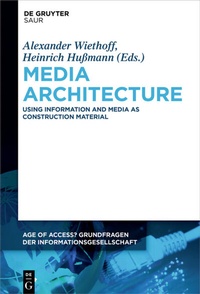
Media Architecture
Description

The augmentation of urban spaces with technology, commonly referred to as
Media Architecture
, has found increasing interest in the scientific community within the last few years. At the same time architects began to use digital media as a
new material
apart from concrete, glass or wood to create buildings and urban structures. Simultaneously, Human-Computer Interaction (HCI) researchers began to exploit the interaction opportunities between users and buildings and to bridge the gaps between interface, information medium and architecture. As an example, they extended architectural structures with interactive, light-emitting elements on their outer shell, thereby transforming the surfaces of these structures into giant public screens. At the same time the wide distribution of mobile devices and the coverage of mobile internet allow manifold interaction opportunities between open data and citizens, thereby enabling the internet of things in the public domain. However, the appropriate distribution of information to all citizens is still cumbersome and a mutual dialogue not always successful (i.e. who gets what data and when?). In this book we therefore provide a deeper investigation of
Using Information and Media as Construction Material
with media architecture as an input and output medium.
More details
Other editions
Additional editions
Persons
Content
- Intro
- Editor's Preface
- Contents
- Introduction
- Media Architecture and the Smart City
- Media Architecture for Shared Encounters
- From Allopoietic Content to Autopoietic Content for Media Architecture through a Better Understanding of Architectural Typologies
- Interfaces of Media Architecture|
- Using Media as Construction Material: Prototypes and Case Studies
- DIY / DIWO Media Architecture: The InstaBooth
- City Apps as Urban Interfaces
- Experiences Deploying Hybrid Media Architecture in Public Environments
- Designing Media Architecture: Technology, Tools and Processes
- Designing Media Architecture: Methhods and Tools
- Interacting with Media Architecture
- Media Façades and Narratives for Public Spaces
- Exploring Distribution as a Condition: Elements of a Minor Metropolitanism
- About the Authors
