

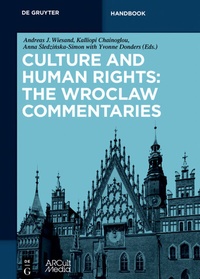
Culture and Human Rights: The Wroclaw Commentaries
Description

Die WROCLAW COMMENTARIES befassen sich mit aktuellen Rechtsfragen und politischen Konsequenzen im Themenfeld Menschenrechte und Kultur (im weiteren Sinne), darunter: Kunst-, Presse- und Meinungsfreiheit; das Recht auf Teilhabe an der Kultur, an alten und neuen Medien sowie am Kulturerbe; Fragen religiöser und sprachlicher Rechte; der Schutz kultureller Minderheiten; Sicherung kultureller Vielfalt und weitere Aspekte.
Fachleute aus allen Teilen Europas und aus den anderen Weltregionen kommentieren ihr jeweiliges Stichwort auf der Grundlage internationaler und nationaler Rechtsinstrumente, von Grundsatzentscheidungen in der Rechtsprechung sowie der einschlägigen Literatur. Das Ergebnis: Ein nutzerfreundliches Handbuch für den Informationsbedarf von Richtern, Anwälten, Behörden und Parlamenten, Beratern, Wissenschaftlern und anderen, die im Bereich von Kultur und Menschenrechten arbeiten oder sich engagieren.
More details
Other editions
Additional editions
Persons
A. Wiesand , ARCult Media
K. Chainoglou , Univ. of Macedonia
A. Sledzinska-Simon , Univ. of Wroclaw
Y. Donders , Univ. of Amsterdam
Content
- Intro
- Table of Contents
- List of Abbreviations
- Preface I
- Preface II
- Introduction
- Part I: Overview articles (Scientific Committee)
- Culture and Human Rights: Concepts, Instruments and Institutions
- Freedom of Expression in the Arts and Media
- Cultural Diversity and Cultural Identity in Human Rights
- Access to Culture, Media, Information in the Digital Age
- Rights and Protection of Social/Socio-cultural Groups
- Freedom of Religion or Belief
- Cultural Heritage in the Human Rights System
- Part II: Keyword articles
- Access Control Technologies
- Administration
- Affirmative Action
- African Human Rights System
- Alliance of Civilizations
- Archaeological Heritage
- Architectural Heritage
- Armed Conflict
- Artists' Freedom of Expression
- Arts Education
- Asian Values
- Assembly and Association
- Authors' Rights / Copyright
- Belief
- Blasphemy
- Caricatures / Cartoons
- Censorship
- Charter of Fundamental Rights of the European Union (CFR)
- Children
- Churches
- Circumcision
- Citizenship
- Clash of Civilisations
- Common Values
- Community Identification
- Constitutional Courts
- Conversion
- Council of Europe (CoE)
- Court of Justice of the European Union (CJEU)
- Cultural Autonomy
- Cultural Dimensions of Human Rights
- Cultural Expressions
- Cultural Genocide
- Cultural Identity
- Cultural Institutions / Infrastructure
- Cultural Policy
- Defamation
- Development
- Digital Media
- Disabilities
- Disability and Copyright
- Discrimination
- Dissidents
- ECHR Cultural Protocol Debates / CAHMIN
- Equality
- European Committee of Social Rights
- European Convention on Human Rights (ECHR)
- The European Court of Human Rights (ECtHR)
- European Union
- European Union Agency for Fundamental Rights (FRA)
- Female Genital Mutilation
- Food
- Free trade
- Fundamentalism
- Gender Stereotypes
- Golden Rule
- Governments
- Hate Crimes
- Hijab
- Historical Truth
- Housing
- Human Dignity
- Human Rights Council
- Human Security
- Hybridity
- Illicit Trafficking of Cultural Objects
- Impact Assessment
- Indigenous Peoples
- Information
- Intangible Cultural Heritage
- Intellectual Property and Human Rights
- Inter-American Human Rights System
- Intercultural Competence
- International Covenant on Economic, Social and Cultural Rights (ICESCR)
- Internet Access
- Internet Content Suppression
- Investigative Journalism
- Journalists
- Landscapes
- Language Rights in Europe
- Languages of Migrants
- LGBT
- Libraries
- Literary Expressions
- Margin of Appreciation
- Media Content
- Migrants
- Movement of Cultural Objects
- Names
- National Minorities
- Older Persons
- Organisation for Security and Cooperation in Europe (OSCE)
- Parody
- Participation in Cultural Life
- Peoples' Rights
- Pornography / Obscenity
- Poverty
- Press Freedom
- Privacy
- Producers
- Public Broadcasting
- Public Space
- Refugees
- Regional and Minority Languages
- Religious Education
- Religious Minorities
- Religious Symbols
- Restitution and Return of Cultural Objects
- Right to Science and Culture
- Roma Culture
- Secularism and Islamic Law
- Social Media
- Status of Artists
- Trolling and Shitstorms
- UN Treaty Bodies
- Underwater Cultural Heritage
- UNESCO
- Universal Declaration of Human Rights (UDHR)
- Universalism and Cultural Relativism
- Urban Planning
- Values
- Whistleblowing
- Youth
