

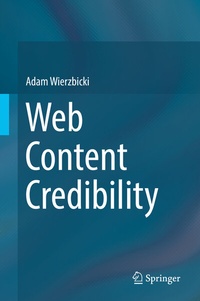
Web Content Credibility
Description

This book introduces readers to Web content credibility evaluation and evaluation support. It highlights empirical research and establishes a solid foundation for future research by presenting methods of supporting credibility evaluation of online content, together with publicly available datasets for reproducible experimentation, such as the Web Content Credibility Corpus.
The book is divided into six chapters. After a general introduction in Chapter 1, including a brief survey of credibility evaluation in the social sciences, Chapter 2 presents definitions of credibility and related concepts of truth and trust. Next, Chapter 3 details methods, algorithms and user interfaces for systems supporting Web content credibility evaluation. In turn, Chapter 4 takes a closer look at the credibility of social media, exemplified in sections on Twitter, Q&A systems, and Wikipedia, as well as fake news detection. In closing, Chapter 5 presents mathematical and simulation models of credibility evaluation, before a final round-up of the book is provided in Chapter 6.
Overall, the book reviews and synthesizes the current state of the art in Web content credibility evaluation support and fake news detection. It provides researchers in academia and industry with both an incentive and a basis for future research and development of Web content credibility evaluation support services.
Reviews / Votes
"Misinformation on the Internet, deliberate or merely out of ignorance, is a serious problem and it puts users in the position of needing strong critical thinking skills to sort wheat from chaff. This book will help. It's an impressive exploration of ideas in the area of Web content credibility evaluation support." (Vint Cerf, Vice President and Chief Internet Evangelist at Google)More details
Other editions
Additional editions
Person
Adam Wierzbicki
is Professor and Vice-President of the Polish-Japanese Institute for Information Technology. His current research interests focus on social informatics, in particular on credibility, trust management, collective intelligence and fairness in distributed systems, and he has published numerous papers in these areas. In 2011-2015, he has led the Reconcile project which concerned the development of tools for the evaluation of Web content credibility. He is also the Steering Committee Chair of the International Conference on Social Informatics.
