

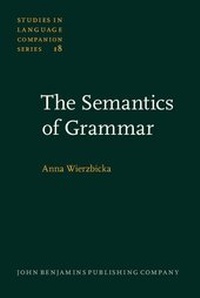
The Semantics of Grammar
1st Edition
Published on 1. January 1988
X, 617 pages
978-90-272-8612-3 (ISBN)
Description

"The semantics of grammar" presents a radically semantic approach to syntax and morphology. It offers a methodology which makes it possible to demonstrate, on an empirical basis, that syntax is neither "autonomous" nor "arbitrary", but that it follows from "semantics". It is shown that every grammatical construction encodes a certain semantic structure, which can be revealed and rigorously stated, so that the meanings encoded in grammar can be compared in a precise and illuminating way, within one language and across language boundaries. The author develops a semantic metalanguage based on lexical universals or near-universals (and, ultimately, on a system of universal semantic primitives), and shows that the same semantic metalanguage can be used for explicating lexical, grammatical and pragmatic aspects of language and thus offers a method for an integrated linguistic description based on semantic foundations. Analyzing data from a number of different languages (including English, Russian and Japanese) the author explores the notion of ethnosyntax and, via semantics, links syntax and morphology with culture. She attemps to demonstrate that the use of a semantic metalanguage based on lexical universals makes it possible to rephrase the Humboldt-Sapir-Whorf hypothesis in such a way that it can be tested and treated as a program for empirical research.
More details
Other editions
Additional editions
Anna Wierzbicka
The Semantics of Grammar
Book
01/1988
John Benjamins Publishing Co
€157.94
Shipment within 10-15 days
Content
- THE SEMANTICS OF GRAMMAR
- Editorial page
- Title page
- Copyright page
- Acknowledgements
- Table of contents
- Introduction
- 1. Language and meaning
- 2. Grammatical semantics
- 3. 'Autonomous syntax': an illustration
- 4. The need for a semantic metalanguage
- 5. The need for an integrated linguistic description
- 6. The proposed semantic metalanguage
- 7. The idea of 'ethno-grammar'
- 8. The philosophy of grammar
- 9. Universals of grammatical semantics
- 10. By their fruits shall ye know them
- Part 1: The semantics of syntax
- 1. The semantics of English complementation in a cross-linguistic perspective
- 1. Introduction
- 1.1 Preliminary remarks
- 1.2 Preliminary illustrations
- 2. TO and 'wanting'
- 2.1 To be or not to be - that is the question
- 2.2 Remember and forget
- 2.3 Verbs of volition
- 2.4 Verbs of attempting
- 2.5 Speech act verbs
- 2.6 Interactional verbs
- 3. TO and opinion
- 3.1 Opinion predicates and 'subject-to-object raising'
- 3.2 'TO BE deletion'
- 3.3 Opinion predicates and 'subject-to-subject raising'
- 4. ING and time
- 4.1 The gerund and simultaneity
- 4.2 Gerunds as noun phrases
- 4.3 TO, ING and action
- 4.4 ING and evaluation
- 5. TO, ING and aspectuals
- 5.1 Constraints on TO complements
- 5.2 Constraints on gerundive complements
- 5.3 The 'doubl-ing constraint'
- 5.4 Aspectual causatives
- 6. TO and emotion
- 6.1 Emotion, awareness and thought
- 6.2 Emotion and attitude
- 6.3 'Projective emotions' and the alleged extraposition
- 6.4 TO versus ING versus THAT
- 7. FOR TO versus TO
- 7.1 FOR TO in emotion sentences
- 7.2 FOR TO and volition
- 7.3 FOR TO and 'emotivity'
- 7.4 FOR TO and evaluation
- 7.5 FOR TO and intellectual judgment
- 7.6 FOR TO and 'obviation'
- 8. THAT and knowledge
- 8.1 Say THA T and know TUA T
- 8.2 THAT sentences with a modal
- 9. The subjunctive: a cross-linguistic perspective
- 9.1 Preliminary remarks
- 9.2 Verbs of volition
- 9.3 Subjunctive in relative clauses
- 9.4 Verbs of emotion and evaluation
- 9.5 A look at some Slavic languages
- 9.6 FOR TO and the subjunctive (a second look)
- 10. Conclusion
- 10.1 General remarks
- 10.2 ING
- 10.3 THAT
- 10.4 TO
- 10.5 FOR TO
- 10.6. Concluding remarks
- Note
- 2. Ethno-syntax and the philosophy of grammar
- 1. Introduction
- 2. Bodily actions and events
- 2.1 Doing something to a part of someone's body
- 2.2 Can a part of the body do something?
- 2.3 What counts as a direct bodily action
- 2.4 Spontaneous involuntary change in the body
- 2.5 Physical closeness
- 2.6 Can you affect a person by looking at him or her?
- 2.7 Can a hat be viewed as a part of the body?
- 2.8 Overt and covert bodily constructions
- 2.9 The status of 'bodily constructions'
- 3. The good/bad dichotomy
- 4. The unknown
- 5. Concluding remark
- Notes
- 3. The semantics of causative constructions in a cross-linguistic perspective
- 1. Introduction
- 2. Japanese
- 3. English
- 4. Hindi
- 5. 'Indirect causation' in English and in French
- 6. Italian
- 7. 'Indirect causation' in Russian
- 8. Causation in grammar: towards a semantic typology of grammatical systems
- 4. The Japanese 'adversative passive' in a typological context(Are grammatical categories vague or multiply polysemous?)
- 1. Introduction
- 2. Main-verb passives
- 2.1 Negative versus positive effects
- 2.2 Neutral-effect passives
- 2.3 Inanimate passive
- 3. Some cross-linguistic comparisons
- 3.1 Datives of misfortune
- 3.2 Datives of affectedness
- 3.3 Inanimate passives
- 4. Conclusion
- Summary of Japanese constructions
- 5. Why can you have a drink when you can't *have an eat?
- 1. Introduction
- 2. Periphrastic verbal construction with have defined
- 3. The over-all semantic invariant of the have a V construction
- 4. Subtypes of the have a V construction
- 4.1 Aimless objectless action which could cause one to feel good
- 4.2 Action aiming at perception which could cause one to know something and which would not cause one to feel bad if it didn't
- 4.3 Tentative action which could cause one to come to know something and which would not cause one to feel bad if it didn't
- 4.4 Semi-voluntary action which could cause one to feel better
- 4.5 Consumption of small parts of objects which could cause one to feel pleasure
- 4.6 Consumption of non-discrete substances which could cause one to feel pleasure
- 4.7 Action superficially involving another entity, which could cause one to feel pleasure
- 4.8 Self-directed action which could cause one to look better
- 4.9 Joint bodily activity which could cause the people involved to feel pleasure
- 4.10 Joint speech activity which could cause the people involved to feel pleasure
- 5. Have a fall
- 6. Have a V versus take a V
- 7. Comparable constructions in other languages
- 8. Conclusion
- Notes
- Summary of construction subtypes
- 6. The semantics of 'internal dative' in English
- 1. Introduction
- 2. Semantic constraints on the 'internal dative' construction
- 3. Semantic subtypes
- 3.1 Transfer
- 3.2 Speaking of future having
- 3.3 Making
- 3.4 Preparing for use
- 3.5 Entertaining
- 3.6 Telling
- 3.7 Teaching
- 3.8 Showing
- 4. Apparent exceptions
- 5. The semantic core
- 6. The semantic basis of transitivity
- 7. Three participants on the stage - but how many in the limelight?
- 7.1 'External dative' only
- 7.2 A non-omissible external dative
- 7.3 A human P and a non-omissible external T
- 7.4 'P-only' speech act verbs
- 7.5 'T-only' speech act verbs
- 7.6 Internal dative only
- 8. A semantic common denominator
- 9. One semantic invariant or eight distinct subtypes?
- Summary of English internal dative constructions
- Part 2: The semantics of morphology
- 7. The meaning of a case: a study of the Polish dative
- 1. Introduction
- 1.1 The core meaning of dative
- 1.2 Language-specific extensions of the core use
- 2. Polish datives with external causes
- 2.1 Causing to have, or not to have
- 2.2 Causing to see
- 2.3 Causing to hear for pleasure and causing to know
- 2.4 Causing to be able to do something
- 2.5 Causing a change in the object
- 2.6 Causing something to happen to a related person
- 2.7 Dative of warning
- 2.8 Causing a change in a body part
- 2.9 Causing contact with a body part
- 3. Datives without external causes
- 3.1 Unintentional feelings
- 3.2 Unintentional cognitive processes (thoughts and 'imaginings')
- 3.3 Unintentional 'wantings'
- 3.4 Unintentional sensations
- 3.5 Unintentional processes in the body
- 3.6 Unintentional changes in the position of body parts
- 3.7 Unintentional changes in appearance
- 3.8 Unintentional features of appearance
- 3.9 Unintentional speech
- 3.10 Agent viewed as experiencer
- 4. Conclusion
- Summary of Polish dative constructions
- 8. The semantics of case marking
- 1. Introduction
- 2. The Russian accusative case
- 3. The Russian 'partitive'
- 4. The Russian genitive plural
- 5. The genitive marking of the accusative in Polish
- 6. The nominative plural in Polish
- 7. Conclusion
- 9. What's in a noun? (or: How do nouns differ in meaning from adjectives?)
- 1. Introduction
- 2. Description versus categorization
- 3. The notion of 'kind'
- 4. Semantic nouniness and syntactic nouniness
- 5. Core adjectival concepts
- 6. Where do nouns 'come from'?
- 7. What are adjectives for?
- 8. Final illustration
- 9. Concluding remarks
- Definitions
- Notes
- 10. Oats and wheat: mass nouns, iconicity, and human categorization
- 1. Introduction
- 2. Preliminary discussion
- 3. The logic of names of fruits and vegetables in Russian
- 4. Water (names of homogeneous substances)
- 5. Chocolate and chocolates (solids with a double status)
- 6. Crockery (names of heterogeneous classes of objects)
- 7. Scissors (names of 'dual objects')
- 8. A grain of rice (substances with a minimal unit)
- 9. Hair, noodles and apples ('singularia mostly', 'pluralia mostly' and 'edible objects')
- 10. Oats (names of substances composed of particles and limited in quantity)
- 11. Guts and woods (names of body parts and places)
- 12. Leftovers (names of heterogeneous groups of objects and/or 'stuffs')
- 13. Clothing versus clothes
- 14. Fruit versus vegetables
- 15. Conclusions
- Summary of class meanings
- Conclusion
- Bibliography
- Subject and name index
- Index of lexical items
- The series Studies in Language Companion Series
