

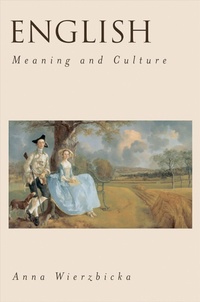
English
Meaning and Culture
1st Edition
Published on 27. April 2006
363 pages
978-0-19-803897-9 (ISBN)
Description

It is widely accepted that English is the first truly global language and lingua franca. Anna Wierzbicka, the distinguished linguist known for her theories of semantics, has written the first book that connects the English language with what she terms "Anglo" culture. Wierzbicka points out that language and culture are not just interconnected, but inseparable. She uses original research to investigate the "universe of meaning" within the English language (both grammar and vocabulary) and places it in historical and geographical perspective. This engrossing and fascinating work of scholarship should appeal not only to linguists and others concerned with language and culture, but the large group of scholars studying English and English as a second language.
More details
Other editions

Content
- Intro
- Contents
- Part I. Meaning, History and Culture
- 1. English as a Cultural Universe
- 1.1. English-the most widely used language in the world
- 1.2. English and Englishes
- 1.3. An illustration: Words, scripts, and human lives
- 1.4. "Anglo English" as a historical formation
- 1.5. The tendency to mistake "Anglo English" for the human norm
- 1.6. The cultural underpinnings of (Anglo) English
- 1.7. A framework for studying and describing meaning
- 2. Anglo Cultural Scripts Seen through Middle Eastern Eyes
- 2.1. Linguistics and intercultural Communication
- 2.2. The theory of cultural scripts
- 2.3. The Anglo ideal of "accuracy" and the practice of "understatement"
- 2.4. "To the best of my knowledge . . ."
- 2.5. Anglo respect for "facts"
- 2.6. "Cool reason": to think vs. to feel
- 2.7. To compel or not to compel? The value of autonomy
- 2.8. Conclusion
- Part II. English Words: From Philosophy to Everyday Discourse
- 3. The Story of RIGHT and WRONG and Its Cultural Implications
- 3.1. Introduction
- 3.2. "Right" and "wrong": A basis for ethics?
- 3.3. The link between "right" and "reason"
- 3.4. "That's right"
- 3.5. An illustration: English vs. Italian
- 3.6. "Right" as a neutral ground between "good" and "true"
- 3.7. Procedural morality
- 3.8. "Right" and "wrong": Increasingly asymmetrical
- 3.9. The changing frequencies of true, truth, right, and wrong
- 3.10. "Right" as a response in dialogue
- 3.11. "Right" and cultural scripts
- 3.12. Retrospect and conclusion: The Puritans, the Enlightenment, the growth of democracy
- 4. Being REASONABLE: A Key Anglo Value and Its Cultural Roots
- 4.1. Introduction
- 4.2. The pre-Enlightenment uses of "reasonable"
- 4.3. The main themes in the modern meanings of the word reasonable
- 4.4. "A reasonable man"
- 4.5. "It is reasonable to" think (say, do) . . .
- 4.6. "Reasonable doubt"
- 4.7. "Reasonable force" and "reasonable care"
- 4.8. "A reasonable time," "A reasonable amount"
- 4.9. "Reasonable" as "reasonably good"
- 4.10. "Reasonable" and "unreasonable"
- 4.11. An internal reconstruction of the semantic history of "reasonable"
- 4.12. "Reasonable" and Anglo cultural scripts
- 4.13. Is the Anglo value of "reasonable" unique? English vs. French
- 5. Being FAIR: Another Key Anglo Value and Its Cultural Underpinnings
- 5.1. The importance of "fairness" in modern Anglo culture
- 5.2. The meaning of fair and not fair
- 5.3. "Fairness" and Anglo political philosophy
- 5.4. "Fairness" vs. "justice"
- 5.5. The illusion of universality
- 5.6. "Fairness" and "fair play": A historical perspective
- 5.7. "Fairness" and "procedural morality"
- Part III. Anglo Culture Reflected in English Grammar
- 6. The English Causatives: Causation and Interpersonal Relations
- 6.1. The cultural elaboration of causation
- 6.2. The English "let"-constructions and the cultural ideal of "noninterference"
- 7. I THINK: The Rise of Epistemic Phrases in Modern English
- 7.1. Introduction
- 7.2. I think
- 7.3. I suppose
- 7.4. I guess
- 7.5. I gather
- 7.6. I presume
- 7.7. I believe
- 7.8. I find
- 7.9. I expect
- 7.10. I take It
- 7.11. I understand
- 7.12. I imagine
- 7.13. I bet
- 7.14. I suspect
- 7.15. I assume
- 7.16. Conclusion
- 8. PROBABLY: English Epistemic Adverbs and Their Cultural Significance
- 8.1. Introduction
- 8.2. Developing a format for the semantic analysis of epistemic adverbs
- 8.3. "Probably" and "likely": The heart of the category of epistemic adverbs
- 8.4. "Confident" adverbs: Evidently, clearly, obviously
- 8.5. "Nonconfident" adverbs: Possibly and conceivably
- 8.6. Hearsay adverbs: Apparently, supposedly, allegedly, and reportedly
- 8.7. The "uncertain" status of certainly
- 8.8. Epistemic adverbs vs. discourse particles
- 8.9. The history of epistemic adverbs in modern english
- Part IV. Conclusion
- 9. The "Cultural Baggage" of English and Its Significance in the World at Large
- 9.1. The legacy of history
- 9.2. Living with concepts
- 9.3. Two illustrations: International law and international aviation
- 9.4. Communication and "vibes"
- 9.5. Intercultural communication and cross-cultural education
- 9.6. English in the world today
- Notes
- References
- Index
- A
- B
- C
- D
- E
- F
- G
- H
- I
- J
- K
- L
- M
- N
- O
- P
- Q
- R
- S
- T
- U
- V
- W
- X
- Y
- Z
