

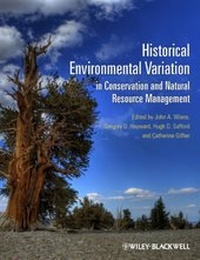
Historical Environmental Variation in Conservation and Natural Resource Management
Description

Reviews / Votes
"The book provides a rich summary and critique of such ideas and approaches that will provide material both for under-graduate courses and for ecologists interested in the theory and practice of understanding historical ecological dynamics." (Ecological Management & Restoration, 18 May 2015) "But each chapter provides guidance on how historical ecology may be fruitfully applied to specific cases of management giving the reader much hope for the future and for potential course corrections on the landscape." (Landscape Ecol, 15 January 2015) "Overall, a very useful reference for advanced students in conservation and ecosystem management as well as researchers and managers developing future adaptation plans. Summing Up: Highly recommended. Upper-division undergraduates and above." (Choice, 1 March 2013)More details
Other editions
Additional editions
Persons
Content
Contributors vii
Foreword x
Preface xii
Acknowledgments xiv
Section 1 Background and History 1 John A. Wiens
1 Setting the stage: theoretical and conceptual background of historical range of variation 3 William H. Romme, John A. Wiens, and Hugh D. Safford
2 Development of historical ecology concepts and their application to resource management and conservation 19 Wayne Padgett, Barbara Schrader, Mary Manning, and Timothy Tear
Section 2 Issues and Challenges 29 Hugh D. Safford
3 Challenges in the application of historical range of variation to conservation and land management 32 Gregory D. Hayward, Thomas T. Veblen, Lowell H. Suring, and Bob Davis
4 Historical ecology, climate change, and resource management: can the past still inform the future? 46 Hugh D. Safford, Gregory D. Hayward, Nicole E. Heller, and John A. Wiens
5 What is the scope of "history" in historical ecology? Issues of scale in management and conservation 63 John A. Wiens, Hugh D. Safford, Kevin Mcgarigal, William H. Romme, and Mary Manning
6 Native Americans, ecosystem development, and historical range of variation 76 Gregory J. Nowacki, Douglas W. Maccleery, and Frank K. Lake
7 Conservation and resource management in a changing world: extending historical range of variation beyond the baseline 92 Stephen T. Jackson
Section 3 Modeling Historic Variation and Its Application For Understanding Future Variability 111 Robert E. Keane
8 Creating historical range of variation (HRV) time series using landscape modeling: overview and issues 113 Robert E. Keane
9 Modeling historical range of variability at a range of scales: an example application 128 Kevin Mcgarigal and William H. Romme
Section 4 Case Studies of Applications 147 Gregory D. Hayward
10 Regional application of historical ecology at ecologically defined scales: forest ecosystems in the Colorado Front Range 149 Thomas T. Veblen, William H. Romme, and Claudia Regan
11 Incorporating concepts of historical range of variation in ecosystem-based management of British Columbia's coastal temperate rainforest 166 Andy Mackinnon and Sari C. Saunders
12 Incorporating HRV in Minnesota national forest land and resource management plans: a practitioner's story 176 Mary Shedd, Jim Gallagher, Michael Jiménez, and Duane Lula
13 Applying historical fire-regime concepts to forest management in the western United States: three case studies 194 Thomas E. Demeo, Frederick J. Swanson, Edward B. Smith, Steven C. Buttrick, Jane Kertis, Jeanne Rice, Christopher D. Ringo, Amy Waltz, Chris Zanger, Cheryl A. Friesen, and John H. Cissel
14 Using historical ecology to inform wildlife conservation, restoration, and management 205 Beth A. Hahn and John L. Curnutt
15 River floodplain restoration experiments offer a window into the past 218 Ramona O. Swenson, Richard J. Reiner, Mark Reynolds, and Jaymee Marty
16 Streams past and future: fluvial responses to rapid environmental change in the context of historical variation 232 Daniel A. Auerbach, N. Leroy Poff, Ryan R. Mcshane, David M. Merritt, Matthew I. Pyne, and Thomas K. Wilding
17 A framework for applying the historical range of variation concept to ecosystem management 246 William H. Romme, Gregory D. Hayward, and Claudia Regan
Section 5 Global Perspectives 263 John A. Wiens
18 Ecological history guides the future of conservation: lessons from Africa 265 A.R.E. Sinclair
19 Ecological history has present and future ecological consequences - case studies from Australia 273 David Lindenmayer
20 A view from the past to the future 281 Keith J. Kirby
21 Is the historical range of variation relevant to rangeland management? 289 Brandon T. Bestelmeyer
22 Knowing the Fennoscandian taiga: ecohistorical lessons 297 Yrjö Haila
Section 6 Challenges for the Future 305
23 Reflections on the relevance of history in a nonstationary world 307 Julio L. Betancourt
24 The growing importance of the past in managing ecosystems of the future 319 Hugh D. Safford, John A. Wiens, and Gregory D. Hayward
Index 329
