

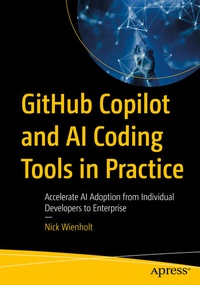
GitHub Copilot and AI Coding Tools in Practice
Description

Learn the current state of generative AI coding tools like GitHub Copilot, what the underlying models mean, and how to use them across the full development life-cycle. Look ahead to the near future of AI-generated software and understand how software developers can stay relevant in the industry.
Many companies have predicted that human coders will soon be redundant due to AI-generated code, but there is a big gap between the expectations and what is actually happening on the ground. A closer look at the current state of the tools and research in this area will offer realism and guidance to developers worried regarding redundancy.
Close the gap between hype and practical applications by receiving context and clear technical information on usage, understanding, and deployment of these tools.
What You Will Learn:
- How to use coding and software AI tools
- How software AI tools work
- How software AI tools fit in an industry context
- How to use AI tools across the SDLC - it's more than just faster coding
Who This Book is For
All software industry participants interested in mastering AI-generated code.
More details
Other editions
Additional editions
Person
Nick Wienholt is a Sydney-based software engineer with more than 25 years of experience in the design and implementation of large-scale software systems, and has spent the last decade focused on development in the data science and AI space. He has a strong track record of delivery across a variety of financial and e-commerce systems, having consulted and worked with a large number of major corporate and propriety trading firms across Australia, and has been a keen user and advocate of ML/AI tools to accelerate development since their release.
Content
Chapter 1: Current State of Play - The High Level View.- Chapter 2: Using an AI Coding Agent.- Chapter 3: Large Language Models - Under the Hood.- Chapter 4: Prompt Engineering with AI Coding Agents.- Chapter 5: Customizing and Extending Copilot.- Chapter 6: Security in the Time of Copilot.- Chapter 7: Designing Applications with Copilot.- Chapter 8: Infrastructure, DevOps and Monitoring with Copilot and AI.- Chapter 9: Databases and AI.- Chapter 10: Copilot and Data Science.- Chapter 11: Code Migrations and Refactoring.- Chapter 12: Testing Augmentation with AI.- Chapter 13: Management Challenges Introducing AI.- Chapter 14: Surviving as a Software Engineer.- Chapter 15: Introducing and Integrating Copilot in an Organization.
