

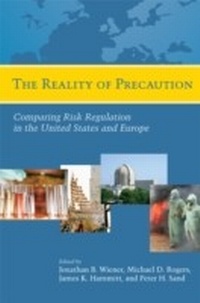
The Reality of Precaution
Comparing Risk Regulation in the United States and Europe
1st Edition
Published on 13. May 2013
602 pages
978-1-136-52256-7 (ISBN)
Description

The 'Precautionary Principle' has sparked the central controversy over European and U.S. risk regulation. The Reality of Precaution is the most comprehensive study to go beyond precaution as an abstract principle and test its reality in practice. This groundbreaking resource combines detailed case studies of a wide array of risks to health, safety, environment and security; a broad quantitative analysis; and cross-cutting chapters on politics, law, and perceptions. The authors rebut the rhetoric of conflicting European and American approaches to risk, and show that the reality has been the selective application of precaution to particular risks on both sides of the Atlantic, as well as a constructive exchange of policy ideas toward 'better regulation.' The book offers a new view of precaution, regulatory reform, comparative analysis, and transatlantic relations.
Reviews / Votes
'The Reality of Precaution offers a sweeping and rigorous look at the issue of risk regulation, examining this critical topic from a wide variety of issues and angles. Must reading for anyone who wants to think seriously about how risk management choices are perceived and framed.'Daniel C. Esty, Hillhouse Professor of Environmental Law and Policy, Yale University and co-author, Green to Gold
'In this era of increased economic globalisation, there is an ever urgent need to further understand how the two most important trade blocks regulate. In this seminal book, bringing together regulatory theories and insightful case studies from Europe and the United States, Prof Wiener and his editorial team have assembled a stellar cast to address the critical and at times perplexing question: which trade block is more precautionary-Europe or the United States. It is a must read for anyone interested in getting a greater grasp of the wider EU and US policy environments.'
Ragnar Lofstedt, Professor of Risk Management, King's College London.
'An outstanding contribution of original scholarship that dispels many conventional wisdoms about US and European risk regulation.'
John D. Graham, Dean, Indiana University School of Public and Environmental Affairs, and former Administrator, U.S. Office of Information and Regulatory Affairs
'Challenging the ubiquitous claim that Europe has become 'more precautionary' than the United States, The Reality of Precaution offers the most comprehensive assessment to date of the risk regulation standards in Europe and America over the past four decades. This is a fresh and much-needed contribution to the debate over the precautionary principle across the Atlantic and beyond.'
Alberto Alemanno, Associate Professor of Law, HEC Paris, and editor of the European Journal of Risk Regulation
'The Reality of Precaution provides a nuanced, fact-based account of the various meanings and applications of the Precautionary Principle in Europe and United States. Rejecting the heated rhetoric that so often accompanies discussion of risk regulation, the editors have put together a balanced volume that ought to be essential reading for both policy analysts and policymakers on both sides of the Atlantic.'
Susan Rose-Ackerman, Henry R. Luce Professor of Jurisprudence, Yale Law School and Department of Political Science; and co-editor, Comparative Administrative Law
'Going beyond the slogans of the precautionary principle, the authors bring together all sides of the debate in the US and Europe and provide in-depth and insightful analysis of the issues. Anyone who cares about environmental policy must read this book.'
Richard D. Morgenstern, Senior Fellow, Resources for the Future and former Acting Deputy Administrator, U.S. Environmental Protection Agency
More details
Edition
1. Auflage
Language
English
Place of publication
London
United Kingdom
Publishing group
Taylor & Francis Ltd
Target group
College/higher education
File size
7,85 MB
ISBN-13
978-1-136-52256-7 (9781136522567)
Copyright in bibliographic data and cover images is held by Nielsen Book Services Limited or by the publishers or by their respective licensors: all rights reserved.
Schweitzer Classification
Other editions
Additional editions
James Hammit | Michael Rogers | Peter Sand
The Reality of Precaution
Comparing Risk Regulation in the United States and Europe
Book
12/2010
1st Edition
Resources for the Future Press (RFF Press)
€259.98
Shipment within 3-4 weeks
James Hammit | Michael Rogers | Peter Sand
The Reality of Precaution
Comparing Risk Regulation in the United States and Europe
Book
12/2010
1st Edition
Resources for the Future Press (RFF Press)
€104.50
Shipment within 3-4 weeks
Persons
Jonathan B. Wiener is a professor of law, environmental policy, and public policy studies at Duke University, and a university fellow at Resources for the Future.
Michael D. Rogers is an independent consultant on risk, science, and ethics, and a former member of the Bureau of European Policy Advisers reporting to the President of the European Commission.
James K. Hammitt is a professor of economics and decision sciences at Harvard University.
Peter H. Sand is a lecturer in international environmental law at the University of Munich.
Michael D. Rogers is an independent consultant on risk, science, and ethics, and a former member of the Bureau of European Policy Advisers reporting to the President of the European Commission.
James K. Hammitt is a professor of economics and decision sciences at Harvard University.
Peter H. Sand is a lecturer in international environmental law at the University of Munich.
Content
Preface
Contributors
I. Introduction
1. The Rhetoric of Precaution
II. Case Studies of Relative Precaution regarding Specific Risks
2. Genetically Modified Foods and Crops
3. Beef, Hormones and Mad Cows
4. Smoking
5. Nuclear Power
6. Automobile Emissions
7. Stratospheric Ozone Protection and Global Climate Change
8. The Marine Environment
9. Biodiversity Conservation
10. Chemicals
11. Medical Errors, New Drug Approval and Patient Safety
12. Terrorism and Weapons of Mass Destruction
III. Precaution in Risk Information Systems
13. Information Disclosure
14. Frameworks for Risk Assessment
IV. A Broader Empirical Test of Relative Precaution
15. A Quantitative Comparison of Relative Precaution in the United States and Europe, 1970-2004
V. Can We Explain the Observed Pattern of Precaution?
16. Political Institutions and the Principle of Precaution
17. Legal and Administrative Systems
18. Risk Perceptions and Risk Attitudes in the US and Europe
19. Precautions Against What? Perceptions, Heuristics and Culture
VI. Conclusions
20. The Real Pattern of Precaution
Acknowledgments
Index
Contributors
I. Introduction
1. The Rhetoric of Precaution
II. Case Studies of Relative Precaution regarding Specific Risks
2. Genetically Modified Foods and Crops
3. Beef, Hormones and Mad Cows
4. Smoking
5. Nuclear Power
6. Automobile Emissions
7. Stratospheric Ozone Protection and Global Climate Change
8. The Marine Environment
9. Biodiversity Conservation
10. Chemicals
11. Medical Errors, New Drug Approval and Patient Safety
12. Terrorism and Weapons of Mass Destruction
III. Precaution in Risk Information Systems
13. Information Disclosure
14. Frameworks for Risk Assessment
IV. A Broader Empirical Test of Relative Precaution
15. A Quantitative Comparison of Relative Precaution in the United States and Europe, 1970-2004
V. Can We Explain the Observed Pattern of Precaution?
16. Political Institutions and the Principle of Precaution
17. Legal and Administrative Systems
18. Risk Perceptions and Risk Attitudes in the US and Europe
19. Precautions Against What? Perceptions, Heuristics and Culture
VI. Conclusions
20. The Real Pattern of Precaution
Acknowledgments
Index
