

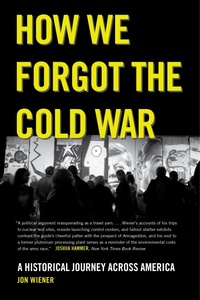
How We Forgot the Cold War
A Historical Journey across America
1st Edition
Published on 15. October 2012
384 pages
978-0-520-95425-0 (ISBN)
Description

Hours after the USSR collapsed in 1991, Congress began making plans to establish the official memory of the Cold War. Conservatives dominated the proceedings, spending millions to portray the conflict as a triumph of good over evil and a defeat of totalitarianism equal in significance to World War II. In this provocative book, historian Jon Wiener visits Cold War monuments, museums, and memorials across the United States to find out how the era is being remembered. The author's journey provides a history of the Cold War, one that turns many conventional notions on their heads.
In an engaging travelogue that takes readers to sites such as the life-size recreation of Berlin's "Checkpoint Charlie" at the Reagan Library, the fallout shelter display at the Smithsonian, and exhibits about "Sgt. Elvis," America's most famous Cold War veteran, Wiener discovers that the Cold War isn't being remembered. It's being forgotten. Despite an immense effort, the conservatives' monuments weren't built, their historic sites have few visitors, and many of their museums have now shifted focus to other topics. Proponents of the notion of a heroic "Cold War victory" failed; the public didn't buy the official story. Lively, readable, and well-informed, this book expands current discussions about memory and history, and raises intriguing questions about popular skepticism toward official ideology.
In an engaging travelogue that takes readers to sites such as the life-size recreation of Berlin's "Checkpoint Charlie" at the Reagan Library, the fallout shelter display at the Smithsonian, and exhibits about "Sgt. Elvis," America's most famous Cold War veteran, Wiener discovers that the Cold War isn't being remembered. It's being forgotten. Despite an immense effort, the conservatives' monuments weren't built, their historic sites have few visitors, and many of their museums have now shifted focus to other topics. Proponents of the notion of a heroic "Cold War victory" failed; the public didn't buy the official story. Lively, readable, and well-informed, this book expands current discussions about memory and history, and raises intriguing questions about popular skepticism toward official ideology.
More details
Other editions
Additional editions
Book
03/2014
1st Edition
University of California Press
€29.76
Shipment within 10-20 days
Book
10/2012
1st Edition
University of California Press
€31.00
Article not available at the moment
Person
Jon Wiener is Professor of History at the University of California, Irvine. Among his books are Gimme Some Truth: The John Lennon FBI Files (UC Press) and Historians in Trouble: Plagiarism, Fraud and Politics in the Ivory Tower.
Content
List of Illustrations
Introduction: Forgetting the Cold War
Part One. The End
1. Hippie Day at the Reagan Library
2. The Victims of Communism Museum: A Study in Failure
Part Two. The Beginning: 1946-1949
3. Getting Started: The Churchill Memorial in Missouri
4. Searching for the Pumpkin Patch: The Whittaker Chambers National Historic Landmark
5. Naming Names, from Laramie to Beverly Hills
6. Secrets on Display: The CIA Museum and the NSA Museum
7. Cold War Cleanup: The Hanford Tour
Part Three. The 1950s
8. Test Site Tourism in Nevada
9. Memorial Day in Lakewood and La Jolla: Korean War Monuments of California
10. Code Name "Ethel": The Rosenbergs in the Museums
11. Mound Builders of Missouri: Nuclear Waste at Weldon Spring
12. Cold War Elvis: Sgt. Presley at the General George Patton Museum
Part Four. The 1960s and After
13. The Graceland of Cold War Tourism: The Greenbrier Bunker
14. Ike's Emmy: Monuments to the Military-Industrial Complex
15. The Fallout Shelters of North Dakota
16. "It Had to Do with Cuba and Missiles": Thirteen Days in October
17. The Museum of the Missile Gap: Arizona's Titan Missile Memorial
18. The Museum of Détente: The Nixon Library in Yorba Linda
Part Five. Alternative Approaches
19. Rocky Flats: Uncovering the Secrets
20. CNN's Cold War: Equal Time for the Russians
21. Harry Truman's Amazing Museum
Conclusion: History, Memory, and the Cold War
Epilogue: From the Cold War to the War in Iraq
Acknowledgments
Notes
Index
Introduction: Forgetting the Cold War
Part One. The End
1. Hippie Day at the Reagan Library
2. The Victims of Communism Museum: A Study in Failure
Part Two. The Beginning: 1946-1949
3. Getting Started: The Churchill Memorial in Missouri
4. Searching for the Pumpkin Patch: The Whittaker Chambers National Historic Landmark
5. Naming Names, from Laramie to Beverly Hills
6. Secrets on Display: The CIA Museum and the NSA Museum
7. Cold War Cleanup: The Hanford Tour
Part Three. The 1950s
8. Test Site Tourism in Nevada
9. Memorial Day in Lakewood and La Jolla: Korean War Monuments of California
10. Code Name "Ethel": The Rosenbergs in the Museums
11. Mound Builders of Missouri: Nuclear Waste at Weldon Spring
12. Cold War Elvis: Sgt. Presley at the General George Patton Museum
Part Four. The 1960s and After
13. The Graceland of Cold War Tourism: The Greenbrier Bunker
14. Ike's Emmy: Monuments to the Military-Industrial Complex
15. The Fallout Shelters of North Dakota
16. "It Had to Do with Cuba and Missiles": Thirteen Days in October
17. The Museum of the Missile Gap: Arizona's Titan Missile Memorial
18. The Museum of Détente: The Nixon Library in Yorba Linda
Part Five. Alternative Approaches
19. Rocky Flats: Uncovering the Secrets
20. CNN's Cold War: Equal Time for the Russians
21. Harry Truman's Amazing Museum
Conclusion: History, Memory, and the Cold War
Epilogue: From the Cold War to the War in Iraq
Acknowledgments
Notes
Index
