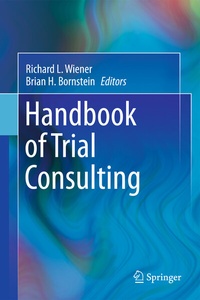
Handbook of Trial Consulting
Description

This volume will be a handbook that treats trial consulting as applied psychology. The purpose of the volume will be to collect the viewpoints of leaders in the field of psychology and law who apply the discipline's theoretical models, methods, and ethics to assist litigators to try cases in the most effective way possible. As a whole, the collection of chapters will describe the theory, business, and mechanics of trial consulting for those interested in learning and practicing the profession. However, it will do so from the perspective of organized theories of jury-decision making. In other words, the work of juror researchers will inform the recommendations and suggestions in the handbook. The volume consists of six sections, each pertaining to a different topic. Multiple chapters with different authors will cover each topic. The topics and corresponding seven sections will be 1) An Introduction to the Theory and Psychology of Jury Decision-Making, 2) Applied Research Methodologies for Trial Consultants, 3) Education and Ethical Considerations for Trial Consultants, 4) Preparing and Cross Examining Witnesses, 5) Technology and Demonstrative Evidence at Trial, and 6) Special Topics in Trial Consulting. Each section will begin with the editors' short introduction reviewing that section and explaining its goals, objectives, and content. Separate individuals, recognized as leaders in their areas will write the remaining chapters in each section. These individuals come from the fields of both psychology and law, and represent viewpoints on these topics from a practice-oriented perspective, but a perspective that is emerges from research results. They are affiliated with a number of academic institutions, including University of Nebraska, John Jay College of Criminal Justice, University of Texas, University of Chicago Simon Fraser University, and private law firms.
Reviews / Votes
From the reviews:
"Handbook is principally oriented towards psychologists, it can also be very useful to other social scientists or legal practitioners . . very useful to those who are interested in examining more in depth the legal and theoretical issues . . chapters are very practical, are clearly evidence based, and can be useful to both lawyers and trail consultants. . The Handbook of Trial Consulting provides . a comprehensive, state-of-the-art review of the major areas that can be subsumed under the title." (Michel Sabourin, PsycCRITIQUES, Vol. 56 (48), November, 2011)More details
Other editions
Additional editions