

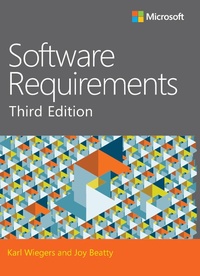
Software Requirements
3rd Edition
Published on 15. August 2013
672 pages
978-0-7356-7962-7 (ISBN)
Description

Now in its third edition, this classic guide to software requirements engineering has been fully updated with new topics, examples, and guidance. Two leaders in the requirements community have teamed up to deliver a contemporary set of practices covering the full range of requirements development and management activities on software projects.
Describes practical, effective, field-tested techniques for managing the requirements engineering process from end to end.
Provides examples demonstrating how requirements "good practices" can lead to fewer change requests, higher customer satisfaction, and lower development costs.
Fully updated with contemporary examples and many new practices and techniques.
Describes how to apply effective requirements practices to agile projects and numerous other special project situations.
Targeted to business analysts, developers, project managers, and other software project stakeholders who have a general understanding of the software development process.
Shares the insights gleaned from the authors' extensive experience delivering hundreds of software-requirements training courses, presentations, and webinars.
New chapters are included on specifying data requirements, writing high-quality functional requirements, and requirements reuse. Considerable depth has been added on business requirements, elicitation techniques, and nonfunctional requirements. In addition, new chapters recommend effective requirements practices for various special project situations, including enhancement and replacement, packaged solutions, outsourced, business process automation, analytics and reporting, and embedded and other real-time systems projects.
Describes practical, effective, field-tested techniques for managing the requirements engineering process from end to end.
Provides examples demonstrating how requirements "good practices" can lead to fewer change requests, higher customer satisfaction, and lower development costs.
Fully updated with contemporary examples and many new practices and techniques.
Describes how to apply effective requirements practices to agile projects and numerous other special project situations.
Targeted to business analysts, developers, project managers, and other software project stakeholders who have a general understanding of the software development process.
Shares the insights gleaned from the authors' extensive experience delivering hundreds of software-requirements training courses, presentations, and webinars.
New chapters are included on specifying data requirements, writing high-quality functional requirements, and requirements reuse. Considerable depth has been added on business requirements, elicitation techniques, and nonfunctional requirements. In addition, new chapters recommend effective requirements practices for various special project situations, including enhancement and replacement, packaged solutions, outsourced, business process automation, analytics and reporting, and embedded and other real-time systems projects.
All prices
More details
Series
Edition
3rd edition
Language
English
Place of publication
Redmond
United States
Target group
College/higher education
File size
21,32 MB
ISBN-13
978-0-7356-7962-7 (9780735679627)
Copyright in bibliographic data and cover images is held by Nielsen Book Services Limited or by the publishers or by their respective licensors: all rights reserved.
Schweitzer Classification
Other editions
Additional editions
Karl Wiegers | Joy Beatty
Software Requirements
Book
08/2013
3rd Edition
Microsoft Press
€44.99
Shipment within 10-20 days
Persons
Joy Beatty, a leader in the software requirements community, has trained thousands of business analysts and helped major organizations build business-analysis centers of excellence. She is coauthor of Visual Models for Software Requirements.
Content
Introduction
Acknowledgments
Software requirements: What, why, and who
Chapter 1: The essential software requirement
Chapter 2: Requirements from the customer's perspective
Chapter 3: Good practices for requirements engineering
Chapter 4: The business analyst
Requirements development
Chapter 5: Establishing the business requirements
Chapter 6: Finding the voice of the user
Chapter 7: Requirements elicitation
Chapter 8: Understanding user requirements
Chapter 9: Playing by the rules
Chapter 10: Documenting the requirements
Chapter 11: Writing excellent requirements
Chapter 12: A picture is worth 1024 words
Chapter 13: Specifying data requirements
Chapter 14: Beyond functionality
Chapter 15: Risk reduction through prototyping
Chapter 16: First things first: Setting requirement priorities
Chapter 17: Validating the requirements
Chapter 18: Requirements reuse
Chapter 19: Beyond requirements development
Requirements for specific project classes
Chapter 20: Agile projects
Chapter 21: Enhancement and replacement projects
Chapter 22: Packaged solution projects
Chapter 23: Outsourced projects
Chapter 24: Business process automation projects
Chapter 25: Business analytics projects
Chapter 26: Embedded and other real-time systems projects
Requirements management
Chapter 27: Requirements management practices
Chapter 28: Change happens
Chapter 29: Links in the requirements chain
Chapter 30: Tools for requirements engineering
Implementing requirements engineering
Chapter 31: Improving your requirements processes
Chapter 32: Software requirements and risk management
Epilogue
Current requirements practice self-assessment
Requirements troubleshooting guide
Sample requirements documents
Glossary
About the authors
Acknowledgments
Software requirements: What, why, and who
Chapter 1: The essential software requirement
Chapter 2: Requirements from the customer's perspective
Chapter 3: Good practices for requirements engineering
Chapter 4: The business analyst
Requirements development
Chapter 5: Establishing the business requirements
Chapter 6: Finding the voice of the user
Chapter 7: Requirements elicitation
Chapter 8: Understanding user requirements
Chapter 9: Playing by the rules
Chapter 10: Documenting the requirements
Chapter 11: Writing excellent requirements
Chapter 12: A picture is worth 1024 words
Chapter 13: Specifying data requirements
Chapter 14: Beyond functionality
Chapter 15: Risk reduction through prototyping
Chapter 16: First things first: Setting requirement priorities
Chapter 17: Validating the requirements
Chapter 18: Requirements reuse
Chapter 19: Beyond requirements development
Requirements for specific project classes
Chapter 20: Agile projects
Chapter 21: Enhancement and replacement projects
Chapter 22: Packaged solution projects
Chapter 23: Outsourced projects
Chapter 24: Business process automation projects
Chapter 25: Business analytics projects
Chapter 26: Embedded and other real-time systems projects
Requirements management
Chapter 27: Requirements management practices
Chapter 28: Change happens
Chapter 29: Links in the requirements chain
Chapter 30: Tools for requirements engineering
Implementing requirements engineering
Chapter 31: Improving your requirements processes
Chapter 32: Software requirements and risk management
Epilogue
Current requirements practice self-assessment
Requirements troubleshooting guide
Sample requirements documents
Glossary
About the authors
