

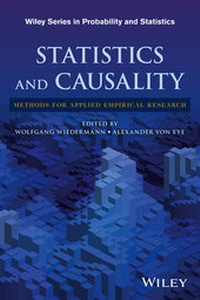
Statistics and Causality
Description

More details
Other editions
Additional editions

Persons
Content
List Of Contributors Xiii
Preface Xvii
Acknowledgments Xxv
Part I Bases Of Causality 1
1 Causation and the Aims of Inquiry 3
Ned Hall
1.1 Introduction, 3
1.2 The Aim of an Account of Causation, 4
1.2.1 The Possible Utility of a False Account, 4
1.2.2 Inquiry's Aim, 5
1.2.3 Role of "Intuitions", 6
1.3 The Good News, 7
1.3.1 The Core Idea, 7
1.3.2 Taxonomizing "Conditions", 9
1.3.3 Unpacking "Dependence", 10
1.3.4 The Good News, Amplified, 12
1.4 The Challenging News, 17
1.4.1 Multiple Realizability, 17
1.4.2 Protracted Causes, 18
1.4.3 Higher Level Taxonomies and "Normal" Conditions, 25
1.5 The Perplexing News, 26
1.5.1 The Centrality of "Causal Process", 26
1.5.2 A Speculative Proposal, 28
2 Evidence and Epistemic Causality 31
Michael Wilde & Jon Williamson
2.1 Causality and Evidence, 31
2.2 The Epistemic Theory of Causality, 35
2.3 The Nature of Evidence, 38
2.4 Conclusion, 40
Part II Directionality Of Effects 43
3 Statistical Inference for Direction of Dependence in Linear Models 45
Yadolah Dodge & Valentin Rousson
3.1 Introduction, 45
3.2 Choosing the Direction of a Regression Line, 46
3.3 Significance Testing for the Direction of a Regression Line, 48
3.4 Lurking Variables and Causality, 54
3.4.1 Two Independent Predictors, 55
3.4.2 Confounding Variable, 55
3.4.3 Selection of a Subpopulation, 56
3.5 Brain and Body Data Revisited, 57
3.6 Conclusions, 60
4 Directionality of Effects in Causal Mediation Analysis 63
Wolfgang Wiedermann & Alexander von Eye
4.1 Introduction, 63
4.2 Elements of Causal Mediation Analysis, 66
4.3 Directionality of Effects in Mediation Models, 68
4.4 Testing Directionality Using Independence Properties of Competing Mediation Models, 71
4.4.1 Independence Properties of Bivariate Relations, 72
4.4.2 Independence Properties of the Multiple Variable Model, 74
4.4.3 Measuring and Testing Independence, 74
4.5 Simulating the Performance of Directionality Tests, 82
4.5.1 Results, 83
4.6 Empirical Data Example: Development of Numerical Cognition, 85
4.7 Discussion, 92
5 Direction of Effects in Categorical Variables: A Structural Perspective 107
Alexander von Eye & Wolfgang Wiedermann
5.1 Introduction, 107
5.2 Concepts of Independence in Categorical Data Analysis, 108
5.3 Direction Dependence in Bivariate Settings: Metric and Categorical Variables, 110
5.3.1 Simulating the Performance of Nonhierarchical Log-Linear Models, 114
5.4 Explaining the Structure of Cross-Classifications, 117
5.5 Data Example, 123
5.6 Discussion, 126
6 Directional Dependence Analysis Using Skew-Normal Copula-Based Regression 131
Seongyong Kim & Daeyoung Kim
6.1 Introduction, 131
6.2 Copula-Based Regression, 133
6.2.1 Copula, 133
6.2.2 Copula-Based Regression, 134
6.3 Directional Dependence in the Copula-Based Regression, 136
6.4 Skew-Normal Copula, 138
6.5 Inference of Directional Dependence Using Skew-Normal Copula-Based Regression, 144
6.5.1 Estimation of Copula-Based Regression, 144
6.5.2 Detection of Directional Dependence and Computation of the Directional Dependence Measures, 146
6.6 Application, 147
6.7 Conclusion, 150
7 Non-Gaussian Structural Equation Models for Causal Discovery 153
Shohei Shimizu
7.1 Introduction, 153
7.2 Independent Component Analysis, 156
7.2.1 Model, 157
7.2.2 Identifiability, 157
7.2.3 Estimation, 158
7.3 Basic Linear Non-Gaussian Acyclic Model, 158
7.3.1 Model, 158
7.3.2 Identifiability, 160
7.3.3 Estimation, 162
7.4 LINGAM for Time Series, 167
7.4.1 Model, 167
7.4.2 Identifiability, 168
7.4.3 Estimation, 168
7.5 LINGAM with Latent Common Causes, 169
7.5.1 Model, 169
7.5.2 Identifiability, 171
7.5.3 Estimation, 174
7.6 Conclusion and Future Directions, 177
8 Nonlinear Functional Causal Models for Distinguishing Cause from Effect 185
Kun Zhang & Aapo Hyvärinen
8.1 Introduction, 185
8.2 Nonlinear Additive Noise Model, 188
8.2.1 Definition of Model, 188
8.2.2 Likelihood Ratio for Nonlinear Additive Models, 188
8.2.3 Information-Theoretic Interpretation, 189
8.2.4 Likelihood Ratio and Independence-Based Methods, 191
8.3 Post-Nonlinear Causal Model, 192
8.3.1 The Model, 192
8.3.2 Identifiability of Causal Direction, 193
8.3.3 Determination of Causal Direction Based on the PNL Causal Model, 193
8.4 On the Relationships Between Different Principles for Model Estimation, 194
8.5 Remark on General Nonlinear Causal Models, 196
8.6 Some Empirical Results, 197
8.7 Discussion and Conclusion, 198
Part III Granger Causality And Longitudinal Data Modeling 203
9 Alternative Forms of Granger Causality, Heterogeneity, and Nonstationarity 205
Peter C. M. Molenaar & Lawrence L. Lo
9.1 Introduction, 205
9.2 Some Initial Remarks on the Logic of Granger Causality Testing, 206
9.3 Preliminary Introduction to Time Series Analysis, 207
9.4 Overview of Granger Causality Testing in the Time Domain, 210
9.5 Granger Causality Testing in the Frequency Domain, 212
9.5.1 Two Equivalent Representations of a VAR(a), 212
9.5.2 Partial Directed Coherence (PDC) as a Frequency-Domain Index of Granger Causality, 213
9.5.3 Some Preliminary Comments, 214
9.5.4 Application to Simulated Data, 215
9.6 A New Data-Driven Solution to Granger Causality Testing, 216
9.6.1 Fitting a uSEM, 217
9.6.2 Extending the Fit of a uSEM, 217
9.6.3 Application of the Hybrid VAR Fit to Simulated Data, 218
9.7 Extensions to Nonstationary Series and Heterogeneous Replications, 221
9.7.1 Heterogeneous Replications, 221
9.7.2 Nonstationary Series, 222
9.8 Discussion and Conclusion, 224
10 Granger Meets Rasch: Investigating Granger Causation with Multidimensional Longitudinal Item Response Models 231
Ingrid Koller, Claus H. Carstensen, Wolfgang Wiedermann & Alexander von Eye
10.1 Introduction, 231
10.2 Granger Causation, 232
10.3 The Rasch Model, 234
10.4 Longitudinal Item Response Theory Models, 236
10.5 Data Example: Scientific Literacy in Preschool Children, 240
10.6 Discussion, 241
11 Granger Causality for Ill-Posed Problems: Ideas, Methods, and Application in Life Sciences 249
Katerina Hlavá ¿ cková-Schindler, Valeriya Naumova & ¿ Sergiy Pereverzyev Jr.
11.1 Introduction, 249
11.1.1 Causality Problems in Life Sciences, 250
11.1.2 Outline of the Chapter, 250
11.1.3 Notation, 251
11.2 Granger Causality and Multivariate Granger Causality, 251
11.2.1 Granger Causality, 252
11.2.2 Multivariate Granger Causality, 253
11.3 Gene Regulatory Networks, 254
11.4 Regularization of Ill-Posed Inverse Problems, 255
11.5 Multivariate Granger Causality Approaches Using ¿¿¿¿1 and ¿¿¿¿2
Penalties, 256
11.6 Applied Quality Measures, 262
11.7 Novel Regularization Techniques with a Case Study of Gene Regulatory Networks Reconstruction, 263
11.7.1 Optimal Graphical Lasso Granger Estimator, 263
11.7.2 Thresholding Strategy, 264
11.7.3 An Automatic Realization of the GLG-Method, 266
11.7.4 Granger Causality with Multi-Penalty Regularization, 266
11.7.5 Case Study of Gene Regulatory Network Reconstruction, 269
11.8 Conclusion, 271
12 Unmeasured Reciprocal Interactions: Specification and Fit Using Structural Equation Models 277
Phillip K. Wood
12.1 Introduction, 277
12.2 Types of Reciprocal Relationship Models, 278
12.2.1 Cross-Lagged Panel Approaches, 278
12.2.2 Granger Causality, 279
12.2.3 Epistemic Causality, 280
12.2.4 Reciprocal Causality, 281
12.3 Unmeasured Reciprocal and Autocausal Effects, 286
12.3.1 Bias in Standardized Regression Weight, 288
12.3.2 Autocausal Effects, 289
12.3.3 Instrumental Variables, 291
12.4 Longitudinal Data Settings, 293
12.4.1 Monte Carlo Simulation, 293
12.4.2 Real-World Data Examples, 302
12.5 Discussion, 304
Part IV Counterfactual Approaches And Propensity Score Analysis 309
13 Log-Linear Causal Analysis of Cross-Classified Categorical Data 311
Kazuo Yamaguchi
13.1 Introduction, 311
13.2 Propensity Score Methods and the Collapsibility Problem for the Logit Model, 313
13.3 Theorem On Standardization and the Lack of Collapsibility of the Logit Model, 316
13.4 The Problem of Zero-Sample Estimates of Conditional Probabilities and the Use of Semiparametric Models to Solve the Problem, 318
13.4.1 The Problem of Zero-Sample Estimates of Conditional Probabilities, 318
13.4.2 Method for Obtaining Adjusted Two-Way Frequency Data for the Analysis of Association between X and Y, 319
13.4.3 Method for Obtaining an Adjusted Three-Way Frequency Table for the Analysis of Conditional Association, 320
13.5 Estimation of Standard Errors in the Analysis of Association with Adjusted Contingency Table Data, 322
13.6 Illustrative Application, 323
13.6.1 Data, 323
13.6.2 Software, 324
13.6.3 Analysis, 324
13.7 Conclusion, 326
14 Design- and Model-Based Analysis of Propensity Score Designs 333
Peter M. Steiner
14.1 Introduction, 333
14.2 Causal Models and Causal Estimands, 334
14.3 Design- and Model-Based Inference with Randomized Experiments, 336
14.3.1 Design-Based Formulation, 337
14.3.2 Model-Based Formulation, 338
14.4 Design- and Model-Based Inferences with PS Designs, 339
14.4.1 Propensity Score Designs, 340
14.4.2 Design- versus Model-Based Formulations of PS Designs, 344
14.4.3 Other Propensity Score Techniques, 346
14.5 Statistical Issues with PS Designs in Practice, 347
14.5.1 Choice of a Specific PS Design, 347
14.5.2 Estimation of Propensity Scores, 350
14.5.3 Estimating and Testing the Treatment Effect, 353
14.6 Discussion, 355
15 Adjustment when Covariates are Fallible 363
Steffi Pohl, Marie-Ann Sengewald & Rolf Steyer
15.1 Introduction, 363
15.2 Theoretical Framework, 364
15.2.1 Definition of Causal Effects, 365
15.2.2 Identification of Causal Effects, 366
15.2.3 Adjusting for Latent or Fallible Covariates, 367
15.3 The Impact of Measurement Error in Covariates on Causal Effect Estimation, 369
15.3.1 Theoretical Impact of One Fallible Covariate, 369
15.3.2 Investigation of the Impact of Fallible Covariates in Simulation Studies, 370
15.3.3 Investigation of the Impact of Fallible Covariates in an Empirical Study, 370
15.4 Approaches Accounting for Latent Covariates, 372
15.4.1 Latent Covariates in Propensity Score Methods, 373
15.4.2 Latent Covariates in ANCOVA Models, 374
15.4.3 Performance of the Approaches in an Empirical Study, 374
15.5 The Impact of Additional Covariates on the Biasing Effect of a Fallible Covariate, 375
15.5.1 Investigation of the Impact of Additional Covariates in an Empirical Study, 376
15.5.2 Investigation of the Impact of Additional Covariates in Simulation Studies, 378
15.6 Discussion, 379
16 Latent Class Analysis with Causal Inference: The Effect of Adolescent Depression on Young Adult Substance Use Profile 385
Stephanie T. Lanza, Megan S. Schuler & Bethany C. Bray
16.1 Introduction, 385
16.2 Latent Class Analysis, 387
16.2.1 LCA With Covariates, 387
16.3 Propensity Score Analysis, 389
16.3.1 Inverse Propensity Weights (IPWs), 390
16.4 Empirical Demonstration, 391
16.4.1 The Causal Question: A Moderated Average Causal Effect, 391
16.4.2 Participants, 391
16.4.3 Measures, 391
16.4.4 Analytic Strategy for LCA With Causal Inference, 394
16.4.5 Results From Empirical Demonstration, 394
16.5 Discussion, 398
16.5.1 Limitations, 399
Part V Designs For Causal Inference 405
17 Can We Establish Causality with Statistical Analyses? The Example of Epidemiology 407
Ulrich Frick & Jürgen Rehm
17.1 Why a Chapter on Design?, 407
17.2 The Epidemiological Theory of Causality, 408
17.3 Cohort and Case-Control Studies, 411
17.4 Improving Control in Epidemiological Research, 414
17.4.1 Measurement, 414
17.4.2 Mendelian Randomization, 416
17.4.3 Surrogate Endpoints (Experimental), 419
17.4.4 Other Design Measures to Increase Control, 420
17.4.5 Methods of Analysis, 421
17.5 Conclusion: Control in Epidemiological Research Can Be Improved, 424
Index 433
List Of Contributors Xiii
Preface Xvii
Acknowledgments Xxv
Part I Bases Of Causality 1
1 Causation and the Aims of Inquiry 3
Ned Hall
1.1 Introduction, 3
1.2 The Aim of an Account of Causation, 4
1.2.1 The Possible Utility of a False Account, 4
1.2.2 Inquiry's Aim, 5
1.2.3 Role of "Intuitions", 6
1.3 The Good News, 7
1.3.1 The Core Idea, 7
1.3.2 Taxonomizing "Conditions", 9
1.3.3 Unpacking "Dependence", 10
1.3.4 The Good News, Amplified, 12
1.4 The Challenging News, 17
1.4.1 Multiple Realizability, 17
1.4.2 Protracted Causes, 18
1.4.3 Higher Level Taxonomies and "Normal" Conditions, 25
1.5 The Perplexing News, 26
1.5.1 The Centrality of "Causal Process", 26
1.5.2 A Speculative Proposal, 28
2 Evidence and Epistemic Causality 31
Michael Wilde & Jon Williamson
2.1 Causality and Evidence, 31
2.2 The Epistemic Theory of Causality, 35
2.3 The Nature of Evidence, 38
2.4 Conclusion, 40
Part II Directionality Of Effects 43
3 Statistical Inference for Direction of Dependence in Linear Models 45
Yadolah Dodge & Valentin Rousson
3.1 Introduction, 45
3.2 Choosing the Direction of a Regression Line, 46
3.3 Significance Testing for the Direction of a Regression Line, 48
3.4 Lurking Variables and Causality, 54
3.4.1 Two Independent Predictors, 55
3.4.2 Confounding Variable, 55
3.4.3 Selection of a Subpopulation, 56
3.5 Brain and Body Data Revisited, 57
3.6 Conclusions, 60
4 Directionality of Effects in Causal Mediation Analysis 63
Wolfgang Wiedermann & Alexander von Eye
4.1 Introduction, 63
4.2 Elements of Causal Mediation Analysis, 66
4.3 Directionality of Effects in Mediation Models, 68
4.4 Testing Directionality Using Independence Properties of Competing Mediation Models, 71
4.4.1 Independence Properties of Bivariate Relations, 72
4.4.2 Independence Properties of the Multiple Variable Model, 74
4.4.3 Measuring and Testing Independence, 74
4.5 Simulating the Performance of Directionality Tests, 82
4.5.1 Results, 83
4.6 Empirical Data Example: Development of Numerical Cognition, 85
4.7 Discussion, 92
5 Direction of Effects in Categorical Variables: A Structural Perspective 107
Alexander von Eye & Wolfgang Wiedermann
5.1 Introduction, 107
5.2 Concepts of Independence in Categorical Data Analysis, 108
5.3 Direction Dependence in Bivariate Settings: Metric and Categorical Variables, 110
5.3.1 Simulating the Performance of Nonhierarchical Log-Linear Models, 114
5.4 Explaining the Structure of Cross-Classifications, 117
5.5 Data Example, 123
5.6 Discussion, 126
6 Directional Dependence Analysis Using Skew-Normal Copula-Based Regression 131
Seongyong Kim & Daeyoung Kim
6.1 Introduction, 131
6.2 Copula-Based Regression, 133
6.2.1 Copula, 133
6.2.2 Copula-Based Regression, 134
6.3 Directional Dependence in the Copula-Based Regression, 136
6.4 Skew-Normal Copula, 138
6.5 Inference of Directional Dependence Using Skew-Normal Copula-Based Regression, 144
6.5.1 Estimation of Copula-Based Regression, 144
6.5.2 Detection of Directional Dependence and Computation of the Directional Dependence Measures, 146
6.6 Application, 147
6.7 Conclusion, 150
7 Non-Gaussian Structural Equation Models for Causal Discovery 153
Shohei Shimizu
7.1 Introduction, 153
7.2 Independent Component Analysis, 156
7.2.1 Model, 157
7.2.2 Identifiability, 157
7.2.3 Estimation, 158
7.3 Basic Linear Non-Gaussian Acyclic Model, 158
7.3.1 Model, 158
7.3.2 Identifiability, 160
7.3.3 Estimation, 162
7.4 LINGAM for Time Series, 167
7.4.1 Model, 167
7.4.2 Identifiability, 168
7.4.3 Estimation, 168
7.5 LINGAM with Latent Common Causes, 169
7.5.1 Model, 169
7.5.2 Identifiability, 171
7.5.3 Estimation, 174
7.6 Conclusion and Future Directions, 177
8 Nonlinear Functional Causal Models for Distinguishing Cause from Effect 185
Kun Zhang & Aapo Hyvärinen
8.1 Introduction, 185
8.2 Nonlinear Additive Noise Model, 188
8.2.1 Definition of Model, 188
8.2.2 Likelihood Ratio for Nonlinear Additive Models, 188
8.2.3 Information-Theoretic Interpretation, 189
8.2.4 Likelihood Ratio and Independence-Based Methods, 191
8.3 Post-Nonlinear Causal Model, 192
8.3.1 The Model, 192
8.3.2 Identifiability of Causal Direction, 193
8.3.3 Determination of Causal Direction Based on the PNL Causal Model, 193
8.4 On the Relationships Between Different Principles for Model Estimation, 194
8.5 Remark on General Nonlinear Causal Models, 196
8.6 Some Empirical Results, 197
8.7 Discussion and Conclusion, 198
Part III Granger Causality And Longitudinal Data Modeling 203
9 Alternative Forms of Granger Causality, Heterogeneity, and Nonstationarity 205
Peter C. M. Molenaar & Lawrence L. Lo
9.1 Introduction, 205
9.2 Some Initial Remarks on the Logic of Granger Causality Testing, 206
9.3 Preliminary Introduction to Time Series Analysis, 207
9.4 Overview of Granger Causality Testing in the Time Domain, 210
9.5 Granger Causality Testing in the Frequency Domain, 212
9.5.1 Two Equivalent Representations of a VAR(a), 212
9.5.2 Partial Directed Coherence (PDC) as a Frequency-Domain Index of Granger Causality, 213
9.5.3 Some Preliminary Comments, 214
9.5.4 Application to Simulated Data, 215
9.6 A New Data-Driven Solution to Granger Causality Testing, 216
9.6.1 Fitting a uSEM, 217
9.6.2 Extending the Fit of a uSEM, 217
9.6.3 Application of the Hybrid VAR Fit to Simulated Data, 218
9.7 Extensions to Nonstationary Series and Heterogeneous Replications, 221
9.7.1 Heterogeneous Replications, 221
9.7.2 Nonstationary Series, 222
9.8 Discussion and Conclusion, 224
10 Granger Meets Rasch: Investigating Granger Causation with Multidimensional Longitudinal Item Response Models 231
Ingrid Koller, Claus H. Carstensen, Wolfgang Wiedermann & Alexander von Eye
10.1 Introduction, 231
10.2 Granger Causation, 232
10.3 The Rasch Model, 234
10.4 Longitudinal Item Response Theory Models, 236
10.5 Data Example: Scientific Literacy in Preschool Children, 240
10.6 Discussion, 241
11 Granger Causality for Ill-Posed Problems: Ideas, Methods, and Application in Life Sciences 249
Katerina Hlavá ¿ cková-Schindler, Valeriya Naumova & ¿ Sergiy Pereverzyev Jr.
11.1 Introduction, 249
11.1.1 Causality Problems in Life Sciences, 250
11.1.2 Outline of the Chapter, 250
11.1.3 Notation, 251
11.2 Granger Causality and Multivariate Granger Causality, 251
11.2.1 Granger Causality, 252
11.2.2 Multivariate Granger Causality, 253
11.3 Gene Regulatory Networks, 254
11.4 Regularization of Ill-Posed Inverse Problems, 255
11.5 Multivariate Granger Causality Approaches Using ¿¿¿¿1 and ¿¿¿¿2
Penalties, 256
11.6 Applied Quality Measures, 262
11.7 Novel Regularization Techniques with a Case Study of Gene Regulatory Networks Reconstruction, 263
11.7.1 Optimal Graphical Lasso Granger Estimator, 263
11.7.2 Thresholding Strategy, 264
11.7.3 An Automatic Realization of the GLG-Method, 266
11.7.4 Granger Causality with Multi-Penalty Regularization, 266
11.7.5 Case Study of Gene Regulatory Network Reconstruction, 269
11.8 Conclusion, 271
12 Unmeasured Reciprocal Interactions: Specification and Fit Using Structural Equation Models 277
Phillip K. Wood
12.1 Introduction, 277
12.2 Types of Reciprocal Relationship Models, 278
12.2.1 Cross-Lagged Panel Approaches, 278
12.2.2 Granger Causality, 279
12.2.3 Epistemic Causality, 280
12.2.4 Reciprocal Causality, 281
12.3 Unmeasured Reciprocal and Autocausal Effects, 286
12.3.1 Bias in Standardized Regression Weight, 288
12.3.2 Autocausal Effects, 289
12.3.3 Instrumental Variables, 291
12.4 Longitudinal Data Settings, 293
12.4.1 Monte Carlo Simulation, 293
12.4.2 Real-World Data Examples, 302
12.5 Discussion, 304
Part IV Counterfactual Approaches And Propensity Score Analysis 309
13 Log-Linear Causal Analysis of Cross-Classified Categorical Data 311
Kazuo Yamaguchi
13.1 Introduction, 311
13.2 Propensity Score Methods and the Collapsibility Problem for the Logit Model, 313
13.3 Theorem On Standardization and the Lack of Collapsibility of the Logit Model, 316
13.4 The Problem of Zero-Sample Estimates of Conditional Probabilities and the Use of Semiparametric Models to Solve the Problem, 318
13.4.1 The Problem of Zero-Sample Estimates of Conditional Probabilities, 318
13.4.2 Method for Obtaining Adjusted Two-Way Frequency Data for the Analysis of Association between X and Y, 319
13.4.3 Method for Obtaining an Adjusted Three-Way Frequency Table for the Analysis of Conditional Association, 320
13.5 Estimation of Standard Errors in the Analysis of Association with Adjusted Contingency Table Data, 322
13.6 Illustrative Application, 323
13.6.1 Data, 323
13.6.2 Software, 324
13.6.3 Analysis, 324
13.7 Conclusion, 326
14 Design- and Model-Based Analysis of Propensity Score Designs 333
Peter M. Steiner
14.1 Introduction, 333
14.2 Causal Models and Causal Estimands, 334
14.3 Design- and Model-Based Inference with Randomized Experiments, 336
14.3.1 Design-Based Formulation, 337
14.3.2 Model-Based Formulation, 338
14.4 Design- and Model-Based Inferences with PS Designs, 339
14.4.1 Propensity Score Designs, 340
14.4.2 Design- versus Model-Based Formulations of PS Designs, 344
14.4.3 Other Propensity Score Techniques, 346
14.5 Statistical Issues with PS Designs in Practice, 347
14.5.1 Choice of a Specific PS Design, 347
14.5.2 Estimation of Propensity Scores, 350
14.5.3 Estimating and Testing the Treatment Effect, 353
14.6 Discussion, 355
15 Adjustment when Covariates are Fallible 363
Steffi Pohl, Marie-Ann Sengewald & Rolf Steyer
15.1 Introduction, 363
15.2 Theoretical Framework, 364
15.2.1 Definition of Causal Effects, 365
15.2.2 Identification of Causal Effects, 366
15.2.3 Adjusting for Latent or Fallible Covariates, 367
15.3 The Impact of Measurement Error in Covariates on Causal Effect Estimation, 369
15.3.1 Theoretical Impact of One Fallible Covariate, 369
15.3.2 Investigation of the Impact of Fallible Covariates in Simulation Studies, 370
15.3.3 Investigation of the Impact of Fallible Covariates in an Empirical Study, 370
15.4 Approaches Accounting for Latent Covariates, 372
15.4.1 Latent Covariates in Propensity Score Methods, 373
15.4.2 Latent Covariates in ANCOVA Models, 374
15.4.3 Performance of the Approaches in an Empirical Study, 374
15.5 The Impact of Additional Covariates on the Biasing Effect of a Fallible Covariate, 375
15.5.1 Investigation of the Impact of Additional Covariates in an Empirical Study, 376
15.5.2 Investigation of the Impact of Additional Covariates in Simulation Studies, 378
15.6 Discussion, 379
16 Latent Class Analysis with Causal Inference: The Effect of Adolescent Depression on Young Adult Substance Use Profile 385
Stephanie T. Lanza, Megan S. Schuler & Bethany C. Bray
16.1 Introduction, 385
16.2 Latent Class Analysis, 387
16.2.1 LCA With Covariates, 387
16.3 Propensity Score Analysis, 389
16.3.1 Inverse Propensity Weights (IPWs), 390
16.4 Empirical Demonstration, 391
16.4.1 The Causal Question: A Moderated Average Causal Effect, 391
16.4.2 Participants, 391
16.4.3 Measures, 391
16.4.4 Analytic Strategy for LCA With Causal Inference, 394
16.4.5 Results From Empirical Demonstration, 394
16.5 Discussion, 398
16.5.1 Limitations, 399
Part V Designs For Causal Inference 405
17 Can We Establish Causality with Statistical Analyses? The Example of Epidemiology 407
Ulrich Frick & Jürgen Rehm
17.1 Why a Chapter on Design?, 407
17.2 The Epidemiological Theory of Causality, 408
17.3 Cohort and Case-Control Studies, 411
17.4 Improving Control in Epidemiological Research, 414
17.4.1 Measurement, 414
17.4.2 Mendelian Randomization, 416
17.4.3 Surrogate Endpoints (Experimental), 419
17.4.4 Other Design Measures to Increase Control, 420
17.4.5 Methods of
Preface
The discussion of concepts of causality has been a staple of philosophical discourse since at least Aristotle. Very well known are Aristotle's four types of causes: the material cause, the formal cause, the efficient cause, and the final cause. Having been introduced into scholarly thinking slightly later, statistics took a moment to make a contribution to causal thinking. Early efforts put forth by statistics reside in two domains. First, in the domain of design, it was discussed whether only experimental data are needed for researchers to make conclusions about causal processes (Fisher, 1926, 1935), or whether observational data can also lead to trustworthy conclusions (see, e.g., Cochran and Chambers, 1965). Second, in the theoretical domain, concepts were developed that would allow one to derive testable hypotheses. Examples of such concepts include counterfactual statistical theory (for discussions, see Holland, 1986; Neyman, 1923/1990; Rubin, 1974, 2005) and causal structural modeling (e.g., Sobel, 1994).
These efforts were needed and important because it is well known that, with standard methods of statistics, that is, with methods from the family of Generalized Linear Models (GLM; Nelder and Wedderburn, 1972) one of the key characteristics of causal effects, direction, cannot be ascertained (for an illustration, see von Eye and DeShon, 2012). For example, the standardized slope parameter for the linear regression of a variable on a variable is exactly the same as the standardized slope parameter for the regression of on and the correlation between and . Thus, conclusions concerning the direction of effects have to be guided by a priori theoretical considerations.
Both, the philosophical and the statistical lines of research have made most impressive progress. In philosophy, various theories of causality have been elaborated, and Hume's classical causality theory (Hume, 1777/1975) now is just one among a number of others. An overview of philosophical theories and discussion can be found in Beebee et al. (2009). In statistics, known approaches have been further developed, in particular, in the domain of models for nonexperimental research, and novel and most promising ideas have been presented, in particular, in the domain of methods of analysis. The links between philosophical theories, design, and statistical data processing have been discussed. Methods of analysis are available that match particular philosophical theories.
This book is concerned with novel statistical approaches to causal analysis, in the context of the continuing development of philosophical theories. This book presents original work, in five modules. In the first module, Bases of Causality, Hall presents an account of causal structures from a foundationalist perspective and explicitly connects it to the aims of any scientific inquiry (Chapter 1). Causal structures are seen as ways in which states of localized bits of the world depend on states of other localized bits. The author discusses why unpacking and rendering this localized dependence account (which is, in essence, a version of the well-established counterfactual or "interventionist" account; e.g., Holland, 1986; Pearl, 2009; Rubin, 1974) may lead to several problems, which so far lack adequate solutions. Further, the author explains why treating causal structures as localized dependences may lead to an abandonment of a core feature of causation, that is, the idea that causes need to be connected to their effects via mediating processes. In Chapter 2, Wilde and Williamson discuss issues associated with standard mechanistic and difference-making theories of causality. Both lines of causality theories are often discussed in the face of counterexamples, and may struggle to explain the evidential practice of establishing causal claims. Similarly, common lines of response to the issue of counterexamples (such as simply dismissing the counterexamples or moving to pluralism) suffer from difficulties in accounting for the practice of establishing causal claims. The authors present an epistemic theory of causality as a valuable alternative. Here, causality is perceived as being purely epistemic in the sense that causal claims are not claims about causal relations that exist independent of humans. Instead, these causal claims enable humans to reason and interact with the environment.
In the empirical sciences, the Pearson correlation coefficient is one of the most widely used statistics to measure the linear association of two variables. Covariances/correlations constitute the essential source of data information used in countless statistical models, such as Factor, Path, and Structural Equation Models (e.g., Bollen, 1989), which are nowadays indispensable for both theorists and applied researchers. A very important (as well as thorny) feature of covariances and correlations is that both do not depend on the order of the variables (i.e., and ). Thus, in particular, in observational data setting, one has to sharply distinguish between correlation and causation. However, in recent years, tremendous theoretical progress has been made, which led to the development of so-called asymmetric facets of the Pearson correlation, that is, situations in which the status of a variable (in terms of "response" or "predictor") is no longer exchangeable. Dodge and Rousson (2000, 2001) proposed the first asymmetric facet of the correlation coefficient through considering the third moments (i.e., the skewness) of two nonnormally distributed variables. The second module, Directionality of Effects, presents novel generalizations of the asymmetric characteristics of the correlation coefficient. All methods presented in this module share that information beyond the second moments of variables (skewness and kurtosis) is considered being informative. In Chapter 3, Dodge and Rousson present new empirical evidence on the adequacy of methods for statistical inference for determining the direction of dependence in linear regression models. The authors present a modified approach to identify the direction of effects in the bivariate setting. Further, direction of dependence approaches in case of lurking/confounding variables,sampling from subpopulations, and in the presence of outliers are discussed. In Chapter 4, Wiedermann and von Eye extend approaches to determine the direction of effects to cases of mediational hypotheses, that is, situations in which a third intervening variable is assumed to affect a predictor-outcome relation. Significance tests are proposed designed to empirically test a putative mediation model against a plausible alternative model (i.e., a model in which the reverse flow of causality is considered). Results from a Monte Carlo simulation study as well as practical applications are presented. In Chapter 5, von Eye and Wiedermann then discuss potential application of direction of dependence methods in the categorical variable setting. The authors present the "generalized direction dependence principle" and propose log-linear model specifications that allow directional statements in terms of both univariate probability distributions and structural elements of observed associations. Early theoretical results of Dodge and Rousson (2000) have also been discussed from a Copula perspective (Sungur, 2005) that led to the development of directional Copula regression methods (Kim and Kim, 2014). In Chapter 6, Kim and Kim discuss recent advances in making directional statements based on Copula regression techniques. The authors present skew-normal Copula-based regression models to analyze directional dependence based on the joint distributional behavior of variables. An empirical demonstration of this new model is given using data from adolescent aggression research. The last two chapters of this module give an excellent overview of recently proposed causal discovery algorithms for nonnormal data. In Chapter 7, Shimizu introduces the so-called linear acyclic non-Gaussian model (LiNGAM; Shimizu et al., 2006) and discusses extensions to various data analytic domains including time series analysis and models in case of latent common causes. Chapter 8 is devoted to causal discovery algorithms for nonlinear data problems. Starting with a summary of linear non-Gaussian causal models, Zhang and Hyvärinen review nonlinear additive noise models, propose a likelihood ratio to decide between two directional candidate models, and embed the approach within an information-theoretic framework. Further, the authors generalize the approach to the postnonlinear causal model (which contains the linear non-Gaussian model and additive noise model as special cases). The performance of these causal discovery approaches is discussed using 77 cause-effect data sets from various scientific disciplines.
The aspect of temporality became a widely accepted requirement to distinguish between association and causation (implicitly following Hume's proposition that the "cause must precede the effect"). In time series analysis, the majority of methods for causal inference use temporal precedence as an essential element to deriving causal statements. However, at least since Yule's seminal papers on 'nonsense' correlations among time-variables (Yule, 1921, 1926), statisticians are well aware that temporal priority cannot per se be regarded as a causal factor. One of the most prominent attempts to incorporate the time factor in elucidating causation was introduced by Granger (1969). In essence, testing "Granger causality" relies ona prediction error approach. A variable is said to "Granger-cause" a...
