

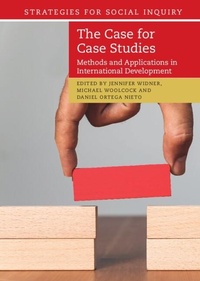
The Case for Case Studies
Methods and Applications in International Development
Published on 11. May 2022
978-1-108-67175-0 (ISBN)
Description

This book seeks to narrow two gaps: first, between the widespread use of case studies and their frequently 'loose' methodological moorings; and second, between the scholarly community advancing methodological frontiers in case study research and the users of case studies in development policy and practice. It draws on the contributors' collective experience at this nexus, but the underlying issues are more broadly relevant to case study researchers and practitioners in all fields. How does one prepare a rigorous case study? When can causal inferences reasonably be drawn from a single case? When and how can policy-makers reasonably presume that a demonstrably successful intervention in one context might generate similarly impressive outcomes elsewhere, or if massively 'scaled up'? No matter their different starting points - disciplinary base, epistemological orientation, sectoral specialization, or practical concerns - readers will find issues of significance for their own field, and others across the social sciences. This title is also available Open Access.
Reviews / Votes
'This exceptional volume brings together a set of renowned experts from the worlds of social science methods and policy evaluation to assess the state-of-the-art for case studies in international development practice. Case studies methods have for too long been viewed as being second-best by many methodologists and practitioners. This volume rectifies this, with several chapters convincingly arguing that case study methods have relative strengths in figuring out how development interventions work and under what complex, real-world conditions they can succeed. Other chapters provide practical guidance for how to use different case study methods for studying development interventions, providing many useful suggestions for researchers and evaluators.' Derek Beach, Professor, Aarhus University, and Author of Process Tracing Methods: Foundations and Guidelines 'At last evaluators and practitioners are offered methodologies that match international development realities - where contexts differ, policy mixes vary and nothing remains static. The translation of new-generation, 'case-based' approaches into development settings, can only strengthen the evaluation enterprise. We might even look forward to credible generalisations and lessons worth learning!' Elliot Stern, Emeritus Professor of Evaluation Research, Lancaster University, and Editor, Evaluation: International Journal of Theory, Research and Practice 'In the face of rapid, unpredictable change and diverse implementation contexts, we need more and better case studies to understand complex phenomena and to use that understanding for better policies, programs and initiatives in other places and times. Evidence about 'what works' on average in randomised controlled trials cannot be simply generalised to other contexts. But too often case studies are not done systematically or carefully. This important volume provides practical, well-informed guidance from leading writers and researchers on how to plan, implement and communicate case studies which can effectively answer questions about those cases and what these mean for planning initiatives in other places in the future. This book should become an essential guide and reference for everyone serious about quality evidence to inform public policy and practice.' Patricia Rogers, founder of BetterEvaluationMore details
Series
Language
English
Place of publication
Cambridge
United Kingdom
Target group
College/higher education
Illustrations
Worked examples or Exercises
File size
3,78 MB
ISBN-13
978-1-108-67175-0 (9781108671750)
Copyright in bibliographic data and cover images is held by Nielsen Book Services Limited or by the publishers or by their respective licensors: all rights reserved.
Schweitzer Classification
Other editions
Additional editions
Jennifer Widner | Michael Woolcock | Daniel Ortega Nieto
The Case for Case Studies
Methods and Applications in International Development
Book
05/2022
Cambridge University Press
€41.80
Shipment within 15-20 days
Jennifer Widner | Michael Woolcock | Daniel Ortega Nieto
The Case for Case Studies
Methods and Applications in International Development
Book
05/2022
Cambridge University Press
€109.00
Shipment within 15-20 days
Persons
Content
1. Using case studies to enhance the quality of explanation and implementation: integrating scholarship and development practice Jennifer Widner, Michael Woolcock, and Daniel Ortega Nieto; Part I. Internal and External Validity Issues in Case Study Research: 2. How to learn about causes in the single case Nancy Cartwright; 3. RCTs versus observational research: assessing the trade-offs Christopher Achen; 4. Drawing contingent generalizations from case studies Andrew Bennett; 5. Will it work here? Using case studies to generate 'key facts' about complex development programs Michael Woolcock; Part II. Ensuring High-Quality Case Studies: 6. Descriptive accuracy in interview-based case studies Jennifer Widner; 7. Selecting cases for comparative sequential analysis: novel uses for old methods Tommaso Pavone; 8. The transparency revolution in qualitative social science: implications for policy analysis Andrew Moravcsik; Part III. Putting Case Studies to Work: Applications to Development Practice: 9. Process Tracing for Program Evaluation Andrew Bennett; 10. Positive Deviance Cases: Their Value for Development Research, Policy, and Practice Melani Cammett; 11. Analytic Narratives and Case Studies; 12. Using Case Studies for Organizational Learning in Development Agencies Sarah Glavey, Oliver Haas, Claudio Santibanez, and Michael Woolcock; 13. Connecting Case Studies to Policy and Practice: Practical Lessons from Operational Experience Maria Gonzalez de Asis and Jennifer Widner.
