

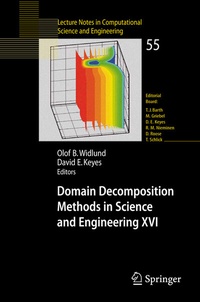
Domain Decomposition Methods in Science and Engineering XVI
1st Edition
Published on 30. July 2007
XXI, 763 pages
978-3-540-34469-8 (ISBN)
Description

Domain decomposition is an active, interdisciplinary research area concerned with the development, analysis, and implementation of coupling and decoupling strategies in mathematical and computational models of natural and engineered systems. Since the advent of hierarchical distributed memory computers, it has been motivated by considerations of concurrency and locality in a wide variety of large-scale problems, continuous and discrete. Historically, it emerged from the analysis of partial differential equations, beginning with the work of Schwarz in 1870. The present volume sets forth new contributions in areas of numerical analysis, computer science, scientific and industrial applications, and software development.
More details
Series
Language
English
Place of publication
Berlin
Germany
Publishing group
Springer Berlin
Target group
College/higher education
Professional and scholarly
Illustrations
XXI, 763 p.
File size
25,58 MB
ISBN-13
978-3-540-34469-8 (9783540344698)
DOI
10.1007/978-3-540-34469-8
Schweitzer Classification
Other editions
Additional editions
Olof Widlund | David E. Keyes
Domain Decomposition Methods in Science and Engineering XVI
Book
12/2006
Springer
€213.99
Shipment within 10-15 days
Content
Plenary Presentations.- Minisymposia.- Contributed Presentations.
