

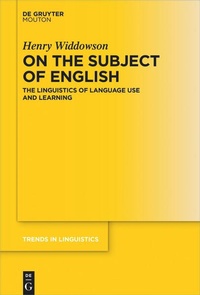
On the Subject of English
The Linguistics of Language Use and Learning
1st Edition
Published on 18. November 2019
X, 272 pages
978-3-11-061966-9 (ISBN)
Description

The globalized use of language calls into question conventional ways of thinking in linguistics,applied linguistics and language pedagogy.
This book critically examines this thinking from an historical, at times satirical, perspective and proposes an alternative conceptualization.
The first section defines a number of key concepts about communication which are taken up in subsequent sections and shown to be relevant to the different but related areas of language study. Issues about the relationship between linguistics and applied linguistics set the scene for a discussion of the nature of discourse, and then how this bears on the understanding of the globalised use of English as a lingua franca.The final section considers the implications of this perspective on communication for how the subject of English language teaching might be redefined.
The book is relevant for anyone who sees the need for a critical consideration of established concepts in linguistics and language pedagogy.
This book critically examines this thinking from an historical, at times satirical, perspective and proposes an alternative conceptualization.
The first section defines a number of key concepts about communication which are taken up in subsequent sections and shown to be relevant to the different but related areas of language study. Issues about the relationship between linguistics and applied linguistics set the scene for a discussion of the nature of discourse, and then how this bears on the understanding of the globalised use of English as a lingua franca.The final section considers the implications of this perspective on communication for how the subject of English language teaching might be redefined.
The book is relevant for anyone who sees the need for a critical consideration of established concepts in linguistics and language pedagogy.
More details
Other editions
Additional editions
Book
09/2021
1st Edition
De Gruyter Mouton
€29.95
Shipment within 7-9 days
E-Book
11/2019
1st Edition
De Gruyter Mouton
€149.95
Available for download
Book
11/2019
1st Edition
De Gruyter Mouton
€149.95
Shipment within 7-9 days
Person
Henry Widdowson
,University of Vienna, Austria
Content
- Intro
- Acknowledgements
- Contents
- Introduction: Only connect!
- Section 1: Theoretical bearings
- Preamble
- Section 2: Linguistics and applied linguistics
- Preamble
- 1. Contextual meaning and the legacy of J. R. Firth
- 2. Linguistic creativity and Jakobson's poetic function
- 3. Applied linguistics, interdisciplinarity and disparate realities
- 4. On the applicability of empirical findings
- Section 3: The analysis and interpretation of language use
- Preamble
- 5. The pretext of interpretation
- 6. Interpersonal positioning and genre conventions
- 7. "So the meaning escapes". On literature and the representation of linguistic realities
- 8. Critical practices: On representation and the interpretation of text
- 9. The novel features of text. Corpus analysis and stylistics
- 10. The unrecoverable context
- 11. Macbeth and the third murderer. An exercise in forensic stylistics
- Section 4: English as a lingua franca
- Preamble
- 12. ELF and the inconvenience of established concepts
- 13. ELF and the pragmatics of language variation
- 14. ELF, adaptive variability and virtual language
- 15. The cultural and creative use of English as a lingua franca
- 16. Creative incompetence
- Section 5: Linguistics in language learning and teaching
- Preamble
- 17. The role of translation in language learning and teaching
- 18. Bilingual competence and lingual capability
- 19. Competence and capability: rethinking the subject English
- 20. Reversions
- References
- Name Index
- Subject Index
