

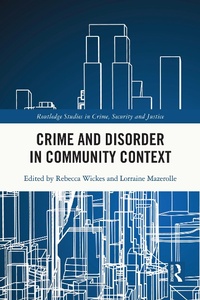
Crime and Disorder in Community Context
1st Edition
Published on 29. November 2021
212 pages
978-1-317-36032-2 (ISBN)
Description

Drawing on unique longitudinal community-level data in Brisbane, this book entwines current ecological theories of crime with key debates on the relevance of 'community' in contemporary urban life to examine the spatial and temporal relationships between community structure, community social capital, informal social control and the occurrence of crime and disorder.
Crime and Disorder in Community Context extends what is known about the concentration of crime in particular types of places, presenting a broad reaching explication of how community structural characteristics, community regulatory processes and crime influence each other over time. It looks at how growing levels of ethnic diversity, income inequality and increasing immigrant concentrations at the community level influence processes necessary for the regulation of crime; the crime control processes for various crime problems in different types of communities; the extent that exogenous shocks, like the 2011 Brisbane flood disaster and the global financial crisis impact on crime, crime prevention and crime control; and engages readers with the methodological complexities associated with the longitudinal study of crime and disorder in contemporary urban communities.
An accessible and compelling read, this will appeal to students and scholars of criminology, sociology, geography, cultural studies and all those interested in the relationship between crime and community.
Crime and Disorder in Community Context extends what is known about the concentration of crime in particular types of places, presenting a broad reaching explication of how community structural characteristics, community regulatory processes and crime influence each other over time. It looks at how growing levels of ethnic diversity, income inequality and increasing immigrant concentrations at the community level influence processes necessary for the regulation of crime; the crime control processes for various crime problems in different types of communities; the extent that exogenous shocks, like the 2011 Brisbane flood disaster and the global financial crisis impact on crime, crime prevention and crime control; and engages readers with the methodological complexities associated with the longitudinal study of crime and disorder in contemporary urban communities.
An accessible and compelling read, this will appeal to students and scholars of criminology, sociology, geography, cultural studies and all those interested in the relationship between crime and community.
Reviews / Votes
For more than a century criminologists, journalists, politicians, and the general public have, in their various ways, been attempting to explain the quite evident links between crime and place. To unravel causal processes properly we need good science, and within that realm, short of difficult to implement experiments there is nothing more powerful than longitudinal studies of community processes and crime measured at the community level. The Australian Community Capacity Study is a landmark achievement because it puts Australia on the international stage of players in this great scientific enterprise. This book, by bringing together for the first time a wide range of studies of the ACCS data by first rate scholars focused on such hot button issues as immigration, hate crime, police violence, and the impact of natural disasters, deserves to be widely read not just by researchers and students but by the general public and policy makers who want to understand the unique strengths and weaknesses of Australian community life.Ross Homel, Foundation Professor of Criminology and Criminal Justice, Griffith University
In the tradition of the best communities and crime scholarship, Wickes and Mazerolle, along with their colleagues, leverage data from a one-of-a-kind study, the Australian Community Capacity Study, to examine crime and crime control in the metropolis. Covering community dynamics related to racial and ethnic diversity, immigration, and social inequality to extra-community forces such as financial crises and ecological disasters, this edited collection on contemporary urban life offers readers a theoretically-informed, data-driven, and policy-relevant understanding of the community context of crime in Australia.
Charis E. Kubrin, Professor, Department of Criminology, Law and Society, University of California, Irvine
Criminologists have been talking about variation in informal social controls across communities for more than a century, but they have seldom had persuasive data that allowed a close look at the mechanisms that generate crime reductions. This book does just that, adding important data points to our understanding of crime and communities. The Australian Community Capacity Study (ACCS) used to generate insights in this volume ranks among the most important community level studies conducted by criminologists to date.
David Weisburd, Distinguished Professor, Department of Criminology, Law and Society
Executive Director, Center for Evidence Based Crime Policy, George Mason University For more than a century criminologists, journalists, politicians, and the general public have, in their various ways, been attempting to explain the quite evident links between crime and place. To unravel causal processes properly we need good science, and within that realm, short of difficult to implement experiments there is nothing more powerful than longitudinal studies of community processes and crime measured at the community level. The Australian Community Capacity Study is a landmark achievement because it puts Australia on the international stage of players in this great scientific enterprise. This book, by bringing together for the first time a wide range of studies of the ACCS data by first rate scholars focused on such hot button issues as immigration, hate crime, police violence, and the impact of natural disasters, deserves to be widely read not just by researchers and students but by the general public and policy makers who want to understand the unique strengths and weaknesses of Australian community life.
Ross Homel, Foundation Professor of Criminology and Criminal Justice, Griffith University
In the tradition of the best communities and crime scholarship, Wickes and Mazerolle, along with their colleagues, leverage data from a one-of-a-kind study, the Australian Community Capacity Study, to examine crime and crime control in the metropolis. Covering community dynamics related to racial and ethnic diversity, immigration, and social inequality to extra-community forces such as financial crises and ecological disasters, this edited collection on contemporary urban life offers readers a theoretically-informed, data-driven, and policy-relevant understanding of the community context of crime in Australia.
Charis E. Kubrin, Professor, Department of Criminology, Law and Society, University of California, Irvine
Criminologists have been talking about variation in informal social controls across communities for more than a century, but they have seldom had persuasive data that allowed a close look at the mechanisms that generate crime reductions. This book does just that, adding important data points to our understanding of crime and communities. The Australian Community Capacity Study (ACCS) used to generate insights in this volume ranks among the most important community level studies conducted by criminologists to date.
David Weisburd, Distinguished Professor, Department of Criminology, Law and Society
Executive Director, Center for Evidence Based Crime Policy, George Mason University
More details
Series
Edition
1. Auflage
Language
English
Place of publication
London
United Kingdom
Publishing group
Taylor & Francis Ltd
Target group
College/higher education
Illustrations
15 Tables, black and white; 7 Line drawings, black and white; 10 Halftones, color; 7 Halftones, black and white; 10 Illustrations, color; 14 Illustrations, black and white
ISBN-13
978-1-317-36032-2 (9781317360322)
Copyright in bibliographic data and cover images is held by Nielsen Book Services Limited or by the publishers or by their respective licensors: all rights reserved.
Schweitzer Classification
Other editions
Additional editions
Rebecca Wickes | Lorraine Mazerolle
Crime and Disorder in Community Context
Book
09/2023
1st Edition
Routledge
€71.98
Shipment within 10-20 days
Rebecca Wickes | Lorraine Mazerolle
Crime and Disorder in Community Context
Book
11/2021
1st Edition
Routledge
€215.41
Shipment within 10-20 days
Persons
Rebecca Wickes is an Associate Professor in the School of Social Sciences and the Director of the Migration and Inclusion Center at Monash University in Melbourne, Australia. Her research focusses on demographic changes in urban communities and their influence on community regulation, crime and disorder.
Lorraine Mazerolle is an Australian Research Council Laureate Fellow (2010-2015), a Professorial Research Fellow at The University of Queensland, School of Social Science, and a Chief Investigator with the ARC Centre of Excellence for Children and Families over the Life Course. Her research interests are in experimental criminology, policing, drug law enforcement, regulatory crime control, and crime prevention.
Lorraine Mazerolle is an Australian Research Council Laureate Fellow (2010-2015), a Professorial Research Fellow at The University of Queensland, School of Social Science, and a Chief Investigator with the ARC Centre of Excellence for Children and Families over the Life Course. Her research interests are in experimental criminology, policing, drug law enforcement, regulatory crime control, and crime prevention.
Content
1.Brisbane: A Story of Neighbourhoods and Crime in a Modern Australian City 2.Immigration and Neighbourhood Crime: Exploring the immigration-crime link in Brisbane over time 3.Understanding Hate: Hate Crime in Brisbane Neighbourhoods 4.Distance to Crime: How Proximity Shapes Residents' Perceptions of Neighbourhood Violence 5.From Perceptions to Actions: The Informal Regulation of Crime 6.Police Legitimacy in the Australian Community Context 7.Social Ties and Crime in Times of Drought and Floods 8.Crime and Disorder in the Suburbs: A Special Case of Master-Planned Communities 9.Converging Neighbourhood Vulnerabilities: The Impact of Exogenous Shocks on Crime
