

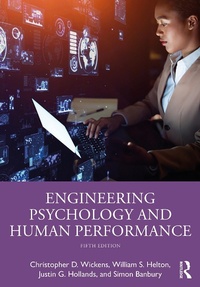
Engineering Psychology and Human Performance
5th Edition
Published on 27. September 2021
596 pages
978-1-000-40135-6 (ISBN)
Description

Forming connections between human performance and design, this new edition of Engineering Psychology and Human Performance examines human-machine interaction. The book is organized directly from a psychological perspective of human information processing, and chapters correspond to the flow of information as it is processed by a human being-from the senses, through the brain, to action-rather than from the perspective of system components or engineering design concepts. Upon completing this book, readers will be able to identify how human ability contributes to the design of technology; understand the connections within human information processing and human performance; challenge the way they think about technology's influence on human performance; and show how theoretical advances have been, or might be, applied to improving human-machine interactions.
This new edition includes the following key features:
A new chapter on research methods
Sections on interruption management and distracted driving as cogent examples of applications of engineering psychology theory to societal problems
A greatly increased number of references to pandemics, technostress, and misinformation
New applications
Amplified emphasis on readability and commonsense examples
Updated and new references throughout the text
This book is ideal for psychology and engineering students, as well as practitioners in engineering psychology, human performance, and human factors. The text is also supplemented by online resources for students and instructors.
This new edition includes the following key features:
A new chapter on research methods
Sections on interruption management and distracted driving as cogent examples of applications of engineering psychology theory to societal problems
A greatly increased number of references to pandemics, technostress, and misinformation
New applications
Amplified emphasis on readability and commonsense examples
Updated and new references throughout the text
This book is ideal for psychology and engineering students, as well as practitioners in engineering psychology, human performance, and human factors. The text is also supplemented by online resources for students and instructors.
Reviews / Votes
"I have always been a fan of this book since its first edition. It has accompanied my whole academic life since then. The current 5th edition is another update with many new data and insights. It continues to be the best introduction to Engineering Psychology I am aware of." -Prof. Dr. Dietrich Manzey, Technical University Berlin, Germany "I have always been a fan of this book since its first edition. It has accompanied my whole academic life since then. The current 5th edition is another update with many new data and insights. It continues to be the best introduction to Engineering Psychology I am aware of." -Prof. Dr. Dietrich Manzey, Technical University Berlin, GermanyMore details
Edition
5th edition
Language
English
Place of publication
London
United Kingdom
Publishing group
Taylor & Francis Ltd
Target group
College/higher education
Product notice
Reflowable
Illustrations
8 Tables, black and white; 123 Line drawings, black and white; 10 Halftones, black and white; 133 Illustrations, black and white
ISBN-13
978-1-000-40135-6 (9781000401356)
Copyright in bibliographic data and cover images is held by Nielsen Book Services Limited or by the publishers or by their respective licensors: all rights reserved.
Schweitzer Classification
Other editions
Additional editions
Christopher D. Wickens | William S. Helton | Justin G. Hollands
Engineering Psychology and Human Performance
Book
09/2021
5th Edition
Routledge
€261.10
Shipment within 10-20 days
Christopher D. Wickens
Engineering Psychology and Human Performance
Book
08/2021
Routledge
Unfortunately, price unknown
Available (delivery time upon request)
Persons
Christopher D. Wickens is Professor Emeritus of Psychology from the University of Illinois, Department of Psychology; Adjunct Professor, Colorado State University, Department of Psychology; and Senior Scientist, Alon Science and Technology, Boulder, Colorado. He has won teaching awards including the Psi-Chi award and the Paul M Fitts award from the Human Factors & Ergonomics Society.
William "Deak" S. Helton is Professor and Director of Human Factors and Applied Cognition at George Mason University and an Adjunct Professor at the University of Canterbury (New Zealand). He was awarded the Earl Alluisi Award for Early Career Achievement by the American Psychological Association and the Griffith Prize by the southern Society for Philosophy and Psychology.
Justin G. Hollands is a Defense Scientist and Senior Advisor with the Human Systems Integration Section at Defense Research and Development Canada-Toronto. He is also an Adjunct Professor of Mechanical and Industrial Engineering at the University of Toronto.
Simon Banbury is co-founder and President of C3 Human Factors Consulting Inc., an independent Canadian-based human factors consultancy specializing in optimizing how people interact with technology. He received his PhD in Cognitive Psychology from the University of Reading in 1996 and has over 25 years of human factors consultancy and applied research experience in defense, industrial, and academic domains.
William "Deak" S. Helton is Professor and Director of Human Factors and Applied Cognition at George Mason University and an Adjunct Professor at the University of Canterbury (New Zealand). He was awarded the Earl Alluisi Award for Early Career Achievement by the American Psychological Association and the Griffith Prize by the southern Society for Philosophy and Psychology.
Justin G. Hollands is a Defense Scientist and Senior Advisor with the Human Systems Integration Section at Defense Research and Development Canada-Toronto. He is also an Adjunct Professor of Mechanical and Industrial Engineering at the University of Toronto.
Simon Banbury is co-founder and President of C3 Human Factors Consulting Inc., an independent Canadian-based human factors consultancy specializing in optimizing how people interact with technology. He received his PhD in Cognitive Psychology from the University of Reading in 1996 and has over 25 years of human factors consultancy and applied research experience in defense, industrial, and academic domains.
Content
1. Introduction 2. Research Methods 3. Signal Detection and Absolute Judgment 4. Attention in Perception and Display Space 5. Spatial Displays 6. Spatial Cognition, Navigation, and Manual Control 7. Language and Communication 8. Memory and Training 9. Decision Making 10. Selection of Action 11. Multitasking 12. Mental Workload and Stress 13. Human-Automation Interaction
