

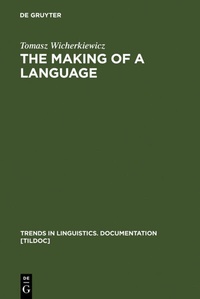
The Making of a Language
The Case of the Idiom of Wilamowice, Southern Poland
1st Edition
Published on 4. August 2011
XI, 539 pages
978-3-11-090540-3 (ISBN)
Description

The book presents unique literature in a minority ethnolect - the Germanic dialect of Wilamowice in Southern Poland. The manuscripts, written in the ethnolect at the beginning of the 20th century, were discovered in 1989. The book contains full versions of several texts of various length written by Florian Biesik, who decided to create a literary standard for Wilamowicean in order to prove its non-German, but possibly Anglo-Saxon, Dutch, Flemish or Frisian origin. Thus it presents both the dialectal literature and the most important elements of the local culture during the final stages of its extinction.
More details
Series
Edition
Reprint 2011
Language
English
Place of publication
Berlin/Boston
Germany
Publishing group
de Gruyter Mouton
Target group
Professional and scholarly
US School Grade: College Graduate Student
Illustrations
4 Abbildungen
4 ill.
File size
12,90 MB
ISBN-13
978-3-11-090540-3 (9783110905403)
Schweitzer Classification
Other editions
Additional editions
Book
02/2003
1st Edition
De Gruyter Mouton
€164.95
Shipment within 7-9 days
Book
01/2003
1st Edition
De Gruyter Mouton
€229.00
Article exhausted; check different version
Person
Tomasz Wicherkiewicz is Associate Professor at The Adam Mickiewicz University in Poznán, Poland.
Content
- Intro
- Acknowledgements
- Abbreviations and symbols
- 1. Preliminaries
- 1.1. General introduction
- 1.2. Methodological remarks
- 2. Wilamowice as a linguistic enclave
- 2.1. The town of Wilamowice
- 2.2. The history of Wilamowice and its ethnolect
- 2.3. Literature on Bielsko-Biala and other Silesian German linguistic enclaves
- 3. Origin of the ethnolect
- 3.1. The Wilamowicean ethnotheory of origin
- 3.2. Translation of Biesik VIII. Wymysau an wymysojer
- 4. Literature in Wilamowicean
- 5. Florian Biesik
- 5.1. Florian Biesik's manuscript
- 5.2. Illustrations
- 5.3. Florian Biesik's introduction to BiesikI. Óf jer welt
- 5.4. Florian Biesik's biography
- 6. Florian Biesik's texts
- Biesik I. Óf jer welt
- Footnotes to BiesikI
- Biesik II. Óm mjer
- Footnotes to BiesikII
- Biesik lll. S'wymysojerysze
- Biesik lV. Dy druzba
- Biesik V. S wymysojer mákia
- Biesik VI. Dy "saison halykja"
- Footnotes to Biesik VI
- Biesik VII. S gre-gre-gregory
- Biesik VIII. Wymysau an Wymysojer
- Biesik lX. Dy nójy póterba?wa kultur
- Footnotes to Biesik lX
- Biesik X. S'wymysojer wunder
- Footnotes to Biesik X
- 7. Orthographic and phonetic issues
- 8. Grammatical issues
- 8.1. Syntax
- 8.2. Morphology
- 8.3. Morphonology
- 9. Lexical semantics
- 9.1. Kinship terms
- 9.2. Family names
- 9.3. Christian names
- 9.4. Nicknames
- 9.5. Toponymics
- 10. Language archaisms and dialectisms
- 11. Ethnolinguistic issues
- 11.1. Folk costumes
- 11.2. Folk culture
- 11.3. Weaving industry and trade
- 11.4. Folk mythology
- 11.5. Local cuisine
- 11.6. Religious life
- 11.7. Polish patriotism, anti-Germanism and anti-Semitism
- Endnotes
- Appendices
- Index of persons referred to in Biesik's poems
- Index of words and forms used in Biesik's poems not recorded in Mojmir's dictionary
- Phonetic transcription (first 36 stanzas of Óf jer well)
- Florian Biesik's texts published by Heinrich Anders (1933)
- References
