

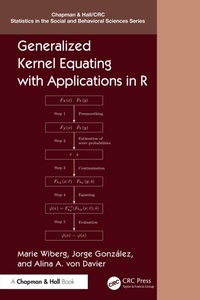
Generalized Kernel Equating with Applications in R
1st Edition
Published on 1. November 2024
272 pages
978-1-315-28376-0 (ISBN)
Description

Generalized Kernel Equating is a comprehensive guide for statisticians, psychometricians, and educational researchers aiming to master test score equating. This book introduces the Generalized Kernel Equating (GKE) framework, providing the necessary tools and methodologies for accurate and fair score comparisons.
The book presents test score equating as a statistical problem and covers all commonly used data collection designs. It details the five steps of the GKE framework: presmoothing, estimating score probabilities, continuization, equating transformation, and evaluating the equating transformation. Various presmoothing strategies are explored, including log-linear models, item response theory models, beta4 models, and discrete kernel estimators. The estimation of score probabilities when using IRT models is described and Gaussian kernel continuization is extended to other kernels such as uniform, logistic, epanechnikov and adaptive kernels. Several bandwidth selection methods are described. The kernel equating transformation and variants of it are defined, and both equating-specific and statistical measures for evaluating equating transformations are included. Real data examples, guiding readers through the GKE steps with detailed R code and explanations are provided. Readers are equipped with an advanced knowledge and practical skills for implementing test score equating methods.
The book presents test score equating as a statistical problem and covers all commonly used data collection designs. It details the five steps of the GKE framework: presmoothing, estimating score probabilities, continuization, equating transformation, and evaluating the equating transformation. Various presmoothing strategies are explored, including log-linear models, item response theory models, beta4 models, and discrete kernel estimators. The estimation of score probabilities when using IRT models is described and Gaussian kernel continuization is extended to other kernels such as uniform, logistic, epanechnikov and adaptive kernels. Several bandwidth selection methods are described. The kernel equating transformation and variants of it are defined, and both equating-specific and statistical measures for evaluating equating transformations are included. Real data examples, guiding readers through the GKE steps with detailed R code and explanations are provided. Readers are equipped with an advanced knowledge and practical skills for implementing test score equating methods.
More details
Series
Edition
1. Auflage
Language
English
Place of publication
London
United Kingdom
Publishing group
Taylor & Francis Ltd
Target group
Professional and scholarly
Illustrations
9 Tables, black and white; 9 Line drawings, color; 25 Line drawings, black and white; 9 Illustrations, color; 25 Illustrations, black and white
ISBN-13
978-1-315-28376-0 (9781315283760)
Copyright in bibliographic data and cover images is held by Nielsen Book Services Limited or by the publishers or by their respective licensors: all rights reserved.
Schweitzer Classification
Other editions
Additional editions
Marie Wiberg | Jorge Gonzalez | Alina A. Von Davier
Generalized Kernel Equating with Applications in R
Book
11/2024
1st Edition
CRC Press
€132.60
Shipment within 10-20 days

Marie Wiberg | Jorge Gonzalez | Alina A. Von Davier
Generalized Kernel Equating with Applications in R
Book
11/2024
CRC Press
Unfortunately, price unknown
Available (delivery time upon request)
Persons
Marie Wiberg is professor in Statistics with specialty in psychometrics at Umea University in Sweden. She is the author of more than 60 peer-review research papers and have edited nine books. Her research interests include test equating, large-scale assessments, parametric and nonparametric item response theory and educational measurement and psychometrics in general.
Jorge Gonzalez is associate professor at the Faculty of Mathematics, Pontificia Universidad Catolica de Chile. He is author of a book and several publications on test equating. His research is focused on statistical modeling of data arising from the social sciences, particularly on the fields of test theory, educational measurement, and psychometrics.
Alina A. von Davier is the chief of assessment at Duolingo, and the Founder of EdAstra Tech. She has received several awards, including the ATP's Career Award, the AERA for signification contribution to educational measurement and research methodology award, and the NCME annual award for scientific contributions. Her research is in the field of computational psychometrics, machine learning, assessment, and education.
Jorge Gonzalez is associate professor at the Faculty of Mathematics, Pontificia Universidad Catolica de Chile. He is author of a book and several publications on test equating. His research is focused on statistical modeling of data arising from the social sciences, particularly on the fields of test theory, educational measurement, and psychometrics.
Alina A. von Davier is the chief of assessment at Duolingo, and the Founder of EdAstra Tech. She has received several awards, including the ATP's Career Award, the AERA for signification contribution to educational measurement and research methodology award, and the NCME annual award for scientific contributions. Her research is in the field of computational psychometrics, machine learning, assessment, and education.
Content
Foreword Preface Part 1: Test Equating and Kernel Equating Overview 1 Introduction 2 Kernel Equating Part 2: Generalized Kernel Equating Framework 3 Presmoothing 4 Estimating Score Probabilities 5 Continuization 6 Bandwidth Selection 7 Equating 8 Evaluating the Equating Transformation Part 3: Applications 9 Examples under the EG design 10 Examples under the NEAT design Part 4: Appendix A Installing R and Reading in Data B R packages for GKE Bibliography
