

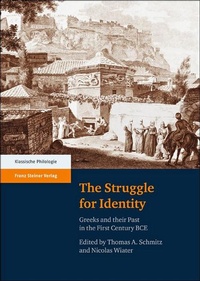
The Struggle for Identity
Description

In the first century BCE, Greek intellectuals had to come to terms with the stability of Roman power. Many of them were active in Rome, which became the cultural centre of the Greek world; others were connected with Roman patrons. Their work became important for the emergence of Greek identity in the Roman Empire.
Bringing together an international group of leading Classical scholars, this volume represents the first attempt at a comprehensive study of Greek cultural identity in the first century: how did the Romans influence the Greeks' view(s) of themselves and of their classical heritage? How did the Greeks interpret the Romans and their role in the world? Covering such different genres as historiography, literary criticism, the novel, and epigram, as well as archaeological material, the contributions explore the intellectual diversity of one of the most significant periods in history and situate the authors active under Augustus within their broader intellectual-historical context.
More details
Other editions
Additional editions
Persons
Content
- Intro
- Contents
- Acknowledgments
- List of Contributors
- List of Illustrations
- Introduction: Approaching Greek Identity
- Greek Classicism
- Writing Roman History - Shaping Greek Identity: The Ideology of Historiography in Dionysius of Halicarnassus
- The Style of the Past: Dionysius of Halicarnassus in Context
- Impacts of Writing in Rome: Greek Authors and Their Roman Environment in the First Century
- Latin, Attic, and other Greek Dialects: Criteria of ??????sµ??in Grammatical Treatises of the First Century
- Augustus chlamydatus. Greek Identity and the bios Kaisaros by Nicolaus of Damascus
- Principate and System
- Men from Mytilene
- Greek Poets and Roman Patrons in the Late Republic and Early Empire
- Who Cared about Greek Identity? Athens in the First Century
- The Image of Athens in Diodorus Siculus
- Paideia and the Function of Homeric Quotations in Chariton's Callirhoe
- Bibliography
- Index
- Passages Discussed
