

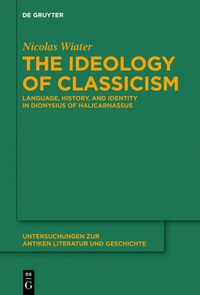
The Ideology of Classicism
Description

So far, the critical writings of Dionysius of Halicarnassus have mainly attracted interest from historians of ancient linguistics. The Ideology of Classicism proposes a novel approach to Dionysius' ouvre as a whole by providing the first systematic study of Greek classicism from the perspective of cultural identity. Drawing on cultural anthropology and Social Identity Theory, Wiater explores the world-view bound up with classicist criticism. Only from within this ideological framework can we understand why Greek and Roman intellectuals in Augustan Rome strove to speak and write like Demosthenes, Lysias, and Isocrates.
Topics addressed by this study include Dionysius' view of the classical past; mimesis and the aesthetics of reading; language and identity; Dionysius' view of the Romans, their power and the role of Greek culture within it; Greek classicism and the contemporary controversy about
Roman
identity among Roman intellectuals; the self-image as Greek intellectuals in the Roman empire of Dionysius and his addressees; the dialogic design of Dionysius' essays and how it implements a sense of elitism and distinction; Dionysius' attitudes towards communities competing with him for leadership in rhetorical education and criticism, such as the Peripatetics and Stoics.
More details
Other editions
Additional editions
Person
Content
2 - Table of Contents [Seite 10]
3 - 1. Introduction: The Aims and Methods of This Study [Seite 14]
3.1 - 1.1 'Webs of Significance' - A Novel Approach to Dionysius' Classicism [Seite 14]
3.1.1 - 1.1.1 Dionysius' Classicism as a Cultural Phenomenon [Seite 14]
3.1.2 - 1.1.2 Dionysius - an 'Augustan'Author? [Seite 21]
3.1.3 - 1.1.3 A Cultural Identity Approach to Dionysius' Classicism [Seite 31]
3.2 - 1.2 The Conceptual Framework of Dionysius' Classicism [Seite 42]
3.2.1 - 1.2.1 Criticismas a Struggle forAuthority [Seite 45]
3.2.2 - 1.2.2 Dionysius' Critical Method as Heir to the Tradition of Classical Rhetoric [Seite 53]
3.2.3 - 1.2.3 The Power of the Text: Creating a Discursive Tradition [Seite 57]
3.2.4 - 1.2.4 Criticism as Constituent of Communities of Intellectuals [Seite 60]
3.3 - 1.3 Conclusions [Seite 65]
4 - 2. Reviving the Past: Language and Identity in Dionysius' Classicism [Seite 73]
4.1 - 2.1 Introduction: Language and Time in Dionysius' Classicism [Seite 73]
4.2 - FilÏsofoc Rhtorik, Miµhsic, and Continuity [Seite 78]
4.2.1 - 2.2.1 Politiko LÏgoi: Learning Classical Identity from Isocrates [Seite 78]
4.2.2 - 2.2.2 Classicist Self-Fashioning: Re-enacting the Past through Miµmhsic [Seite 90]
4.3 - 2.3 Language and Power: Getting the Romans into the Picture [Seite 105]
4.3.1 - 2.3.1 Greeks, Romans, Barbarians: Dionysius' Interpretation ofAugustanRome [Seite 105]
4.3.2 - 2.3.2 Dionysius' Interpretation of the Roman Present inContext [Seite 113]
4.3.3 - 2.3.3 Greek or Roman? The Ambiguity of Dionysius' View of Augustan Rome [Seite 120]
4.3.4 - 2.3.4 Coda: How Historical is Dionysius' Model of History? [Seite 123]
4.4 - 2.4 Summary [Seite 129]
5 - 3. History and Criticism: The Construction of a Classicist Past [Seite 133]
5.1 - 3.1 'Metahistory' avant la lettre: Dionysius on Historical Writing [Seite 134]
5.2 - 3.2 Deconstructing Thucydides [Seite 143]
5.2.1 - 3.2.1 Identifying with the Past: Why Herodotus Succeeded where Thucydides Failed [Seite 145]
5.2.2 - 3.2.2 Classicist History: Theopompus' 'Isocratean' Approach to the Past [Seite 162]
5.2.3 - 3.2.3 Between History and Criticism: Re-writing the MelianDialogue [Seite 167]
5.3 - 3.3 A Greek Past for the Roman Present: The Project of Dionysius' Antiquitates [Seite 178]
5.3.1 - 3.3.1 The Archaeology of Roman Power [Seite 184]
5.3.2 - 3.3.2 Identity and Difference: Be Roman, Go Greek? [Seite 211]
5.4 - 3.4 Summary [Seite 236]
6 - 4. Knowledge and Elitism: Being a Classicist Critic [Seite 239]
6.1 - 4.1 Reading and Distinction in Dionysius' Classicism [Seite 243]
6.2 - 4.2 'Authentic Reading': Becoming a Classicist Critic [Seite 248]
6.2.1 - 4.2.1 The Failures of Scholarship Past: Redressing the Balance between Theory and Practice [Seite 248]
6.2.2 - 4.2.2 Misreading Tradition: Deconstructing Chrysippus [Seite 252]
6.2.3 - 4.2.3 Refuting the Idea of a 'Natural Word Order' [Seite 256]
6.2.4 - 4.2.4 On Literary Composition : A Normative Aesthetics of Classical Style [Seite 259]
6.2.5 - 4.2.5 Dionysius' Writings: A Classical Course of Education [Seite 270]
6.3 - 4.3 The Mysteries of Education: Being an Elite Critic [Seite 276]
6.3.1 - 4.3.1 Knowledge and Elitism [Seite 277]
6.3.2 - 4.3.2 The Mysteries of Knowledge [Seite 280]
6.3.3 - 4.3.3 Classical Politicians and Classicist Readers: Knowledge and Leadership [Seite 283]
6.4 - 4.4 Summary [Seite 290]
7 - 5. Enacting Distinction: The Interactive Structure of Dionysius' Writings [Seite 292]
7.1 - 5.1 Criticism as Dialogic Interaction: Creating an 'Imagined Community' of Classicists [Seite 294]
7.2 - 5.2 Strategies ofDistinction:Out-Group Reading [Seite 310]
7.2.1 - 5.2.1 'Objective Critic' vs 'Subjective Critic': The Peripatetic on Trial [Seite 316]
7.2.2 - 5.2.2 The Aesthetics of Criticism: Dionysius vs the Platonists [Seite 323]
7.3 - 5.3 Summary [Seite 361]
8 - 6. Conclusions [Seite 365]
9 - References [Seite 374]
10 - Indices [Seite 400]
10.1 - 1. Key Notions, Persons, Places [Seite 400]
10.2 - 2. Greek Terms [Seite 404]
10.3 - 3. PassagesDiscussed [Seite 405]
