

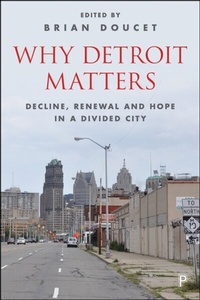
Why Detroit Matters
Decline, Renewal and Hope in a Divided City
Policy Press
1st Edition
Published on 6. April 2017
304 pages
978-1-4473-2789-9 (ISBN)
Description

Detroit has come to symbolise deindustrialization and the challenges, and opportunities, it presents. As many cities struggle with urban decline, racial and ethnic tensions and the consequences of neoliberal governance and political fragmentation, Detroit's relevance grows stronger.
Why Detroit Matters bridges academic and non-academic responses to this extreme example of a fractured and divided, post-industrial city.
Contributions from many of the leading scholars on Detroit are joined by influential writers, planners, artists and activists who have contributed chapters drawing on their experiences and ideas. The book concludes with interviews with some of the city's most important visionaries who are engaged in inspiring practices which provide powerful lessons for Detroit and other cities around the world.
The book will be a valuable reference for scholars, practitioners and students from across disciplines including geography, planning, architecture, sociology, urban studies, history, American studies, and economics.
Why Detroit Matters bridges academic and non-academic responses to this extreme example of a fractured and divided, post-industrial city.
Contributions from many of the leading scholars on Detroit are joined by influential writers, planners, artists and activists who have contributed chapters drawing on their experiences and ideas. The book concludes with interviews with some of the city's most important visionaries who are engaged in inspiring practices which provide powerful lessons for Detroit and other cities around the world.
The book will be a valuable reference for scholars, practitioners and students from across disciplines including geography, planning, architecture, sociology, urban studies, history, American studies, and economics.
Reviews / Votes
"This is a most welcome addition to the growing body of literature that not only is bringing long overdue attention to Detroit but also seeks to provide much needed nuance and complexity to Manichean debates. Doucet challenges readers to dissect the conscious choices that led Detroit into and out of bankruptcy rather than accept what transpired as inevitable." Journal of Urban Affairs "This is an important and unique book in the context of the future of cities globally. In considering Detroit as a symbol of aspects of post-industrial decline and regeneration, it gives voice to a range of normally excluded voices and narratives. It therefore provides a valuably rounded set of perspectives and visions which, together, help the reader to understand the forces that have shaped the city, and wider lessons for creating more inclusive cities." John McCarthy, Associate Professor, School of the Built Environment, Heriot Watt University, UKMore details
Edition
First Edition
Language
English
Place of publication
Bristol
United Kingdom
Publishing group
Bristol University Press
Target group
Professional and scholarly
Illustrations
Not illustrated
ISBN-13
978-1-4473-2789-9 (9781447327899)
DOI
https://doi.org/10.51952/9781447327899
Copyright in bibliographic data and cover images is held by Nielsen Book Services Limited or by the publishers or by their respective licensors: all rights reserved.
Schweitzer Classification
Other editions
Additional editions
Why Detroit Matters
Decline, Renewal and Hope in a Divided City
Book
04/2017
1st Edition
Policy Press
€44.80
Shipment within 15-20 days
Why Detroit Matters
Decline, Renewal and Hope in a Divided City
Book
04/2017
1st Edition
Policy Press
€105.90
Shipment within 15-20 days
Why Detroit Matters
Decline, Renewal and Hope in a Divided City
E-Book
04/2017
1st Edition
Policy Press
€50.99
Available for download
Persons
Brian Doucet is an Associate Professor in the School of Planning at the University of Waterloo, Canada. Originally from Toronto, he lived in the
Netherlands between 2004 and 2017 where he taught Geography at Utrecht University and subsequently Urban Studies at Erasmus University College in Rotterdam. www.briandoucet.com
Netherlands between 2004 and 2017 where he taught Geography at Utrecht University and subsequently Urban Studies at Erasmus University College in Rotterdam. www.briandoucet.com
Content
Introduction: Why Detroit Matters ~ Brian Doucet;
Section I: Lessons from Detroit;
Detroit's Bankruptcy: Treating the symptom, not the cause ~ George Galster;
Detroit in Bankruptcy: What are the Lessons to be Learned? ~ Reynolds Farley ;
Between economic revival and social disruption: The redevelopment of Greater Downtown and the emergence of new socio-spatial Inequalities ~ Rene Kreichauf;
A new urban medicine show: On the limits of blight remediation ~ Joshua Akers;
Reshaping the gray spaces: Resident self-provisioning and urban form in Detroit ~ Kimberley Kinder;
Preserving Detroit by preserving Its baseball history ~ Jason Roche;
This is (not) Detroit: Projecting the future of Germany's Ruhr region ~ Julia Sattler;
Intermezzo I: 'You may not know my Detroit' ~ jessica Care moore;
Section II: Practices from Detroit;
Evolution of municipal government in Detroit ~ John Gallagher;
Detroit's emerging innovation in urban infrastructure: how liabilities become assets for energy, water, industry and informatics ~ Dan Kinkead;
Visions In conflict: A city of possibilities ~ Sharon Howell and Richard Feldman;
Reconstructing Detroit: the resilient city ~ Khalil Ligon;
Reawakening culture among Detroit's resident majority ~ Jessica Brooke Williams;
Make sure you're helping: Experts, solidarity and effective partnering with locals ~ Drew Philp;
New Strategies DMC, takin' it all back home: Lessons from Detroit for arts practices in the Netherlands ~ Friso Wiersum, Bart Witte and Niko Doulos;
Intermezzo II: My Detroit ~ Tyree Guyton;
Section III: Conversations from Detroit;
Lowell Boileau, artist and founder of DetroitYES;
Sandra Hines, Detroit Coalition Against Police Brutality;
Malik Yakini, Detroit Black Community Food Security Network;
Dan Carmody, Eastern Market Corporation;
Jackie Victor, Avalon International Breads;
Phil Cooley, Entrepreneur, owner of Slows Bar-B-Q and Ponyride;
Wayne Curtis and Myrtle Thompson-Curtis, Feedom Freedom Farmers;
Julia Putnam, Amanda Rosman and Marisol Teachworth, The James and Grace Lee Boggs School;
Yusef Shakur, author and neighbourhood organizer;
Grace Lee Boggs, activist;
Conclusion: Detroit and the future of the city ~ Brian Doucet.
Section I: Lessons from Detroit;
Detroit's Bankruptcy: Treating the symptom, not the cause ~ George Galster;
Detroit in Bankruptcy: What are the Lessons to be Learned? ~ Reynolds Farley ;
Between economic revival and social disruption: The redevelopment of Greater Downtown and the emergence of new socio-spatial Inequalities ~ Rene Kreichauf;
A new urban medicine show: On the limits of blight remediation ~ Joshua Akers;
Reshaping the gray spaces: Resident self-provisioning and urban form in Detroit ~ Kimberley Kinder;
Preserving Detroit by preserving Its baseball history ~ Jason Roche;
This is (not) Detroit: Projecting the future of Germany's Ruhr region ~ Julia Sattler;
Intermezzo I: 'You may not know my Detroit' ~ jessica Care moore;
Section II: Practices from Detroit;
Evolution of municipal government in Detroit ~ John Gallagher;
Detroit's emerging innovation in urban infrastructure: how liabilities become assets for energy, water, industry and informatics ~ Dan Kinkead;
Visions In conflict: A city of possibilities ~ Sharon Howell and Richard Feldman;
Reconstructing Detroit: the resilient city ~ Khalil Ligon;
Reawakening culture among Detroit's resident majority ~ Jessica Brooke Williams;
Make sure you're helping: Experts, solidarity and effective partnering with locals ~ Drew Philp;
New Strategies DMC, takin' it all back home: Lessons from Detroit for arts practices in the Netherlands ~ Friso Wiersum, Bart Witte and Niko Doulos;
Intermezzo II: My Detroit ~ Tyree Guyton;
Section III: Conversations from Detroit;
Lowell Boileau, artist and founder of DetroitYES;
Sandra Hines, Detroit Coalition Against Police Brutality;
Malik Yakini, Detroit Black Community Food Security Network;
Dan Carmody, Eastern Market Corporation;
Jackie Victor, Avalon International Breads;
Phil Cooley, Entrepreneur, owner of Slows Bar-B-Q and Ponyride;
Wayne Curtis and Myrtle Thompson-Curtis, Feedom Freedom Farmers;
Julia Putnam, Amanda Rosman and Marisol Teachworth, The James and Grace Lee Boggs School;
Yusef Shakur, author and neighbourhood organizer;
Grace Lee Boggs, activist;
Conclusion: Detroit and the future of the city ~ Brian Doucet.
