

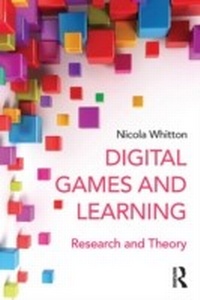
Digital Games and Learning
Research and Theory
1st Edition
Published on 26. March 2014
225 pages
978-1-136-21643-5 (ISBN)
Description

In recent years, there has been growing interest in the use of digital games to enhance teaching and learning at all educational levels, from early years through to lifelong learning, in formal and informal settings. The study of games and learning, however, takes a broader view of the relationship between games and learning, and has a diverse multi-disciplinary background.
Digital Games and Learning: Research and Theory provides a clear and concise critical theoretical overview of the field of digital games and learning from a cross-disciplinary perspective. Taking into account research and theory from areas as varied as computer science, psychology, education, neuroscience, and game design, this book aims to synthesise work that is relevant to the study of games and learning. It focuses on four aspects of digital games: games as active learning environments, games as motivational tools, games as playgrounds, and games as learning technologies, and explores each of these areas in detail.
This book is an essential guide for researchers, designers, teachers, practitioners, and policy makers who want to better understand the relationship between games and learning.
Digital Games and Learning: Research and Theory provides a clear and concise critical theoretical overview of the field of digital games and learning from a cross-disciplinary perspective. Taking into account research and theory from areas as varied as computer science, psychology, education, neuroscience, and game design, this book aims to synthesise work that is relevant to the study of games and learning. It focuses on four aspects of digital games: games as active learning environments, games as motivational tools, games as playgrounds, and games as learning technologies, and explores each of these areas in detail.
This book is an essential guide for researchers, designers, teachers, practitioners, and policy makers who want to better understand the relationship between games and learning.
Reviews / Votes
"The literature on games has become a dense and confusing growth. Nicola Whitton's Digital Games and Learning finally gives a lucid and illuminating guide to both the forest and the trees. For anyone interested in games and learning this is the best 'strategy guide' available today."--James Paul Gee, Mary Lou Fulton Presidential Professor of Literacy Studies, Arizona State University
"Finally! A book that builds robust bridges from learning research to practical game design and back again! Whitton's Digital Games and Learning boldly presents the core mechanisms of both learning and games, and from there builds up solid frameworks that can be used in a variety of contexts. This book is a tremendous boon to anyone who is designing or analyzing games for learning."
--Jesse Schell, CEO of Schell Games and Distinguished Professor of Entertainment Technology at Carnegie Mellon University
More details
Series
Language
English
Place of publication
London
United Kingdom
Publishing group
Taylor & Francis Ltd
Target group
College/higher education
Product notice
Reflowable
Illustrations
24 s/w Tabellen
24 Tables, black and white
File size
1,13 MB
ISBN-13
978-1-136-21643-5 (9781136216435)
Copyright in bibliographic data and cover images is held by Nielsen Book Services Limited or by the publishers or by their respective licensors: all rights reserved.
Schweitzer Classification
Other editions
Additional editions
Book
04/2014
1st Edition
Routledge
€231.60
Shipment within 15-20 days
Book
03/2014
1st Edition
Routledge
€74.30
Shipment within 15-20 days
Person
Nicola Whitton works as a Senior Research Fellow at Manchester Metropolitan University. She holds a doctorate in the use of educational games for learning and her research focuses on the relationship between games, play and learning. More broadly, her research interests encompass learning and teaching innovation and the use of rich media and technology for learning.
Content
Part 1: Introduction
Chapter 1
Overview
Chapter 2
Evaluating digital games for learning
Part 2: Games as active learning environments
Chapter 3
Games as meaningful challenges
Chapter 4
Games as authentic contexts
Chapter 5
Games as social interactions
Part 3: Games as motivational tools
Chapter 6
Games as engaging events
Chapter 7
Games as designed enjoyment
Chapter 8
Games as reward mechanisms
Part 4: Games as playgrounds
Chapter 9
Games as protected play
Chapter 10
Games as experimental spaces
Chapter 11
Games as other worlds
Part 5: Games as learning technologies
Chapter 12
Games as interactive systems
Chapter 13
Games as digital habitats
Chapter 14
Games as multi-sensory experiences
Part 6: Conclusion
Chapter 15
The future of games and learning
Chapter 1
Overview
Chapter 2
Evaluating digital games for learning
Part 2: Games as active learning environments
Chapter 3
Games as meaningful challenges
Chapter 4
Games as authentic contexts
Chapter 5
Games as social interactions
Part 3: Games as motivational tools
Chapter 6
Games as engaging events
Chapter 7
Games as designed enjoyment
Chapter 8
Games as reward mechanisms
Part 4: Games as playgrounds
Chapter 9
Games as protected play
Chapter 10
Games as experimental spaces
Chapter 11
Games as other worlds
Part 5: Games as learning technologies
Chapter 12
Games as interactive systems
Chapter 13
Games as digital habitats
Chapter 14
Games as multi-sensory experiences
Part 6: Conclusion
Chapter 15
The future of games and learning
