

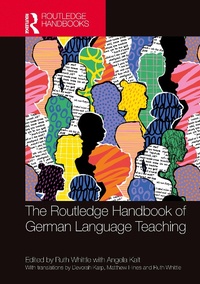
The Routledge Handbook of German Language Teaching
1st Edition
Published on 16. September 2024
354 pages
978-1-040-11444-5 (ISBN)
Description

The Routledge Handbook of German Language Teaching evaluates and addresses multifaceted, multilevel needs of students and teachers within teaching German as a foreign, as well as a second, language through taking a transcultural approach.
Each contribution starts with the author situating themselves in the geographical and institutional context in which they teach as well as the way in which they teach, for example, in person or online. This acknowledges the Handbook's internationally widespread contributors, from countries with different histories in terms of cultural, linguistic and educational diversity more generally and the teaching of German in particular. The chapters reflect their voices and consider language learners as people who have their own identities.
Material such as plays, poems, short literary texts, rap, singing and drawing are discussed in this book as being influential for language learners from beginner level and beyond. This book proposes that 'learning' happens by both the teachers and the learners going on a journey and both changing the outlook on each other and themselves along that journey. Alongside this, questions are asked with respect to curricula and the relation between speaking German and 'belonging' in a German-speaking country.
This Handbook will primarily appeal to teachers and instructors of German, as well as those training to become German language instructors. Moreover, the book will appeal to researchers interested in the linguistic and theoretical aspects of German language teaching.
Each contribution starts with the author situating themselves in the geographical and institutional context in which they teach as well as the way in which they teach, for example, in person or online. This acknowledges the Handbook's internationally widespread contributors, from countries with different histories in terms of cultural, linguistic and educational diversity more generally and the teaching of German in particular. The chapters reflect their voices and consider language learners as people who have their own identities.
Material such as plays, poems, short literary texts, rap, singing and drawing are discussed in this book as being influential for language learners from beginner level and beyond. This book proposes that 'learning' happens by both the teachers and the learners going on a journey and both changing the outlook on each other and themselves along that journey. Alongside this, questions are asked with respect to curricula and the relation between speaking German and 'belonging' in a German-speaking country.
This Handbook will primarily appeal to teachers and instructors of German, as well as those training to become German language instructors. Moreover, the book will appeal to researchers interested in the linguistic and theoretical aspects of German language teaching.
More details
Edition
1. Auflage
Language
English
Place of publication
London
United Kingdom
Publishing group
Taylor & Francis Ltd
Target group
College/higher education
Professional and scholarly
Illustrations
21 Tables, black and white; 12 Line drawings, black and white; 9 Halftones, black and white; 21 Illustrations, black and white
ISBN-13
978-1-040-11444-5 (9781040114445)
Copyright in bibliographic data and cover images is held by Nielsen Book Services Limited or by the publishers or by their respective licensors: all rights reserved.
Schweitzer Classification
Other editions
Additional editions
Ruth Whittle
The Routledge Handbook of German Language Teaching
Book
approx. 07/2026
1st Edition
Routledge
€63.50
Not yet published

Ruth Whittle
The Routledge Handbook of German Language Teaching
Book
10/2024
Routledge
Unfortunately, price unknown
Available (delivery time upon request)
Ruth Whittle
The Routledge Handbook of German Language Teaching
Book
09/2024
1st Edition
Routledge
€333.80
Shipment within 15-20 days
Person
Ruth Whittle is Associate Professor at the Department of Modern Languages, University of Birmingham, UK.
Angela Kalt was a lecturer in Anglistik and Amerikanistik at the Katholische Universitaet Eichstaett-Ingolstadt, Germany.
Angela Kalt was a lecturer in Anglistik and Amerikanistik at the Katholische Universitaet Eichstaett-Ingolstadt, Germany.
Content
List of Contributors
Preface
Part I: Overview
1. Contexts of Teaching German
2. Linguistic and Cultural Competency in Context
3. Communicating Across a Transcultural World: The Place(s) of Critical Terminology
4. The Question of Linguistic Identity in India
Part II: Opening the German-Language World to the Learner Through Working With Literature and Theatre
5. Interculturality and Mediation: Literature as an Object of Learning in DaF/DaZ
6. Language-Sensitive Literature Teaching
7. Intercultural Literature in Germany Since the 1960s from a DaF Perspective
8. Multilingual Theatre in the German Language and Culture Class: Inviting Larners to Eplore Fuid Identities
Part III: Opening the German-Language World to the Learner Through Working With Film and Song
9. Language Learning Through Music in a Super-Diverse Culture
10. The Role of Short Films in Cultural Studies in Teaching German as a Foreign Language (DaF)
Part IV: A Critical Evaluation of Language Learning - Some Teachers' Perspectives
11. Distance not Distant: Enriched, Enlivened Online Learning
12. A Critical Evaluation of the Digital Media Revolution in 2020/21
13. Inside the Classroom: Translating From and Into German
14. Developing Communication Skills Through Collaborative Learning in the German Language Classroom
15. A Voice and a Choice - Introducing Portfolio Assessment to German Courses at an Australian university
Part V: Difficult Histories in the German-Language Classroom
16. Exploring the Transnational in Teaching on the GDR in UK Higher Education
17. Teaching Germany's 1968: New Questions and Directions
Part VI: Teaching, Learning and Evaluation in the Transcultural Classroom
18. The Changing Space of Germany in Turkey
based on an interview with Kerstin Reichardt, conducted by Silke Henkele:
19. What Integration? Refugees and Their Teachers Battle with 'Integration'
based on an interview with Christiane Roesinger conducted by Silke Henkele, and with Claudia Huebner-Pitsela
20. Learning German as a Migrant in Austria: A Discussion of the Gap Between Research and Practice
21. Bridging the Gap: Fusing Language and Content Whilst Addressing Atudent Heterogeneity in Erasmus Courses at Potsdam University
22. The 'Native Speaker' Teacher: A Languages Professional in a Transcultural World
Index
Preface
Part I: Overview
1. Contexts of Teaching German
2. Linguistic and Cultural Competency in Context
3. Communicating Across a Transcultural World: The Place(s) of Critical Terminology
4. The Question of Linguistic Identity in India
Part II: Opening the German-Language World to the Learner Through Working With Literature and Theatre
5. Interculturality and Mediation: Literature as an Object of Learning in DaF/DaZ
6. Language-Sensitive Literature Teaching
7. Intercultural Literature in Germany Since the 1960s from a DaF Perspective
8. Multilingual Theatre in the German Language and Culture Class: Inviting Larners to Eplore Fuid Identities
Part III: Opening the German-Language World to the Learner Through Working With Film and Song
9. Language Learning Through Music in a Super-Diverse Culture
10. The Role of Short Films in Cultural Studies in Teaching German as a Foreign Language (DaF)
Part IV: A Critical Evaluation of Language Learning - Some Teachers' Perspectives
11. Distance not Distant: Enriched, Enlivened Online Learning
12. A Critical Evaluation of the Digital Media Revolution in 2020/21
13. Inside the Classroom: Translating From and Into German
14. Developing Communication Skills Through Collaborative Learning in the German Language Classroom
15. A Voice and a Choice - Introducing Portfolio Assessment to German Courses at an Australian university
Part V: Difficult Histories in the German-Language Classroom
16. Exploring the Transnational in Teaching on the GDR in UK Higher Education
17. Teaching Germany's 1968: New Questions and Directions
Part VI: Teaching, Learning and Evaluation in the Transcultural Classroom
18. The Changing Space of Germany in Turkey
based on an interview with Kerstin Reichardt, conducted by Silke Henkele:
19. What Integration? Refugees and Their Teachers Battle with 'Integration'
based on an interview with Christiane Roesinger conducted by Silke Henkele, and with Claudia Huebner-Pitsela
20. Learning German as a Migrant in Austria: A Discussion of the Gap Between Research and Practice
21. Bridging the Gap: Fusing Language and Content Whilst Addressing Atudent Heterogeneity in Erasmus Courses at Potsdam University
22. The 'Native Speaker' Teacher: A Languages Professional in a Transcultural World
Index
