

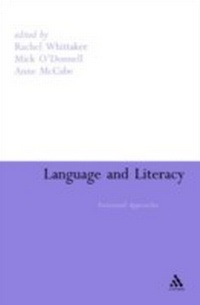
Language and Literacy
Functional Approaches
1st Edition
Published on 8. December 2006
304 pages
978-1-4411-1994-0 (ISBN)
Description

This volume examines the relationship between language and literacy from a systemic functional perspective. The book starts with a retrospective view on the development of language education practices, written by eminent linguistics Michael Halliday and Ruqaiya Hasan, and then shows how this approach is implemented today. The second section presents a detailed analysis of how considerations of literacy education are approached in educational systems around the world. The contributors examine issues such as metadiscourse, genre, cultural politics, and how systemic functional grammar can help to raise literacy standards. The final section looks at literacy in more specific disciplines, including history, literature, science and student writing.
The essays collected here present a comprehensive analysis of language and literacy from a systemic functional perspective, written by academics at the forefront of the field. It will be of interest to researchers in systemic functional linguistics, or language and education.
The essays collected here present a comprehensive analysis of language and literacy from a systemic functional perspective, written by academics at the forefront of the field. It will be of interest to researchers in systemic functional linguistics, or language and education.
Reviews / Votes
mention- Book News Inc./ August 2007 "In the United States, where so-called balanced literary is often discussed and promoted an articulation of the language-centered, SFL-inspired approach to literacy education seems timely. This work chronicles how the SFL movement has situated itself in the middle ground between authoritarian instruction (e.g., phonics) and progressive instruction (e.g., whole language). Instructors working in the SFL tradition maintain simultaneous perspectives on language as structure and language as social action, and the examples in this book illustrate, with detail and specificity, just exactly how these perspectives are realized in day-to-day, genre-based instruction. In describing these practices, this book provides its readers with one method for working toward balanced literacy in the classroom. Language and literacy graduate students, language teachers, and those interested in international trends in language and literacy are likely to find this work useful and informative." -Mary M. Juzwik and Anne Heintz, Studies in Second Language Acquisition, December 2008More details
Edition
1. Auflage
Language
English
Place of publication
New York
United States
Target group
Professional and scholarly
ISBN-13
978-1-4411-1994-0 (9781441119940)
Copyright in bibliographic data and cover images is held by Nielsen Book Services Limited or by the publishers or by their respective licensors: all rights reserved.
Schweitzer Classification
Other editions
Additional editions
Book
12/2008
Continuum International Publishing Group Ltd.
€71.98
Article exhausted; check different version
Persons
Rachel Whittaker is Lecturer in the Department of English at the Universidad Autonoma de Madrid, Spain. Anne McCabe is a full-time professor in the Department of English and Communication, Saint Louis University, Madrid Campus. Mick O'Donnell is Lecturer in the Department of Informatics at the Universidad Autonoma de Madrid, Spain.
Content
Introduction
Part I: Development of the SFL Literacy Approach
1. Retrospective on literacy, Michael Halliday (University of Sydney, Australia) and Ruqaiya Hasan
2. Literacy and current debates over reading, Frances Christie (University of Sydney, Australia)
3. The 'Write it Right' project, Robert Veel (University of Sydney, Australia)
Part II: Approaches to literacy in educational systems around the world
4. Metadiscourse: meaning, consciousness and literacy learning, J.R. Martin (University of Sydney, Australia)
5. Towards a pedagogical grammar, John Polias (Lexis Education, Australia) and Brian Dare (Lexis Education, Australia)
6. Whole school genre maps, Bronwyn Custance
7. The impact of genre theory and pedagogy and systemic functional linguistics on National Literacy Strategies in the UK, Paddy Walsh
8. Language, literacy and cultural politics: the debate on the new language curriculum in Portugal, Carlos A. M. Gouveia (University of Lisbon, Portugal)
9. Implementing the genre approach in a South African school, Carol Thomson (University of KwaZulu-Natal, Australia) and Mike Hart (University of KwaZulu-Natal, Australia)
III: Literacy across specific disciplines
10. Reconstruing 'personal time' as 'collective time': learning the discourse of history, Caroline Coffin (The Open University, UK)
11. Exploring a novel through engagement with its grammatical form, Lorraine McDonald (Australian Catholic University, Australia)
12. Guiding senior secondary schools towards writing academically-valued responses to poetry, Susan Marshall
13. Emergent disciplinary: a comparative study of Theme in undergraduate essays in geography and history of science, Ann Hewings (The Open University, UK) and Sarah North (The Open University, UK)
Part I: Development of the SFL Literacy Approach
1. Retrospective on literacy, Michael Halliday (University of Sydney, Australia) and Ruqaiya Hasan
2. Literacy and current debates over reading, Frances Christie (University of Sydney, Australia)
3. The 'Write it Right' project, Robert Veel (University of Sydney, Australia)
Part II: Approaches to literacy in educational systems around the world
4. Metadiscourse: meaning, consciousness and literacy learning, J.R. Martin (University of Sydney, Australia)
5. Towards a pedagogical grammar, John Polias (Lexis Education, Australia) and Brian Dare (Lexis Education, Australia)
6. Whole school genre maps, Bronwyn Custance
7. The impact of genre theory and pedagogy and systemic functional linguistics on National Literacy Strategies in the UK, Paddy Walsh
8. Language, literacy and cultural politics: the debate on the new language curriculum in Portugal, Carlos A. M. Gouveia (University of Lisbon, Portugal)
9. Implementing the genre approach in a South African school, Carol Thomson (University of KwaZulu-Natal, Australia) and Mike Hart (University of KwaZulu-Natal, Australia)
III: Literacy across specific disciplines
10. Reconstruing 'personal time' as 'collective time': learning the discourse of history, Caroline Coffin (The Open University, UK)
11. Exploring a novel through engagement with its grammatical form, Lorraine McDonald (Australian Catholic University, Australia)
12. Guiding senior secondary schools towards writing academically-valued responses to poetry, Susan Marshall
13. Emergent disciplinary: a comparative study of Theme in undergraduate essays in geography and history of science, Ann Hewings (The Open University, UK) and Sarah North (The Open University, UK)
