

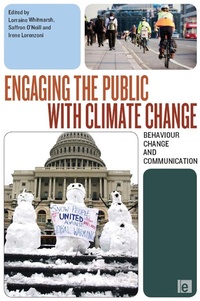
Engaging the Public with Climate Change
Behaviour Change and Communication
1st Edition
Published on 25. June 2012
320 pages
978-1-136-54048-6 (ISBN)
Description

Despite increasing public awareness of climate change, our behaviours relating to consumption and energy use remain largely unchanged. This book answers the urgent call for effective engagement methods to foster sustainable lifestyles, community action, and social change.
Written by practitioners and academics, the chapters combine theoretical perspectives with case studies and practical guidance, examining what works and what doesn't, and providing transferable lessons for future engagement approaches. Showcasing innovative thought and approaches from around the world, this book is essential reading for anyone working to foster real and lasting behavioural and social change.
Written by practitioners and academics, the chapters combine theoretical perspectives with case studies and practical guidance, examining what works and what doesn't, and providing transferable lessons for future engagement approaches. Showcasing innovative thought and approaches from around the world, this book is essential reading for anyone working to foster real and lasting behavioural and social change.
Reviews / Votes
'How do we break out of the hardened habits of mind and practice which prevent us from addressing climate change - and do so soon? This book is an important contribution to help answer this question. It offers many and encouraging, but no quick and easy answers to help create effective ways of engaging people while we still have hope of steering our journey in a desirable direction.'Susanne Moser, Independent Scholar, Susanne Moser Research & Consulting
'This book is not just an excellent synthesis of the latest research - it contains, at all levels, a very welcome exchange of experience between the leading academics, communications specialists and community practitioners. I cannot think of anyone involved in public engagement who would not benefit from reading it.'
George Marshall, Founder, Climate Outreach and Information Network
'This book successfully addresses many of the complex cultural and behavioural issues tied up with responding to climate change. It provides practical guides to motivating public engagement, as well as discussing many of the barriers. It is a 'must read' for everyone, from climate scientists to policy advisers.'
Professor David Karoly, University of Melbourne, Australia
'By offering a powerful combination of theoretical and practical case studies, Engaging the Public with Climate Change helps professionals and students alike to recognise climate change communication which empowers behaviour change rather than preaches it.'
Mike Hulme, Professor of Climate Change, University of East Anglia
More details
Language
English
Place of publication
London
United Kingdom
Publishing group
Taylor & Francis Ltd
Target group
College/higher education
File size
4,59 MB
ISBN-13
978-1-136-54048-6 (9781136540486)
Copyright in bibliographic data and cover images is held by Nielsen Book Services Limited or by the publishers or by their respective licensors: all rights reserved.
Schweitzer Classification
Other editions
Additional editions
Lorraine Whitmarsh | Saffron O'Neill | Irene Lorenzoni
Engaging the Public with Climate Change
Behaviour Change and Communication
Book
05/2015
1st Edition
Routledge
€80.65
Shipment within 10-20 days
Lorraine Whitmarsh | Saffron O'Neill | Irene Lorenzoni
Engaging the Public with Climate Change
Behaviour Change and Communication
Book
11/2010
1st Edition
Earthscan Ltd
€206.90
Shipment within 3-4 weeks
Persons
Dr. Lorraine Whitmarsh is a Lecturer in Environmental Psychology at the University of Cardiff, UK.
Dr. Saffron O'Neill is a Research Fellow in Climate Adaptation at the University of Melbourne, Australia.
Dr. Irene Lorenzoni is a Lecturer in Environmental Politics and Governance at the University of East Anglia, UK.
All three editors are affiliated to the Tyndall Centre for Climate Change Research, University of East Anglia.
Dr. Saffron O'Neill is a Research Fellow in Climate Adaptation at the University of Melbourne, Australia.
Dr. Irene Lorenzoni is a Lecturer in Environmental Politics and Governance at the University of East Anglia, UK.
All three editors are affiliated to the Tyndall Centre for Climate Change Research, University of East Anglia.
Content
Foreword
Susanne Moser, Independent Scholar, Susanne Moser Research & Consulting
Introduction: Opportunities and Barriers to Engaging Individuals with Climate Change
Part 1: Theories and Models.
1. Old habits and New Routes to Sustainable Behaviour
2. Carbon Budgets and Carbon Capability: Lessons from Personal Carbon Trading
3. Public Engagement in Climate Action: Policy and Public Expectations
4. Collective Self and Individual Choice: The Role of Social Comparisons in Promoting Public Engagement with Climate Change
5. Dismantling the Consumption-Happiness Myth: A Neuropsychological Perspective on the Mechanisms that Lock us in to Unsustainable Consumption
6. Public Engagement with Climate Adaptation: An Imperative for (and Driver Of) Institutional Reform?
7. Ecological Citizenship as Public Engagement
Part 2: Methods, Media and Tools
8. Engaging People in Saving Energy on a Large Scale: Lessons from the Programmes of the Energy Saving Trust in the UK
9. Keeping Up with the Joneses in the Great British Refurb: The Impacts and Limits of Social Learning in Eco-Renovation
10. Up-Scaling Social Behaviour Change Programmes: The Case of Ecoteams
11. The Role and Effectiveness of Governmental and Non-Governmental Communications in Engaging the Public with Climate Change
12. Communicating Energy Demand: Measurement, Display and the Language of Things
13. The Role of New Media in Engaging the Public with Climate Change
14. Low Carbon Communities: A Grassroots Perspective on Public Engagement
Conclusion: What have we Learnt and where do we go from Here?
Susanne Moser, Independent Scholar, Susanne Moser Research & Consulting
Introduction: Opportunities and Barriers to Engaging Individuals with Climate Change
Part 1: Theories and Models.
1. Old habits and New Routes to Sustainable Behaviour
2. Carbon Budgets and Carbon Capability: Lessons from Personal Carbon Trading
3. Public Engagement in Climate Action: Policy and Public Expectations
4. Collective Self and Individual Choice: The Role of Social Comparisons in Promoting Public Engagement with Climate Change
5. Dismantling the Consumption-Happiness Myth: A Neuropsychological Perspective on the Mechanisms that Lock us in to Unsustainable Consumption
6. Public Engagement with Climate Adaptation: An Imperative for (and Driver Of) Institutional Reform?
7. Ecological Citizenship as Public Engagement
Part 2: Methods, Media and Tools
8. Engaging People in Saving Energy on a Large Scale: Lessons from the Programmes of the Energy Saving Trust in the UK
9. Keeping Up with the Joneses in the Great British Refurb: The Impacts and Limits of Social Learning in Eco-Renovation
10. Up-Scaling Social Behaviour Change Programmes: The Case of Ecoteams
11. The Role and Effectiveness of Governmental and Non-Governmental Communications in Engaging the Public with Climate Change
12. Communicating Energy Demand: Measurement, Display and the Language of Things
13. The Role of New Media in Engaging the Public with Climate Change
14. Low Carbon Communities: A Grassroots Perspective on Public Engagement
Conclusion: What have we Learnt and where do we go from Here?
