

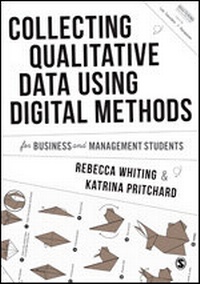
Collecting Qualitative Data Using Digital Methods
1st Edition
Published on 4. November 2020
128 pages
978-1-5297-3654-0 (ISBN)
Description

Part of SAGE's Mastering Business Research Methods Series, conceived and edited by Bill Lee, Mark N. K. Saunders and Vadake K. Narayanan and designed to support researchers by providing in-depth and practical guidance on using a chosen method of data collection or analysis.
In Collecting Qualitative Data Using Digital Methods, Rebecca Whiting and Katrina Pritchard provide a concise and accessible guide to a digital data collection method, comprised of tracking and trawling that can be used to collect qualitative data in the fields of business, management and organizational research.
With practical guidance and insight into how to use this approach in your own research, this book provides invaluable support to Business and Management masters students who choose to work with secondary data when completing their dissertations.
In Collecting Qualitative Data Using Digital Methods, Rebecca Whiting and Katrina Pritchard provide a concise and accessible guide to a digital data collection method, comprised of tracking and trawling that can be used to collect qualitative data in the fields of business, management and organizational research.
With practical guidance and insight into how to use this approach in your own research, this book provides invaluable support to Business and Management masters students who choose to work with secondary data when completing their dissertations.
Reviews / Votes
Approaches to using internet data in management research usually focus on large quantitative datasets. Here, Whiting and Pritchard outline a long overdue, innovative, qualitative approach to gaining research insights from on-line material. As part of the SAGE Mastering Business Research Methods series, the authors' tracking and trawling method will prove revolutionary for Masters students. However, management scholars in general will also deeply appreciate this little gem of a book as not just presenting a novel on-line method but also an invaluable source of advice on addressing challenges like ethical and copyright issues in this rapidly growing area of research. -- Gillian Symon This book offers an engaging and accessible introduction to qualitative research methods built on tracking and trawling through the wealth of material available online. Whiting and Pritchard offer a nuanced overview of the varieties of online data and the different tools available for locating material to use in our research projects. They combine practical tips with a reflexive sensitivity to the meaning of data and the emergent design of research projects. This book is a highly valuable qualitative researcher's travel guide to the Internet with helpful advice for both newer and more experienced researchers. -- Christine Hine The Internet contains rich qualitative material, yet until now we have lacked a systematic guide to help students design and execute digital studies. Carefully delineating digital research from doing a literature review, the book helps students on every step of their research journey in accessible language that nonetheless does not 'dumb down' its subject. With increasing numbers of students unable to gain access to fieldwork sites (especially in the aftermath of the Covid-19 pandemic) this book is sure to become essential reading on research methods and dissertations modules, and will be of value to experienced researchers too. -- Samantha WarrenMore details
Series
Language
English
Place of publication
London
United Kingdom
Publishing group
Sage Publications Ltd (Digital)
Target group
College/higher education
ISBN-13
978-1-5297-3654-0 (9781529736540)
Copyright in bibliographic data and cover images is held by Nielsen Book Services Limited or by the publishers or by their respective licensors: all rights reserved.
Schweitzer Classification
Other editions
Additional editions
Rebecca Whiting | Katrina Pritchard
Collecting Qualitative Data Using Digital Methods
Book
12/2020
1st Edition
SAGE Publications Ltd
€63.40
Shipment within 15-20 days
Rebecca Whiting | Katrina Pritchard
Collecting Qualitative Data Using Digital Methods
Book
12/2020
1st Edition
SAGE Publications Ltd
€130.60
Shipment within 15-20 days
Persons
Rebecca Whiting is a Senior Lecturer in the Department of Organizational Psychology at Birkbeck, University of London where she leads the Department's Qualitative Research Group. She is interested in a wide range of qualitative methodologies, including the use of digital and visual data, and in the ethics of conducting research that uses such data. She has published journal articles and book chapters on aspects of qualitative methods, including in The SAGE Handbook of Qualitative Business and Management Research Methods and the Oxford University Press volume, Unconventional Methodology in Organization and Management Research. Her research topics include the discursive construction of work identities, work-life boundaries, diversity (particularly age, gender and class and how they are socially constructed) and invisible work.
Katrina Pritchard is a Professor in the School of Management, Swansea University where she is Deputy Dean and the School's Director of Learning and Teaching. She has published journal articles and book chapters on aspects of qualitative methods, including in The SAGE Handbook of Qualitative Business and Management Research Methods and Symon and Cassell's (2012) Qualitative Organizational Research: Core methods and current challenges. Katrina's methodological interests extend from traditional to creative qualitative methods, including visual and object-based in addition to digital methods. She researches a range of topics related to issues of identity at work.
Katrina Pritchard is a Professor in the School of Management, Swansea University where she is Deputy Dean and the School's Director of Learning and Teaching. She has published journal articles and book chapters on aspects of qualitative methods, including in The SAGE Handbook of Qualitative Business and Management Research Methods and Symon and Cassell's (2012) Qualitative Organizational Research: Core methods and current challenges. Katrina's methodological interests extend from traditional to creative qualitative methods, including visual and object-based in addition to digital methods. She researches a range of topics related to issues of identity at work.
Content
Chapter 1: Introduction
Chapter 2: Understanding tracking and trawling
Chapter 3: Basic components of tracking and trawling methodology
Chapter 4: Conducting research online
Chapter 5: Examples of collecting qualitative data with digital methods
Chapter 6: Conclusions
Chapter 2: Understanding tracking and trawling
Chapter 3: Basic components of tracking and trawling methodology
Chapter 4: Conducting research online
Chapter 5: Examples of collecting qualitative data with digital methods
Chapter 6: Conclusions
