

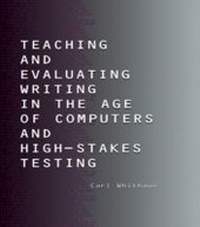
Teaching and Evaluating Writing in the Age of Computers and High-Stakes Testing
1st Edition
Published on 27. April 2005
202 pages
978-1-317-44143-4 (ISBN)
Description

This book takes on a daunting task: How do writing teachers continue to work toward preparing students for academic and real-world communication situations, while faced with the increasing use of standardized high-stakes testing? Teachers need both the technical ability to deal with this reality and the ideological means to critique the information technologies and assessment methods that are transforming the writing classroom.
Teaching and Evaluating Writing in the Age of Computers and High-Stakes Testing serves this dual need by offering a theoretical framework, actual case studies, and practical methods for evaluating student writing. By examining issues in writing assessment--ranging from the development of electronic portfolios to the impact of state-wide, standards-based assessment methods on secondary and post-secondary courses--this book discovers four situated techniques of authentic assessment that are already in use at a number of locales throughout the United States. These techniques stress:
*interacting with students as communicators using synchronous and asynchronous environments;
*describing the processes and products of student learning rather than enumerating deficits;
*situating pedagogy and evaluation within systems that incorporate rather than exclude local variables; and
*distributing assessment among diverse audiences.
By advocating for a flexible system of communication-based assessment in computer-mediated writing instruction, this book validates teachers' and students' experiences with writing and also acknowledges the real-world weight of the new writing components on the SAT and ACT, as well as on state-mandated standardized writing and proficiency exams.
Teaching and Evaluating Writing in the Age of Computers and High-Stakes Testing serves this dual need by offering a theoretical framework, actual case studies, and practical methods for evaluating student writing. By examining issues in writing assessment--ranging from the development of electronic portfolios to the impact of state-wide, standards-based assessment methods on secondary and post-secondary courses--this book discovers four situated techniques of authentic assessment that are already in use at a number of locales throughout the United States. These techniques stress:
*interacting with students as communicators using synchronous and asynchronous environments;
*describing the processes and products of student learning rather than enumerating deficits;
*situating pedagogy and evaluation within systems that incorporate rather than exclude local variables; and
*distributing assessment among diverse audiences.
By advocating for a flexible system of communication-based assessment in computer-mediated writing instruction, this book validates teachers' and students' experiences with writing and also acknowledges the real-world weight of the new writing components on the SAT and ACT, as well as on state-mandated standardized writing and proficiency exams.
Reviews / Votes
"Those unfamiliar with composition theory will find this scholarly text a particularly informative resource. Recommended. Graduate students, researchers, and practitioners."-CHOICE
"The issues addressed are timely and controversial....The topic will resonate with many teachers, academics, and policy makers. This book is written from the perspective of someone who has practiced what he preaches...."
-Jim Cummins
Ontario Institute for the Studies of Education/University of Toronto, Canada
"...shows us new ways to describe and evaluate multimedia composition and online dialogues, which are an increasingly important aspect of writing practices both inside and outside of schools. The examples are excellent."
-Bertram (Chip) Bruce
University of Illinois at Urbana-Champaign
"The message of this book--basically, that we need to focus first on what we need to teach and then on how to assess it--turns the current process on its head....Whether a reader buys Whithaus's argument or not, that reader will engage with the argument."
-Bill Condon
Washington State University
More details
Language
English
Place of publication
London
United Kingdom
Publishing group
Taylor & Francis Ltd
Target group
Professional and scholarly
File size
11,25 MB
ISBN-13
978-1-317-44143-4 (9781317441434)
Copyright in bibliographic data and cover images is held by Nielsen Book Services Limited or by the publishers or by their respective licensors: all rights reserved.
Schweitzer Classification
Other editions
Additional editions
Book
04/2005
1st Edition
Routledge
€132.90
Shipment within 10-20 days
Book
04/2005
1st Edition
Routledge
€41.70
Shipment within 10-20 days
Person
Whithaus, Carl
Content
Contents: Preface. Introduction. Educational Policy, Testing Writing, and Developing Multimedia Composing Skills. Writing (About) Sounds, Drawing Videos: Multimedia Compositions and Electronic Portfolios. Situation(s): Using Descriptive Evaluation. Negotiating Assessment and Distributive Evaluation. Interaction. Distributive Evaluation. High-Stakes Testing and 21st-Century Literacies. Tools (AES) and Media (Blogs). Strings.
