

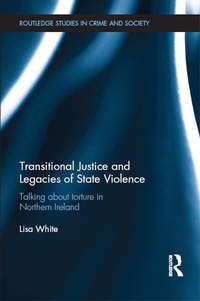
Transitional Justice and Legacies of State Violence
Published on 5. March 2015
216 pages
978-1-135-98124-2 (ISBN)
Description

As politicians, public bodies and non-Governmental organisations continue to profess an interest in making peace with the past, this highly original study explores the motivation, significance and legacy of 'making public' experiences of state violence in Northern Ireland.
Based on a synthesis of documentary material with the findings from a series of contemporary interviews, this timely book uncovers the reasoning behind many Republican former detainees' accounts of state violence and torture. It examines the aims of those who 'went public' during the conflict and discusses the meaning they attached to their stories and the various responses to them. It also identifies some of the risks involved in criticising the violence of the British State and illuminates the ways in which 'truths' are often contested in Northern Ireland - both during the conflict and in the years which have followed. A unique piece of interdisciplinary work, the study disentangles and evaluates the discourses presented by former detainees and makes an innovative and interesting contribution to knowledge about transitional justice and legacies of state violence.
The book is suitable for social science scholars interested in human rights, state violence, criminology and transitional justice, as well as those seeking to understand more about experiences of imprisonment and the legacy of the Northern Ireland conflict.
Based on a synthesis of documentary material with the findings from a series of contemporary interviews, this timely book uncovers the reasoning behind many Republican former detainees' accounts of state violence and torture. It examines the aims of those who 'went public' during the conflict and discusses the meaning they attached to their stories and the various responses to them. It also identifies some of the risks involved in criticising the violence of the British State and illuminates the ways in which 'truths' are often contested in Northern Ireland - both during the conflict and in the years which have followed. A unique piece of interdisciplinary work, the study disentangles and evaluates the discourses presented by former detainees and makes an innovative and interesting contribution to knowledge about transitional justice and legacies of state violence.
The book is suitable for social science scholars interested in human rights, state violence, criminology and transitional justice, as well as those seeking to understand more about experiences of imprisonment and the legacy of the Northern Ireland conflict.
Reviews / Votes
'What does torture and brutality feel like to those at the receiving end? What are the factors which lead victims to narrate their experience afterwards or to keep silent? In what ways does masculinity restrict or fashion the ways in which narration occurs? What is the link between storytelling and propaganda? Lisa White's findings from her interviews with republican male prisoners in Northern Ireland provide us with fascinating, complex and informative answers to those questions. This book will be of great value to anyone interested in how people seek to come to terms with the legacy of political violence and conflict.' - Bill Rolston, Emeritus Professor, University of Ulster, UK'Through a tenacious reading of the stories of men detainees during the Northern Ireland "Troubles", the author upsets conventional preoccupations with truth claiming (with all that this implies for exclusion and privileging hierarchies of victimhood). By contrast, this book shows how and why "truth-sharing" should be the basis for communicative action and political healing. This book is essential reading for all students of conflict studies, transitional justice and victimisation.' - Mary Corcoran, Senior Lecturer in Criminology, Keele University, UK
More details
Series
Language
English
Place of publication
London
United Kingdom
Publishing group
Taylor & Francis Ltd
Target group
College/higher education
Product notice
Reflowable
File size
0,44 MB
ISBN-13
978-1-135-98124-2 (9781135981242)
Copyright in bibliographic data and cover images is held by Nielsen Book Services Limited or by the publishers or by their respective licensors: all rights reserved.
Schweitzer Classification
Other editions
Additional editions
Lisa White
Transitional Justice and Legacies of State Violence
Talking about torture in Northern Ireland
Book
11/2016
1st Edition
Routledge
€47.90
Shipment within 10-20 days
Lisa White
Transitional Justice and Legacies of State Violence
Talking about torture in Northern Ireland
Book
03/2015
1st Edition
Routledge
€140.40
Shipment within 15-20 days
Person
Lisa White is a Senior Lecturer in Criminology at the University of Lincoln. Dr. White's interests include state violence, imprisonment and human rights.
Content
1. Introduction 2. The History of State Violence in Northern Ireland 3. Defining Experiences of State Violence 4. Revealing as Healing 5. The Masculinity of 'Making Public' 6. Former Detainees' Narratives as Propaganda 7. Discourse, Denial and Dehumanisation 8. Seeking Accountability for State Violence 9. The Problems and Possibilities of Talking About Violence.
