

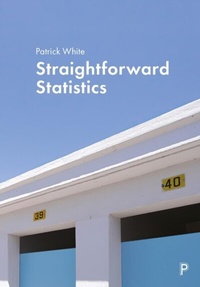
Straightforward Statistics
1st Edition
Published on 26. September 2023
218 pages
978-1-4473-6327-9 (ISBN)
Description

Are you struggling with introductory statistics? Are you trying to get ahead in your course, but feel like you're going around in circles? This short and down-to-earth textbook will give you the knowledge and confidence you need to get acquainted with the fundamentals of statistical concepts and techniques.
Assuming no prior knowledge, and avoiding jargon and dense equations, it will ease your anxiety and demonstrate the value of good descriptive analysis. With a focus on practical use and outcomes, the book:
* provides an accessible grounding in the key elements of descriptive statistical analysis;
* has a clear focus on techniques to describe patterns and relationships in your data;
* provides helpful summaries and exercises, and a glossary of terms to reinforce understanding.
With over 20 years' experience in teaching statistics at all levels and to students from many different subject areas, Patrick White has written an invaluable guide to key concepts and basic statistical techniques. Regardless of your background, this is the book that will help you interpret and use numbers to make the breakthrough that you need to achieve success in your university course.
Assuming no prior knowledge, and avoiding jargon and dense equations, it will ease your anxiety and demonstrate the value of good descriptive analysis. With a focus on practical use and outcomes, the book:
* provides an accessible grounding in the key elements of descriptive statistical analysis;
* has a clear focus on techniques to describe patterns and relationships in your data;
* provides helpful summaries and exercises, and a glossary of terms to reinforce understanding.
With over 20 years' experience in teaching statistics at all levels and to students from many different subject areas, Patrick White has written an invaluable guide to key concepts and basic statistical techniques. Regardless of your background, this is the book that will help you interpret and use numbers to make the breakthrough that you need to achieve success in your university course.
Reviews / Votes
"This book addresses the needs of a wide range of students who may not feel confident about their ability to use statistics. It provides them with a user-friendly launch pad for using basic statistics in their research projects." Martyn Denscombe, De Montfort University "This book provides a great introduction for students who want to undertake quantitative or mixed-methods research for their dissertation. Many are not well versed in mathematics and statistics, and this book provides a gentle introduction. Chapters 9 and 10 are especially helpful, as they cover how to present numerical information and analysis, which some other textbooks do not do as well." Carrie Philips, University of Sunderland "An engaging, clear and informative introductory guide to working with statistics. Full of detailed explanations and helpful examples, this book will appeal to anyone starting out with learning statistical analysis." Rebecca Morris, University of Warwick "This is a tremendously useful introduction to the practical issues that confront undergraduate, masters, and early year doctoral students looking to carry out quantitative social science research for the first time. While many textbooks claim to offer an accessible, user-friendly roadmap to statistics, precious few delivers on that promise like this one. The book assumes no specific software capabilities or prior knowledge of mathematics beyond basic arithmetic and offers a lifeline to students with anxieties about quantitative research. Rather than pummelling readers with impenetrable algebra or esoteric coding instructions, Dr White offers them a gentle guide to the most important decisions that they will face in their projects and gives them all the information that they need to make the correct choices. In describing the basic principles of data collection, analysis, and presentation, unnecessary complications are avoided in favour of communicating a practical understanding in layman's terms, which is a very rare thing in methodology textbooks. I would highly recommend this to all instructors teaching university psychology, sociology, politics, or criminology students, as a handy compliment to software specific texts." Zack Grant, University of Oxford"This is a great simple and accessible statistics book. I will be using it with all my undergraduate students. It is particularly great to see which data sets Patrick has used and be able to use these with students in the classroom. " Bethany Simmonds, Aberystwyth University
More details
Edition
First Edition
Language
English
Place of publication
Bristol
United Kingdom
Publishing group
Bristol University Press
Target group
Professional and scholarly
Illustrations
47 s/w Abbildungen, 31 s/w Tabellen
31 Tables, black and white; 47 Illustrations, black and white
ISBN-13
978-1-4473-6327-9 (9781447363279)
Copyright in bibliographic data and cover images is held by Nielsen Book Services Limited or by the publishers or by their respective licensors: all rights reserved.
Schweitzer Classification
Other editions
Additional editions

Patrick White
Straightforward Statistics
E-Book
09/2023
1st Edition
Policy Press
€31.99
Available for download

Patrick White
Straightforward Statistics
Book
09/2023
1st Edition
Policy Press
€31.00
Shipment within 15-20 days

Patrick White
Straightforward Statistics
Book
09/2023
1st Edition
Policy Press
€136.50
Shipment within 15-20 days
Person
Patrick White is Associate Professor in the Department of Sociology at University of Leicester.
Content
Introduction: Why this book actually is different
1. Everybody's talking about it: important terms explained in everyday language
2. What are numbers really about?
3. Absolute beginnings: starting statistical analysis one variable at a time
4. What you see is only half the story: why you need more than averages to describe distributions
5. How the tables turn: examining relationships between categorical variables
6. What does it all mean? Comparing distributions between groups
7. You're so predictable: using correlations
8. Where do we draw the line? How regression analysis can tell you more than correlation
9. A graph is like a joke: if you have to explain it, it isn't any good
10. Telling statistical stories: how to present your findings and conclusions
1. Everybody's talking about it: important terms explained in everyday language
2. What are numbers really about?
3. Absolute beginnings: starting statistical analysis one variable at a time
4. What you see is only half the story: why you need more than averages to describe distributions
5. How the tables turn: examining relationships between categorical variables
6. What does it all mean? Comparing distributions between groups
7. You're so predictable: using correlations
8. Where do we draw the line? How regression analysis can tell you more than correlation
9. A graph is like a joke: if you have to explain it, it isn't any good
10. Telling statistical stories: how to present your findings and conclusions
