

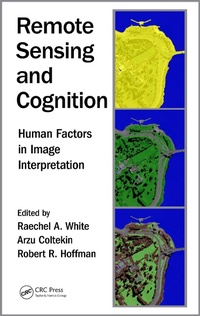
Remote Sensing and Cognition
Human Factors in Image Interpretation
1st Edition
Published on 19. April 2018
190 pages
978-1-351-04045-7 (ISBN)
Description

Human factors play a critical role in the design and interpretation of remotely sensed imagery for all Earth sciences. Remote Sensing and Cognition: Human Factors in Image Interpretation brings together current topics widely recognized and addressed regarding human cognition in geographic imagery, especially remote sensing imagery with complex data. It addresses themes around expertise including methods for knowledge elicitation and modeling of expertise, the effects of different aspects of realism on the interpretation of the environment, spatial learning using imagery, the effect of visual perspective on interpretation, and a variety of technologies and methods for utilizing knowledge in the analysis of remote sensing imagery.
Written by leaders in the field, this book provides answers to the host of questions raised at the nexus of psychology and remote sensing. Academics and researchers with an interest in the human issues surrounding the use of remote sensing data will find this book to be an invaluable resource. The topics covered in this book are useful for both the scientific analysis of remote sensing imagery as well as the design and display of remote sensing imagery to facilitate a variety of other tasks including education and wayfinding.
Features
Brings together remote sensing, environmental, and computer scientists discussing their work from a psychological or human factors perspective
Answers questions related to aesthetics of scientific visualization and mathematical analysis of perceptible objects
Explains the perception and interpretation of realistic representations
Provides illustrative real-world examples
Shows how the features of display symbols, elements, and patterns have clear effects on processes of perception and visual search
Written by leaders in the field, this book provides answers to the host of questions raised at the nexus of psychology and remote sensing. Academics and researchers with an interest in the human issues surrounding the use of remote sensing data will find this book to be an invaluable resource. The topics covered in this book are useful for both the scientific analysis of remote sensing imagery as well as the design and display of remote sensing imagery to facilitate a variety of other tasks including education and wayfinding.
Features
Brings together remote sensing, environmental, and computer scientists discussing their work from a psychological or human factors perspective
Answers questions related to aesthetics of scientific visualization and mathematical analysis of perceptible objects
Explains the perception and interpretation of realistic representations
Provides illustrative real-world examples
Shows how the features of display symbols, elements, and patterns have clear effects on processes of perception and visual search
Reviews / Votes
"Almost two decades have passed since the initial foray into the intersection of psychology and remote sensing. And so, our community of like-minded researchers will no doubt welcome the arrival of this latest endeavor. Much has changed since then, not only in our ability to gather geospatial data, but also to access it and extract actionable information. However, performing this task (sense-making) in an accurate and efficient manner requires awareness of, and careful attention to, not only the technologies required, but the human factors that are inextricably involved as well. This update and expansion on the prior work will help both the seasoned researcher (as a go to reference), as well as the newcomer (as required reading), through the breadth and depth of insights provided within a single, cohesive work."-Paul Pope, Space & Remote Sensing group, Los Alamos National Laboratory, USA
"Since collaborating with Dr. Hoffman (and others) on the earlier version of this book, the science behind human acquisition of spatial knowledge has advanced greatly. And a second examination of these advances (not merely an update, but a companion volume) ensures that the scientific timeline (due to both advancing science and technology) is retained. This volume also adds two important features. First, it stretches across a myriad of disciplines involving such knowledge acquisition and, second, it treats the topic globally.
For anyone who uses geospatial information (or anyone who wants to), this book can serve as an invaluable background resource. It's worth the read!"
- H. Michael Mogil, Certified Consulting Meteorologist
"We are here treated with an update to the classic The Interpretation of Remote Sensing Imagery: The Human Factor. As with the Editors themselves, the area has 'moved on' substantively since the turn of the century. Now here, in its many elaborated forms, is a maturing science that cries out for reappraisal and reinterpretation and this text provides it in spades. Assembling a stellar line of contributors, the present Editors have done a marvelous job of illustrating the involving intellectual evolution of the burgeoning human science based on geospatial analyses. As with its progenitor, I anticipate that this also will become a classic of our times."
-Peter Hancock, University of Central Florida, USA
More details
Edition
1. Auflage
Language
English
Place of publication
London
United Kingdom
Publishing group
Taylor & Francis Ltd
Target group
Professional and scholarly
Illustrations
14 farbige Abbildungen, 12 s/w Tabellen, 35 s/w Abbildungen
12 Tables, black and white; 14 Illustrations, color; 35 Illustrations, black and white
File size
30,39 MB
ISBN-13
978-1-351-04045-7 (9781351040457)
Copyright in bibliographic data and cover images is held by Nielsen Book Services Limited or by the publishers or by their respective licensors: all rights reserved.
Schweitzer Classification
Other editions
Additional editions
Raechel A. White | Arzu Coltekin | Robert R. Hoffman
Remote Sensing and Cognition
Human Factors in Image Interpretation
Book
06/2020
1st Edition
CRC Press
€88.30
Shipment within 15-20 days
Raechel A. White | Arzu Coltekin | Robert R. Hoffman
Remote Sensing and Cognition
Human Factors in Image Interpretation
Book
05/2018
1st Edition
CRC Press
€275.29
Shipment within 15-20 days
Persons
Raechel Bianchetti received her doctoral degree from the Pennsylvania State University. Her doctoral research explored the cognitive processes and knowledge that facilitate remote sensing image interpretation and the use of geovisual analytic approaches to facilitate insight generation from imagery. Prior to that, she studied remote sensing at the University of Idaho for a variety of physical science applications including geological mapping on Mars and forests in Idaho.
Robert R. Hoffman, Ph.D. is a Senior Research Scientist, IHMC, Pensacola FL. Hoffman is a recognized world leader in cognitive systems engineering, Expertise Studies, and Human-Centered Computing. He is a Fellow of the Association for Psychological Science, Fellow of the Human Factors and Ergonomics Society, Senior Member of the Association for the Advancement of Artificial Intelligence, and a Fulbright Scholar. He has been Principal Investigator, Co-Principal Investigator, Principal Scientist, Senior Research Scientist, Principal Author, or Principle Subcontractor on over 60 grants and contracts totaling nearly $12M. He has led efforts including large, multi-partner, multi-year grant collaborations, contracted alliances of university and private sector partners, and multi-university research initiatives. His Ph.D. is in experimental psychology from the University of Cincinnati, where he received McMicken Scholar, Psi Chi, and Delta Tau Kappa Honors. Following a Postdoctoral Associateship at the Center for Research on Human Learning at the University of Minnesota, he joined the faculty of the Institute for Advanced Psychological Studies at Adelphi University. He pioneered the study of methods for eliciting the knowledge of domain experts. Hoffman has been recognized internationally in psychology, remote sensing, human factors engineering, and artificial intelligence-for his research on the psychology of expertise, the methodology of cognitive task analysis, HCC issues for intelligent systems technology, and the design of cognitive work systems. Hoffman is a Co-Editor for the Department on Human-Centered Computing in IEEE: Intelligent Systems. He is Editor for the book Series, "Expertise: Research and Applications." He was a co-founder of The Journal of Cognitive Engineering and Decision Making.
Robert R. Hoffman, Ph.D. is a Senior Research Scientist, IHMC, Pensacola FL. Hoffman is a recognized world leader in cognitive systems engineering, Expertise Studies, and Human-Centered Computing. He is a Fellow of the Association for Psychological Science, Fellow of the Human Factors and Ergonomics Society, Senior Member of the Association for the Advancement of Artificial Intelligence, and a Fulbright Scholar. He has been Principal Investigator, Co-Principal Investigator, Principal Scientist, Senior Research Scientist, Principal Author, or Principle Subcontractor on over 60 grants and contracts totaling nearly $12M. He has led efforts including large, multi-partner, multi-year grant collaborations, contracted alliances of university and private sector partners, and multi-university research initiatives. His Ph.D. is in experimental psychology from the University of Cincinnati, where he received McMicken Scholar, Psi Chi, and Delta Tau Kappa Honors. Following a Postdoctoral Associateship at the Center for Research on Human Learning at the University of Minnesota, he joined the faculty of the Institute for Advanced Psychological Studies at Adelphi University. He pioneered the study of methods for eliciting the knowledge of domain experts. Hoffman has been recognized internationally in psychology, remote sensing, human factors engineering, and artificial intelligence-for his research on the psychology of expertise, the methodology of cognitive task analysis, HCC issues for intelligent systems technology, and the design of cognitive work systems. Hoffman is a Co-Editor for the Department on Human-Centered Computing in IEEE: Intelligent Systems. He is Editor for the book Series, "Expertise: Research and Applications." He was a co-founder of The Journal of Cognitive Engineering and Decision Making.
Content
Cognitive and Perceptual Processes in Remote Sensing Image Interpretation. Characteristics of Geospatial Photographs in Constructing Human Spatial Knowledge. Intersectional Perspectives on the Landscape Concept: Art, Cognition, and Military Perspectives. Head in the Clouds, Feet on the Ground: Applying Our Terrestrial Minds to Satellite Perspectives. Eye-Tracking Evaluation of Non-Photorealistic Maps of Cities and Photo-Realistic Visualization of an Extinct Village. Designing Geographic Information for Mountains: Mixed Methods Research. The Human Factors of Geospatial Intelligence. Employing Ontology to Capture Expert Intelligence within GEOBIA: Automation of the Interpretation Process.
