

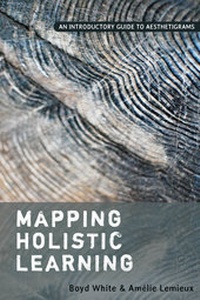
Mapping Holistic Learning
Description

Mapping Holistic Learning: An Introductory Guide to Aesthetigrams introduces the concept of aesthetigrams. These are participant-produced visual maps of aesthetic engagement. The map-making strategy was originally developed by one of the authors, Boyd White, to assist him in understanding what his university-level students were experiencing as they interacted with artworks. Such interactions are, after all, private, individualistic, and fleeting. How can a teacher foster student/teacher dialogue that might lead to enhanced engagement, much less do research, without a concrete record of such engagement? Aesthetigrams provide that record.
Recently, the strategy has been adapted to other fields of study-the teaching of literature, and philosophy for children, as well as the writing of poetry. Boyd White and Amélie Lemieux are persuaded that the strategy could be expanded into other disciplines. For example, might it not be useful for a teacher to know what a student is feeling and thinking as she struggles with a mathematical concept?
Mapping Holistic Learning is divided into three sections. Chapter 1 addresses the theoretical framework that underpins the authors' research. The second section, Chapters 2 to 5, provides examples of aesthetigram usage within the formal education environment, in art and literature classrooms. The third section, Chapters 6 and 7, introduces two recent experiments in informal settings-one in an adult poetry workshop, the other in a philosophy-for-children workshop. It is not necessary to follow the book in chronological order. Readers are invited to attend to the chapters that most closely address their individual interests.
More details
Other editions
Additional editions
Persons
Boyd White, Ph.D. in Art Education (Concordia University), is Associate Professor, Faculty of Education, at McGill University. He is the author of Aesthetics Primer (2009), Essays on Aesthetic Education for the 21st Century (2010), and Aesthetics, Empathy and Education (2013), co-edited with Tracie Costantino.
Amélie Lemieux is a Ph.D. Candidate (Educational Studies) at McGill University. Her research interests focus on the intersections between aesthetic reception and literacy, particularly in school settings. She has received two CGS Bombardier scholarships (M.A., Ph.D.) for her research in that area.
Content
List of Figures - Acknowledgements - Boyd White and Amélie Lemieux: Introduction - Amélie Lemieux and Boyd White: Epistemological and Ontological Stances - Boyd White: Putting Theory into Practice: Aesthetigrams: Mapping Aesthetic Experiences - Boyd White: More Recent Developments: Visual Art - Amélie Lemieux: Recent Developments: Aesthetigram-Making in the Literature Classroom - Amélie Lemieux: Applications with CEGEP (18-20-Year-Old) Students - Introduction: Other Applications - Boyd White: The Poetry Workshop - Natalie M. Fletcher: Philosograms as Aesthetic Maps of Philosophical Inquiry - Contributor's Bio - Index
