

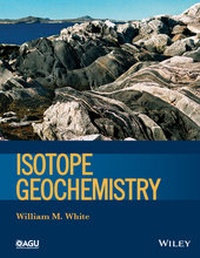
Isotope Geochemistry
Description

More details
Other editions
Additional editions

Person
Content
Preface xi
About the companion website xiii
Chapter 1: Atoms and nuclei: their physics and origins 1
1.1 Introduction 1
1.2 Physics of the Nucleus 2
1.2.1 Early development of atomic and the nuclear theory 2
1.2.2 Some definitions and units 3
1.2.3 Nucleons, nuclei, and nuclear forces 3
1.2.4 Atomic masses and binding energies 4
1.2.5 The liquid-drop model 6
1.2.6 The shell model of the nucleus 7
1.2.7 Collective model 11
1.3 Radioactive Decay 12
1.3.1 Gamma decay 12
1.3.2 Alpha decay 13
1.3.3 Beta decay 13
1.3.4 Electron capture 14
1.3.5 Spontaneous fission 15
1.4 Nucleosynthesis 16
1.4.1 Cosmological nucleosynthesis 18
1.4.2 Stellar nucleosynthesis 18
1.4.3 Explosive nucleosynthesis 25
1.4.4 Nucleosynthesis in interstellar space 27
1.4.5 Summary 28
Notes 29
References 29
Suggestions for Further Reading 30
Problems 30
Chapter 2: Decay systems and geochronology I 32
2.1 Basics of Radioactive Isotope Geochemistry 32
2.1.1 Introduction 32
2.1.2 The basic equations 33
2.1.3 A special case: the U-Th-Pb system 35
2.2 Geochronology 36
2.2.1 Isochron dating 36
2.2.2 Calculating an isochron 37
2.3 The K-Ar-Ca System 39
2.3.1 Diffusion, cooling rates, and closure temperatures 40
2.3.2 40Ar-39Ar dating 43
2.4 The Rb-Sr System 47
2.4.1 Rb-Sr chemistry and geochronology 48
2.4.2 Sr isotope chronostratigraphy 49
2.5 The Sm-Nd System 50
2.5.1 Sm-Nd model ages and crustal residence times 55
2.6 The Lu-Hf System 56
2.7 The Re-Os System 61
2.7.1 The Re-Os decay system 61
2.7.2 Re-Os geochronology 63
2.7.3 The 190Pt-186Os decay 65
Notes 66
References 66
Suggestions for Further Reading 68
Problems 69
Chapter 3: Decay systems and geochronology II: U and Th 72
3.1 Introduction 72
3.1.1 Chemistry of U, Th, and Pb 72
3.1.2 The 238U/235U ratio and uranium decay constants 73
3.2 Pb-Pb Ages and Isochrons 74
3.2.1 Total U-Pb isochrons 76
3.2.2 Th/U ratios 77
3.3 Zircon Dating 77
3.4 U-decay Series Dating 83
3.4.1 Basic principles 84
3.4.2 234U-238U dating 86
3.4.3 230Th-238U dating 88
3.4.4 231Pa-235U dating 91
3.4.5 226Ra dating 93
3.4.6 210Pb dating 93
3.4.7 210Po-210Pb dating 95
Notes 96
References 97
Suggestions for Further Reading 98
Problems 98
Chapter 4: Geochronology III: other dating methods 101
4.1 Cosmogenic Nuclides 101
4.1.1 Cosmic rays in the atmosphere 101
4.1.2 14C dating 102
4.1.3 10Be, 26Al, and 36Cl 106
4.1.4 Cosmogenic and bomb-produced radionuclides in hydrology 108
4.1.5 In-situ produced cosmogenic nuclides 110
4.2 Fission Tracks 114
4.2.1 Analytical procedures 115
4.2.2 Interpreting fission track ages 117
4.2.3 Interpreting track length 119
Notes 121
References 122
Suggestions for Further Reading 123
Problems 123
Chapter 5: Isotope cosmochemistry 125
5.1 Introduction 125
5.2 Cosmochronology 126
5.2.1 Conventional methods 126
5.2.2 Extinct radionuclides 129
5.2.3 Extinct radionuclides in the Earth 136
5.2.4 Origin of short-lived nuclides 145
5.3 Stardust and Isotopic Anomalies in Meteorites 146
5.3.1 Neon alphabet soup and "pre-solar" noble gases in meteorites 146
5.3.2 Isotopic composition of pre-solar grains 148
5.3.3 Other exotic components in meteorites 151
5.4 Oxygen Isotope Variations and Nebular Processes 151
5.5 Exposure Ages of Meteorites 154
Notes 154
References 155
Suggestions for Further Reading 158
Problems 159
Chapter 6: Radiogenic isotope geochemistry of the mantle 161
6.1 Introduction 161
6.1.1 Definitions: time-integrated and time-averaged 162
6.2 Isotope Geochemistry of the Earth's Mantle 163
6.2.1 The Sr-Nd-Hf picture 163
6.2.2 The Pb picture 166
6.3 Balancing Depleted Mantle and Crust 172
6.4 Mantle Plume Reservoirs 179
6.4.1 Mantle plumes and the mantle zoo 179
6.4.2 The evolution of mantle geochemical reservoirs 180
6.5 Geographic Variations in Mantle Isotopic Composition 187
6.6 The Subcontinental Lithosphere 189
6.7 U-Series Isotopes and Melt Generation 193
6.7.1 Spiegelman and Elliot model of melt transport 194
Notes 198
References 201
Suggestions for Further Reading 203
Problems 204
Chapter 7: Radiogenic isotope geochemistry of the continental crust and the oceans 205
7.1 Introduction 205
7.2 Growth of the Continental Crust Through Time 205
7.2.1 Mechanisms of crustal growth 205
7.2.2 The Hadean eon and the earliest continental crust 206
7.2.3 Subsequent growth of the crust 212
7.2.4 Nd and Hf isotopic approaches to crustal evolution 215
7.3 Isotopic Composition of the Continental Crust 217
7.3.1 Sediments and rivers as samples of the upper crust 218
7.3.2 Isotopic composition of the lower crust 221
7.3.3 Pb isotope ratios and the Th/U ratio of the crust 223
7.4 Other Approaches to Crustal Composition and Evolution 224
7.5 Subduction Zones 226
7.5.1 Geochemistry of two-component mixtures 226
7.5.2 Isotopic compositions of subduction-related magmas 228
7.6 Radiogenic Isotopes in Oceanography 231
7.6.1 Oceanographic circulation and geochemical cycling 232
7.6.2 Nd, Hf, Os, and Pb in the modern ocean 233
7.6.3 Radiogenic isotopes in paleoceanography 236
Notes 240
References 240
Suggestions for Further Reading 244
Problems 244
Chapter 8: Stable isotope geochemistry I: Theory 246
8.1 Introduction 246
8.2 Notation and Definitions 246
8.2.1 The ¿¿¿¿ notation 246
8.2.2 The fractionation factor 247
8.3 Theory of Mass Dependent Isotopic Fractionations 247
8.3.1 Equilibrium fractionations 249
8.3.2 Kinetic fractionation 258
8.4 Mass Independent Fractionation 260
8.5 Hydrogen and Oxygen Isotope Ratios in the Hydrologic System 262
8.6 Isotope Fractionation in the Biosphere 265
8.6.1 Carbon isotope fractionation during photosynthesis 265
8.6.2 Nitrogen isotope fractionation in biological processes 269
8.6.3 Oxygen and hydrogen isotope fractionation by plants 271
8.6.4 Carbon and hydrogen isotopic composition of organic matter in sediments 271
8.6.5 Biological fractionation of sulfur isotopes 273
Notes 274
References 274
Suggestions for Further Reading 275
Problems 276
Chapter 9: Stable isotope geochemistry II: High temperature applications 277
9.1 Introduction 277
9.2 Equilibrium Fractionations Among Minerals 277
9.2.1 Compositional and structural dependence of equilibrium fractionations 277
9.2.2 Geothermometry 279
9.3 Stable Isotope Composition of the Mantle 282
9.3.1 Oxygen 283
9.3.2 Carbon 284
9.3.3 Hydrogen 286
9.3.4 Nitrogen 287
9.3.5 Sulfur 288
9.4 Oxygen Isotopes in Magmatic Processes 288
9.4.1 Oxygen isotope changes during crystallization 289
9.4.2 Combined fractional crystallization and assimilation 291
9.4.3 Combining radiogenic and oxygen isotopes 291
9.4.4 Sediment subduction versus assimilation 292
9.4.5 Stable isotopes as indicators of crust-to-mantle recycling 296
9.5 Oxygen Isotopes in Hydrothermal Systems 298
9.5.1 Ridge crest hydrothermal activity and metamorphism of the oceanic crust 298
9.5.2 Meteoric geothermal systems 301
9.5.3 Water-rock reaction: Theory 301
9.5.4 The Skaergaard intrusion 303
9.5.5 Oxygen isotopes and mineral exploration 304
9.6 Sulfur Isotopes and Ores 305
9.6.1 Introduction 305
9.6.2 Sulfur isotope fractionations in magmatic processes 306
9.6.3 Sulfur isotope fractionation in hydrothermal systems 307
9.6.4 Isotopic composition of sulfide ores 309
Notes 312
References 312
Suggestions for Further Reading 314
Problems 315
Chapter 10: Stable isotope geochemistry III: Low temperature applications 316
10.1 Stable Isotopes in Paleontology, Archeology, and the Environment 316
10.1.1 Introduction 316
10.1.2 Isotopes and diet: You are what you eat 316
10.1.3 Carbon isotopes and the evolution of horses and grasslands 318
10.1.4 Isotopes, archeology, and paleodiets 321
10.1.5 Carbon isotopes and the earliest life 323
10.1.6 Tracing methane contamination in drinking water 325
10.2 Stable Isotopes in Paleoclimatology 326
10.2.1 Introduction 326
10.2.2 The record of climate change in deep sea sediments 327
10.2.3 The quaternary d18O record 327
10.2.4 The cause of quaternary glaciations 329
10.2.5 Carbon isotopes, ocean circulation, and climate 332
10.2.6 The tertiary marine d18O record 334
10.2.7 Continental isotopic records 336
10.2.8 Vostok and EPICA Antarctic ice cores 337
10.2.9 Ice records from Greenland: GRIP, GISP, and NGRIP 338
10.2.10Speleotherm and related climate records 340
10.2.11Soils and paleosols 341
10.3 The Carbon Cycle, Isotopes, and Climate 342
10.3.1 The short-term carbon cycle and anthropogenic impacts 342
10.3.2 The quaternary carbon isotope record and glacial cycles 347
10.3.3 The long-term carbon cycle 351
Notes 359
References 359
Suggestions for Further Reading 362
Problems 363
Chapter 11: Unconventional isotopes and approaches 364
11.1 Introduction 364
11.2 Applications of Isotopic Clumping 365
11.3 Mass Independent Isotope Fractionations 368
11.3.1 Mass-independent fractionation of oxygen in the atmosphere 368
11.3.2 Mass independent sulfur isotope fractionation and the rise of atmospheric oxygen 369
11.4 Isotopes of Iron and Molybdenum 370
11.4.1 Fe isotopes and the great oxidation event 371
11.4.2 Mo isotopes and oxygenation of the oceans 374
11.5 Isotopes of Copper and Zinc 377
11.5.1 Cu isotopes 377
11.5.2 Zn isotopes 380
11.6 Isotopes of Boron and Lithium 383
11.6.1 Boron isotopes 384
11.6.2 Li isotopes 389
11.7 Isotopes of Magnesium and Calcium 392
11.7.1 Mg isotopes 392
11.7.2 Calcium isotopes 396
11.8 Silicon Isotopes 400
11.9 Chlorine Isotopes 404
Notes 407
References 408
Suggestions for Further Reading 416
Problems 416
Chapter 12: Noble gas isotope geochemistry 418
12.1 Introduction 418
12.1.1 Noble gas chemistry 418
12.1.2 Noble gases in the Solar System 419
12.2 Helium 422
12.2.1 He in the atmosphere, crust, and oceans 422
12.2.2 He in the mantle 424
12.3 Neon 426
12.3.1 Neon in the solid earth 428
12.4 Argon 429
12.5 Krypton 431
12.6 Xenon 432
12.7 Implications of Noble Gas Isotope Ratios for the Origin and Evolution of the Earth 436
12.7.1 Mantle reservoirs of noble gases in the modern Earth 436
12.7.2 Formation of the Earth and evolution of the atmosphere 443
Notes 447
References 448
Suggestions for Further Reading 452
Problems 452
Appendix: Mass spectrometry 453
A.1 Sample Extraction and Preparation 453
A.2 The Mass Spectrometer 453
A.2.1 The ion source 454
A.2.2 The mass analyzer 455
A.2.3 The detector 457
A.3 Accelerator Mass Spectrometry 458
A.4 Analytical Strategies 459
A.4.1 Correcting mass fractionation 459
A.4.2 Deconvolution of results 461
A.4.3 Isotope dilution analysis 461
Notes 462
References 463
Problems 463
Index 465
Chapter 1
Atoms and nuclei: their physics and origins
1.1 Introduction
Isotope geochemistry has grown over the last 50 years to become one of the most important fields in the earth sciences as well as in geochemistry. It has two broad subdivisions: radiogenic isotope geochemistry and stable isotope geochemistry. These subdivisions reflect the two primary reasons why the relative abundances of isotopes of some elements vary in nature: radioactive decay and chemical fractionation.1 One might recognize a third subdivision: cosmogenic isotope geochemistry, in which both radioactive decay and chemical fractionation are involved, but additional nuclear processes can be involved as well.
The growth in the importance of isotope geochemistry reflects its remarkable success in attacking fundamental problems of earth science, as well as problems in astrophysics, physics, and biology (including medicine). Isotope geochemistry has played an important role in transforming geology from a qualitative, observational science to a modern quantitative one. To appreciate the point, consider the Ice Ages, a phenomenon that has fascinated geologist and layman alike for more than 150 years. The idea that much of the Northern Hemisphere was once covered by glaciers was first advanced by Swiss zoologist Louis Agassiz in 1837. His theory was based on observations of geomorphology and modern glaciers. Over the next 100 years, this theory advanced very little, other than the discovery that there had been more than one ice advance. No one knew exactly when these advances had occurred, how long they lasted, or why they occurred. Stable and radiogenic isotopic studies in the last 50 years have determined the exact times of these ice ages and the exact extent of temperature change (about 3°C or so in temperate latitudes, more at the poles). Knowing the timing of these glaciations has allowed us to conclude that variations in the Earth's orbital parameters (the Milankovitch parameters) and resulting changes in insolation have been the direct cause of these ice ages. Comparing isotopically determined temperatures with concentrations in bubbles in carefully dated ice cores leads to the hypothesis that atmospheric plays an important role in amplifying changes in insolation. Careful U-Th dating of corals has also revealed the detailed timing of the melting of the ice sheet and consequent sea level rise. Comparing this with stable isotope geothermometry shows that melting lagged warming (not too surprisingly). Other isotopic studies revealed changes in the ocean circulation system as the last ice age ended. Changes in ocean circulation may also be an important feedback mechanism affecting climate. Twenty-five years ago, all this seemed very interesting, but not very relevant. Today, it provides us with critical insights into how the planet's climate system works. With the current concern over potential global warming and greenhouse gases, this information is extremely "relevant".
Some isotope geochemistry even seeps into public consciousness through its application to archeology and forensics. For example, a recent National Geographic television documentary described how carbon-14 dating of 54 beheaded skeletons in a mass grave in Dorset, England revealed they were tenth century and how strontium and oxygen isotope ratios revealed they were those of Vikings executed by Anglo-Saxons and not visa versa, as originally suspected. Forensic isotopic analysis gets occasional mention in both in shows like CSI: Crime Scene Investigation and in newspaper reporting of real crime investigations.
Other examples of the impact of isotope geochemistry would include such diverse topics as ore genesis, mantle dynamics, hydrology, and hydrocarbon migration, monitors of the cosmic ray flux, crustal evolution, volcanology, oceanic circulation, environmental protection and monitoring, and paleontology. Indeed, there are few, if any, areas of geological inquiry where isotopic studies have not had a significant impact.
One of the first applications of isotope geochemistry remains one of the most important: geochronology and cosmochronology: the determination of the timing of events in the history of the Earth and the Solar System. The first "date" was obtained in 1907 by Bertram Boltwood, a Yale University chemist, who determined the age of uranium ore samples by measuring the amount of the radiogenic daughter of U, namely Pb, present. Other early applications include determining the abundance of isotopes in nature to constrain models of the nucleus and of nucleosynthesis (the origin of the elements). Work on the latter problem still proceeds. The origins of stable isotope geochemistry date to the work of Harold Urey and his colleagues in the 1940s. Paleothermometry was one of the first applications of stable isotope geochemistry as it was Urey who recognized the potential of stable isotope geochemistry to solving the riddle of the Ice Ages.
This book will touch on many, though not all, of these applications. We'll focus first on geochronology and then consider how radiogenic isotopes have been used to understand the origin and evolution of the Earth. Next, we consider the fundamental principles underlying stable isotope geochemistry and then examine it applications to fields as diverse as paleoclimate, paleontology, archeology, ore genesis, and magmatic evolution. In the final chapters, we'll see how the horizons of stable isotope geochemistry have broadened from a few light elements such as hydrogen, carbon, and oxygen to much of the periodic table. Finally, we examine the isotope geochemistry of the noble gases, whose isotopic variations are due to both nuclear and chemical processes and provide special insights into the origins and behavior of the Earth.
Before discussing applications, however, we must build a firm basis in the nuclear physics. We'll do that in the following sections. With that basis, in the final sections of this chapter we'll learn how the elements have been created over the history of the Universe in a variety of cosmic environments.
1.2 Physics of the nucleus
1.2.1 Early development of atomic and the nuclear theory
John Dalton, an English schoolteacher, first proposed that all matter consists of atoms in 1806. William Prout found that atomic weights were integral multiples of the mass of hydrogen in 1815, something known as the Law of Constant Proportions. This observation was strong support for the atomic theory, though it was subsequently shown to be only approximate, at best. J. J. Thomson of the Cavendish Laboratory in Cambridge developed the first mass spectrograph in 1906 and showed why the Law of Constant Proportions did not always hold: those elements not having integer weights had several isotopes, each of which had mass that was an integral multiple of the mass of H. In the meantime, Rutherford, also of Cavendish, had made another important observation: that atoms consisted mostly of empty space. This led to Niels Bohr's model of the atom, proposed in 1910, which stated that the atom consisted of a nucleus, which contained most of the mass, and electrons in orbit about it.
It was nevertheless unclear why some atoms had different masses than other atoms of the same element. The answer was provided by W. Bothe and H. Becker of Germany and James Chadwick of England: the neutron. Bothe and Becker discovered the particle, but mistook it for radiation. Chadwick won the Nobel Prize for determining the mass of the neutron in 1932. Various other experiments showed the neutron could be emitted and absorbed by nuclei, so it became clear that differing numbers of neutrons caused some atoms to be heavier than other atoms of the same element. This bit of history leads to our first basic observation about the nucleus: it consists of protons and neutrons.
1.2.2 Some definitions and units
Before we consider the nucleus in more detail, let's set out some definitions: : the number of neutrons, : the number of protons (same as atomic number since the number of protons dictates the chemical properties of the atom), : Mass number , : Atomic Mass, : Neutron excess number . Isotopes have the same number of protons but different numbers of neutrons; isobars have the same mass number ; isotones have the same number of neutrons but different number of protons.
The basic unit of nuclear mass is the unified atomic mass unit (also known as the dalton and the atomic mass unit or amu), which is based on unified atomic mass units; that is, the mass of is 12 unified atomic mass units (abbreviated 2). The masses of atomic particles are:
proton:
neutron 1.008664916 u
electron
1.2.3 Nucleons, nuclei, and nuclear forces
Figure 1.1 is a plot of versus showing which nuclides are stable. A key observation in understanding the nucleus is that not all combinations of and result in stable nuclides. In other words, we cannot simply throw protons and neutrons (collectively termed nucleons) together randomly and expect them to form a nucleus. For some combinations of and , a nucleus forms but is unstable, with half-lives from to . A relative few combinations of and result in stable nuclei. Interestingly, these stable nuclei generally have , as Figure 1.1 shows. Notice also that for small A, , for large A, . This is another important observation that will lead us to the first model of the nucleus.
Figure 1.1 Neutron number versus proton number for stable...
