

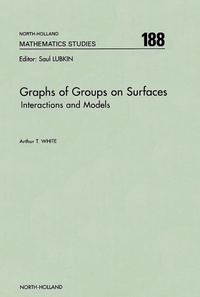
Graphs of Groups on Surfaces
Interactions and Models
Published on 27. April 2001
378 pages
978-0-08-050758-3 (ISBN)
Description

The book, suitable as both an introductory reference and as a text book in the rapidly growing field of topological graph theory, models both maps (as in map-coloring problems) and groups by means of graph imbeddings on sufaces. Automorphism groups of both graphs and maps are studied. In addition connections are made to other areas of mathematics, such as hypergraphs, block designs, finite geometries, and finite fields. There are chapters on the emerging subfields of enumerative topological graph theory and random topological graph theory, as well as a chapter on the composition of English church-bell music. The latter is facilitated by imbedding the right graph of the right group on an appropriate surface, with suitable symmetries. Throughout the emphasis is on Cayley maps: imbeddings of Cayley graphs for finite groups as (possibly branched) covering projections of surface imbeddings of loop graphs with one vertex. This is not as restrictive as it might sound; many developments in topological graph theory involve such imbeddings.The approach aims to make all this interconnected material readily accessible to a beginning graduate (or an advanced undergraduate) student, while at the same time providing the research mathematician with a useful reference book in topological graph theory. The focus will be on beautiful connections, both elementary and deep, within mathematics that can best be described by the intuitively pleasing device of imbedding graphs of groups on surfaces.
More details
Other editions
Additional editions
Book
04/2001
North-Holland
€203.99
Article exhausted; check different version
Content
Chapter 1. HISTORICAL SETTINGChapter 2. A BRIEF INTRODUCTION TO GRAPH THEORY 2-1. Definition of a Graph2-2. Variations of Graphs2-3. Additional Definitions2-4. Operations on Graphs2-5. ProblemsChapter 3. THE AUTOMORPHISM GROUP OF A GRAPH3-1. Definitions3-2. Operations on Permutations Groups3-3. Computing Automorphism Groups of Graphs3-4. Graphs with a Given Automorphism Group3-5. ProblemsChapter 4. THE CAYLEY COLOR GRAPH OF A GROUP PRESENTATION4-1. Definitions4-2. Automorphisms4-3. Properties4-4. Products4-5. Cayley Graphs4-6. ProblemsChapter 5. AN INTRODUCTION TO SURFACE TOPOLOGY5-1. Definitions5-2. Surfaces and Other 2-manifolds5-3. The Characteristic of a Surface5-4. Three Applications5-5. Pseudosurfaces5-6. ProblemsChapter 6. IMBEDDING PROBLEMS IN GRAPH THEORY6-1. Answers to Some Imbedding Questions6-2. Definition of "Imbedding"6-3. The Genus of a Graph6-4. The Maximum Genus of a Graph6-5. Genus Formulae for Graphs6-6. Rotation Schemes6-7. Imbedding Graphs on Pseudosurfaces6-8. Other Topological Parameters for Graphs6-9. Applications6-10. ProblemsChapter 7. THE GENUS OF A GROUP7-1. Imbeddings of Cayley Color graphs7-2. Genus Formulae for Groups7-3. Related Results7-4. The Characteristic of a Group7-5. ProblemsChapter 8. MAP-COLORING PROBLEMS8-1. Definitions and the Six-Color Theorem8-2. The Five-Color Theorem8-3. The Four-Color Theorem8-4. Other Map-Coloring Problems:The Heawood Map-Coloring Theorem8-5. A Related Problem8-6. A Four-Color Theorem for the Torus8-7. A Nine-Color Theorem for the Torus and Klein Bottle8-8. k-degenerate Graphs8-9. Coloring Graphs on Pseudosurfaces8-10. The Cochromatic Number of Surfaces8-11. ProblemsChapter 9. QUOTIENT GRAPHS AND QUOTIENT MANIFOLDS:CURRENT GRAPHS AND THE COMPLETE GRAPH THEOREM9-1. The Genus of Kn9-2. The Theory of Current Graphs as Applied to Kn9-3. A Hint of Things to Come9-4. ProblemsChapter 10. VOLTAGE GRAPHS10-1. Covering Spaces10-2. Voltage Graphs10-3. Examples10-4. The Heawood Map-coloring Theorem (again)10-5. Strong Tensor Products10-6. Covering Graphs and Graphical Products10-7. ProblemsChapter 11. NONORIENTABLE GRAPH IMBEDDINGS11-1. General Theory11-2. Nonorientable Covering Spaces11-3. Nonorientable Voltage Graph Imbeddings11-4. Examples11-5. The Heawood Map-coloring Theorem, Nonorientable Version11-6. Other Results11-7. ProblemsChapter 12. BLOCK DESIGNS12-1. Balanced Incomplete Block Designs12-2. BIBDs and Graph Imbeddings12-3. Examples12-4. Strongly Regular Graphs12-5. Partially Balanced Incomplete Block Designs12-6. PBIBDs and Graph Imbeddings12-7. Examples12-8. Doubling a PBIBD12-9. ProblemsChapter 13. HYPERGRAPH IMBEDDINGS13-1. Hypergraphs13-2. Associated Bipartite Graphs13-3. Imbedding Theory for Hypergraphs13-4. The Genus of a Hypergraph13-5. The Heawood Map-Coloring Theorem, for Hypergraphs 13-6. The Genus of a Block Design13-7. An Example13-8. Nonorientable Analogs13-9. ProblemsChapter 14. FINITE FIELDS ON SURFACES14-1. Graphs Modelling Finite Rings14-2. Basic Theorems About Finite Fields14-3. The Genus of Fp14-4. The Genus of Fpr14-5. Further Results14-6. ProblemsChapter 15. FINITE GEOMETRIES ON SURFACES15-1. Axiom Systems for Geometries15-2. n-Point Geometry15-3. The Geometries of Fano, Pappus, and Desargues15-4. Block Designs as Models for Geometries15-5. Surface Models for Geometries15-6. Fano, Pappus, and Desargues Revisited15-7. 3-Configurations15-8. Finite Projective Planes15-9. Finite Affine Planes15-10. Ten Models for AG(2,3)15-11. Completing the Euclidean Plane15-12. ProblemsChapter 16. MAP AUTOMORPHISM GROUPS16-1. Map Automorphisms16-2. Symmetrical Maps16-3. Cayley Maps16-4. Complete Maps16-5. Other Symmetrical Maps16-6. Self -Complementary Graphs16-7. Self-dual Maps16-8. Paley Maps16-9. ProblemsChapter 17.
