

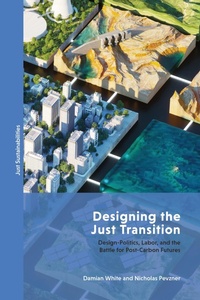
Designing the Just Transition
Design-Politics, Labor, and the Battle for Post-Carbon Futures
Will be published approx. on 9. July 2026
296 pages
978-1-350-33256-0 (ISBN)
Description

Environmental politics is clearly at an impasse, increasingly foreclosed by a fragmenting elite consensus on climate change, an escalating populist backlash on the right, and a pervasive sense of climate doom on the left. This book considers what new openings might be offered by a labor-centered transition focused on our creative agency and our collective capacities to design new worlds.
Whilst political mobilizations and smart policy are vital for making progress on decarbonization, Designing the Just Transition suggests that a more environmentally and socially just future will also have to be materialized and built, coded and created, imagined, desired, and enacted by many hands, many skills and many forms of visible and invisible design labor. The mainstream design industry is not to be trusted. Nevertheless, this book brings political ecology and environmental-labor studies into dialogue with critical design praxis, activism, and scholarship. It critically appraises traditions of worker-centered design, ecological and regional planning, sustainable and climate-smart architecture, and 'design when everyone designs.'
Rather than embracing a scolding green politics of limits or techno-utopian propaganda, Designing the Just Transition points to a wealth of resources for thinking about how we still might engage in democratic world-making on a warmer, more restless, and more turbulent planet.
Whilst political mobilizations and smart policy are vital for making progress on decarbonization, Designing the Just Transition suggests that a more environmentally and socially just future will also have to be materialized and built, coded and created, imagined, desired, and enacted by many hands, many skills and many forms of visible and invisible design labor. The mainstream design industry is not to be trusted. Nevertheless, this book brings political ecology and environmental-labor studies into dialogue with critical design praxis, activism, and scholarship. It critically appraises traditions of worker-centered design, ecological and regional planning, sustainable and climate-smart architecture, and 'design when everyone designs.'
Rather than embracing a scolding green politics of limits or techno-utopian propaganda, Designing the Just Transition points to a wealth of resources for thinking about how we still might engage in democratic world-making on a warmer, more restless, and more turbulent planet.
More details
Series
Language
English
Place of publication
London
United Kingdom
Publishing group
Bloomsbury Publishing PLC
Target group
College/higher education
Professional and scholarly
File size
6,44 MB
ISBN-13
978-1-350-33256-0 (9781350332560)
Copyright in bibliographic data and cover images is held by Nielsen Book Services Limited or by the publishers or by their respective licensors: all rights reserved.
Schweitzer Classification
Other editions
Additional editions
Damian White | Nicholas Pevzner
Designing the Just Transition
Design-Politics, Labor, and the Battle for Post-Carbon Futures
Book
approx. 08/2026
Bloomsbury Academic
€116.50
Not yet published
Persons
Damian White is Professor of Social Theory and Environmental Studies and Dean of Liberal Arts at the Rhode Island School of Design, USA. White has published four books to date in the fields of environmental design studies including Bookchin: A Critical Appraisal (2008), and Autonomy, Solidarity, Possibility: The Colin Ward Reader (2011).
Nicholas Pevzner is an Assistant Professor in the Department of Landscape Architecture and Regional Planning at the University of Pennsylvania's Stuart Weitzman School of Design, and a Faculty Fellow at the Kleinman Center for Energy Policy at Penn, USA
Nicholas Pevzner is an Assistant Professor in the Department of Landscape Architecture and Regional Planning at the University of Pennsylvania's Stuart Weitzman School of Design, and a Faculty Fellow at the Kleinman Center for Energy Policy at Penn, USA
Content
Introduction: Resisting the It's-too-late-o-cene by DesignChapter 1. The Just Transition as a Social, Political, and Design Imaginary
Chapter 2. Environmental, Ecological, and "Nature-Inspired" Design Histories
Chapter 3. Green Design as Threat and Promise for Architecture, Design, and Planning
Chapter 4. Labor-Centered and Worker-Centered Design for Just Transitions?
Chapter 5. Critical Design Studies and the Labors of Cocreation
Chapter 6. The Green New Deal, Design, Planning, and the Public Imagination
Chapter 7. Planetary Designs and Speculative Climate Design Futures
Chapter 8. The Politics of the Just Transition in an Age of Disenchantment
Chapter 2. Environmental, Ecological, and "Nature-Inspired" Design Histories
Chapter 3. Green Design as Threat and Promise for Architecture, Design, and Planning
Chapter 4. Labor-Centered and Worker-Centered Design for Just Transitions?
Chapter 5. Critical Design Studies and the Labors of Cocreation
Chapter 6. The Green New Deal, Design, Planning, and the Public Imagination
Chapter 7. Planetary Designs and Speculative Climate Design Futures
Chapter 8. The Politics of the Just Transition in an Age of Disenchantment
