

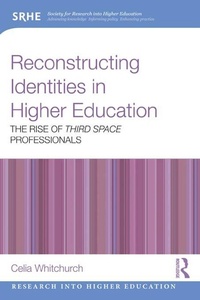
Reconstructing Identities in Higher Education
The rise of 'Third Space' professionals
1st Edition
Published on 12. November 2012
184 pages
978-1-136-22638-0 (ISBN)
Description

Reconstructing Identities in Higher Education: The Rise of Third Space Professionals draws on studies conducted in Australia, the United Kingdom and the United States to explore the roles and identities of a growing number of staff associated with broadly based institutional projects such as student life and welfare, widening participation, learning support, community partnership, research and business partnership, and institutional research. Thus, at the same time as professional staff are acquiring academic credentials, some academic staff are moving in a more project-oriented direction. This has effectively created a Third Space between professional and academic spheres in which lateral interactions, involving teams and networks, occur in parallel with formal institutional structures and processes, and give rise to new forms of management and leadership. Yet such developments have tended to occur 'under the radar', and have not been fully articulated.
The concept of Third Space is offered as a way of exploring the knowledges, relationships, legitimacies and languages that characterise those who work in less boundaried roles, and the implications of these developments for both individuals and institutions. The ability to problematise and accommodate a series of paradoxes and tensions, for instance between formal and more open-ended structures and relationships, would appear to be at the heart of working in Third Space. Individuals also grapple with the fact that Third Space can, at one and the same time, be a safe haven for experimentation and creativity, and also a risky space in which there is likely to be contestation and uncertainty.
The text is addressed to professional and academic staff who, by design or default, for long or short periods, find themselves working in Third Space environments; to those to whom such staff may be responsible, including senior management teams; and also to researchers interested in changing identities in higher education.
The concept of Third Space is offered as a way of exploring the knowledges, relationships, legitimacies and languages that characterise those who work in less boundaried roles, and the implications of these developments for both individuals and institutions. The ability to problematise and accommodate a series of paradoxes and tensions, for instance between formal and more open-ended structures and relationships, would appear to be at the heart of working in Third Space. Individuals also grapple with the fact that Third Space can, at one and the same time, be a safe haven for experimentation and creativity, and also a risky space in which there is likely to be contestation and uncertainty.
The text is addressed to professional and academic staff who, by design or default, for long or short periods, find themselves working in Third Space environments; to those to whom such staff may be responsible, including senior management teams; and also to researchers interested in changing identities in higher education.
Reviews / Votes
"Whitchurch's research has implications for our understanding of professionals in higher education and organizational structures in modern higher education institutions. She frames professional roles according to four "dispositions"-bounded professionals, cross-boundary professionals, unbounded professionals, and blended professionals-that can be distinguished by their degree of agency within their organizational structure and their affinity to their associated spaces, knowledges, relationships, and legitimacies. The resulting typology forms 16 unique identity categories that can help us understand the context, motivations, and operational behaviors of professionals in complex organizations". - Jeri L. Childers, University of Technology, SydneyMore details
Series
Language
English
Place of publication
London
United Kingdom
Publishing group
Taylor & Francis Ltd
Target group
College/higher education
Professional and scholarly
Illustrations
1 s/w Abbildung, 16 s/w Tabellen
16 Tables, black and white; 1 Illustrations, black and white
File size
2,29 MB
ISBN-13
978-1-136-22638-0 (9781136226380)
Copyright in bibliographic data and cover images is held by Nielsen Book Services Limited or by the publishers or by their respective licensors: all rights reserved.
Schweitzer Classification
Other editions
Additional editions
Celia Whitchurch
Reconstructing Identities in Higher Education
The rise of 'Third Space' professionals
Book
10/2012
1st Edition
Routledge
€185.70
Shipment within 15-20 days
Celia Whitchurch
Reconstructing Identities in Higher Education
The rise of 'Third Space' professionals
Book
10/2012
1st Edition
Routledge
€52.60
Shipment within 15-20 days
Person
Dr Celia Whitchurch is Senior Lecturer in Higher Education at the University of London Institute of Education. Between 2005 and 2009 she undertook two studies funded by the UK Leadership Foundation for Higher Education on the changing roles and identities of professional staff, and the emergence of a Third Space between academic and professional spheres of activity. In 2010 she edited a monograph with George Gordon, entitled Academic and Professional Identities in Higher Education: The Challenges of a Diversifying Workforce, also published by Routledge.
Content
Part I 1. Introduction 2. The Concept of Third Space Part II 3. Being a Third Space Professional 4. Paradoxes and Dilemmas Part III 5. Third Space Professionals and the Organisational Interface 6. Possible Futures
