

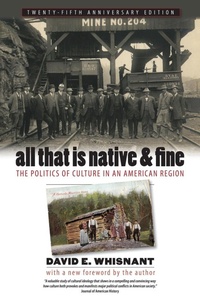
All That Is Native and Fine
The Politics of Culture in an American Region
2nd Edition
Published on 25. August 2018
384 pages
978-1-4696-4938-2 (ISBN)
Description

In the American imagination, “Appalachia” designates more than a geographical region. It evokes fiddle tunes, patchwork quilts, split-rail fences, and all the other artifacts that decorate a cherished romantic region in the American mind. In this classic work, David Whisnant challenges this view of Appalachia (and consequently a broader imaginative tendency) by exploring connections between the comforting simplicity of cultural myth and the troublesome complexities of cultural history.
Looking at the work of ballad hunters and collectors, folk and settlement school founders, folk festival promoters, and other culture workers, Whisnant examines a process of intentional and systematic cultural intervention that had — and still has — far-reaching consequences. He opens the way into a more sophisticated understanding of the politics of culture in Appalachia and other regions. In a new foreword for this twenty-fifth anniversary edition, Whisnant reflects on how he came to write this book, how readers responded to it, and how some of its central concerns have animated his later work.
Looking at the work of ballad hunters and collectors, folk and settlement school founders, folk festival promoters, and other culture workers, Whisnant examines a process of intentional and systematic cultural intervention that had — and still has — far-reaching consequences. He opens the way into a more sophisticated understanding of the politics of culture in Appalachia and other regions. In a new foreword for this twenty-fifth anniversary edition, Whisnant reflects on how he came to write this book, how readers responded to it, and how some of its central concerns have animated his later work.
More details
Other editions
Additional editions
Book
02/2009
25th Edition
The University of North Carolina Press
€47.90
Shipment within 15-20 days
Person
David E. Whisnant is author of Modernizing the Mountaineer: People, Power and Planning in Appalachia and Rascally Signs in Sacred Places: The Politics of Culture in Nicaragua. He lives in Chapel Hill, North Carolina, where he is currently doing historical research and writing for the National Park Service.
