

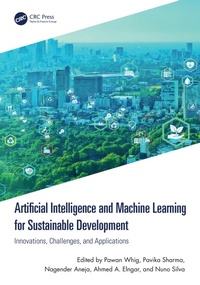
Artificial Intelligence and Machine Learning for Sustainable Development
Innovations, Challenges, and Applications
1st Edition
Published on 18. December 2024
286 pages
978-1-040-22877-7 (ISBN)
Description

Artificial Intelligence and Machine Learning for Sustainable Development is a comprehensive exploration of how artificial intelligence (AI) and machine learning (ML) technologies are revolutionizing the field of sustainable development.
The book examines cutting-edge innovations, practical applications, and potential challenges in harnessing AI and ML to address global sustainability issues. It offers insights into how these technologies can optimize resource management, improve environmental monitoring, enhance decision-making processes, and promote equitable, eco-friendly solutions. This book would be of special interest to researchers, policymakers, and practitioners seeking to leverage cutting-edge technology for a more sustainable future.
The book examines cutting-edge innovations, practical applications, and potential challenges in harnessing AI and ML to address global sustainability issues. It offers insights into how these technologies can optimize resource management, improve environmental monitoring, enhance decision-making processes, and promote equitable, eco-friendly solutions. This book would be of special interest to researchers, policymakers, and practitioners seeking to leverage cutting-edge technology for a more sustainable future.
Reviews / Votes
The widely celebrated benefits of technological development during the past two centuries are now overshadowed by evidence of grave troubles in society, economics, politics, and Earth's climate, ones often delivered, alas, by the very same set of technical wonders. How are we to think about these astonishing contrasts? The writings gathered in this collection offer rigorous, insightful methods for exploring the major challenges that vex world society today. A treasure chest of theories and case histories, the book offers sustenance for all of those seeking fruitful alternatives.--Langdon Winner, Professor at Rensselaer Polytechnic Institute, author of Autonomous Technology: Technics-out-of-control as a theme in political thought, and The whale and the reactor: A search for limits in an age of high technology.
An interesting collection of chapters that reflect on the role of technology vis-a-vis sustainable development. Highly relevant against the backdrop of the imminent risks created by climate change, and rightly critical of technosolutionist approaches, the contributions to this volume helpfully highlight the political aspects of this challenging conundrum. Not to be missed.
--Mark Coeckelbergh, Professor at the University of Vienna, author of AI Ethics, Green Leviathan, and The Political Philosophy of AI.
More details
Edition
1. Auflage
Language
English
Place of publication
London
United Kingdom
Publishing group
Taylor & Francis Ltd
Target group
College/higher education
Professional and scholarly
Illustrations
11 Tables, black and white; 28 Line drawings, black and white; 28 Illustrations, black and white
File size
14,05 MB
ISBN-13
978-1-040-22877-7 (9781040228777)
Copyright in bibliographic data and cover images is held by Nielsen Book Services Limited or by the publishers or by their respective licensors: all rights reserved.
Schweitzer Classification
Other editions
Additional editions
Pawan Whig | Pavika Sharma | Nagender Aneja
Artificial Intelligence and Machine Learning for Sustainable Development
Innovations, Challenges, and Applications
Book
approx. 07/2026
1st Edition
CRC Press
€64.50
Not yet published
Pawan Whig | Pavika Sharma | Nagender Aneja
Artificial Intelligence and Machine Learning for Sustainable Development
Innovations, Challenges, and Applications
Book
12/2024
1st Edition
CRC Press
€164.50
Shipment within 10-20 days
Persons
Dr. Pawan Whig, Research Scientist, Threws and Ex-Dean Research, Vivekananda Institute of Professional Studies-TC, India
Dr. Pavika Sharma, Assistant Professor, Bhagwan Parshuram Institute of Technology, India
Dr. Nagender Aneja, Bradley Department of Electrical and Computer Engineering, Virginia Tech, Blacksburg, VA, USA
Dr. Ahmed A. Elngar, Head of Computers and Artificial Intelligence, Beni-Suef University, Egypt
Dr. Nuno Silva, Chief Scientific and Technology Officer, UnifAI Technology, United Kingdom.
Dr. Pavika Sharma, Assistant Professor, Bhagwan Parshuram Institute of Technology, India
Dr. Nagender Aneja, Bradley Department of Electrical and Computer Engineering, Virginia Tech, Blacksburg, VA, USA
Dr. Ahmed A. Elngar, Head of Computers and Artificial Intelligence, Beni-Suef University, Egypt
Dr. Nuno Silva, Chief Scientific and Technology Officer, UnifAI Technology, United Kingdom.
Content
1. Obstacles and Resolutions: Integrating Artificial Intelligence in Sustainable Development , 2. Building a Sustainable Future: Education Initiatives and Employment Opportunities , 3. Energy Trading: Enhancing Sustainability in Renewable Resource Management, 4. A Comprehensive Review on Artificial Intelligence: Machine Learning Models for Environmental Sustainability, 5. AI for Sustainable Development in the Media and Entertainment Industry, 6. AI and Water Resource Management: Ensuring Access and Sustainability, 7. Building Blocks of Artificial Intelligence and Machine Learning: A Framework for Sustainable Development, 8. Sustainable Smart Cities in African Digital Space, 9. Smart City Governance and Citizen Engagement, 10. Fighting Fraud With Algorithms: AI Solutions for Claim Detection and Revolutionizing Fraud Detection in Insurance, 11. Challenges and Ethical Considerations Regarding AI and Media Practitioners: Toward a Sustainable Relationship, 12. Innovative Applications of AI for Sustainable Supply Chain Management in Environmental Conservation, 13. Challenges and Prospects of Implementing AI-Powered Retail and Consumer Packaged Solutions in the Global Supply Chain for Enhanced Well-Being, 14. The Future of Business Is Intelligence in Education: AI for Efficiency, Innovation, and Growth, 15. Ensuring Ethical Practices in AI and ML Toward a Sustainable Future, 16. Charting the Ethical Horizon: A Deep Dive Into AI Ethics, Unraveling the Moral Threads in Machine Intelligence Development, 17. Moving Beyond Gender: Recognizing Equality and Inclusivity Across Cultures Through Feminist AI, 18. The Contribution of Artificial Intelligence to Foster Sustainable Food Systems in Agriculture, 19. Plastic Waste Management: Challenges and Potential Solutions with the Application of AI
