

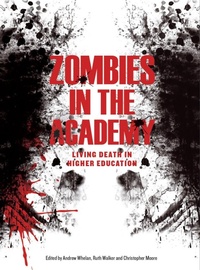
Zombies in the Academy
Living Death in Higher Education
1st Edition
Published on 6. January 2013
398 pages
978-1-78320-076-4 (ISBN)
Description

Zombies in the Academy taps into the current popular fascination with zombies and brings together scholars from a range of fields, including cultural and communications studies, sociology, film studies and education, to give a critical account of the political, cultural and pedagogical state of the university through the metaphor of zombiedom. The contributions to this volume argue that the increasing corporatization of the academy - an environment emphasizing publication, narrow research, and a vulnerable tenure system - is creating a crisis in higher education best understood through the language of zombie culture: the undead, contagion and plague, among others. Zombies in the Academy presents essays from a variety of scholars and creative writers who present an engaging and entertaining appeal for serious recognition of the conditions of contemporary humanities teaching, culture and labour practices.
Reviews / Votes
'The mindless focus on centres of learning as corporate entities, in which publication for its own sake, tenuous tenure and narrow research is the order of the day, is producing an intellectually dead environment in which bureaucratic zombies are sucking the life out of teaching and learning' -- Social Science Space * David Canter * 'This volume utilizes the metaphor of the zombie to explore what it means to learn and teach within a system bereft of genuine animation, vitality and free will.' * Canadian Association of University Teachers bulletin *More details
Edition
1. Auflage
Language
English
Place of publication
United Kingdom
Publishing group
Intellect
Target group
Professional and scholarly
ISBN-13
978-1-78320-076-4 (9781783200764)
Copyright in bibliographic data and cover images is held by Nielsen Book Services Limited or by the publishers or by their respective licensors: all rights reserved.
Schweitzer Classification
Other editions
Additional editions
Andrew Whelan | Ruth Walker | Christopher Moore
Zombies in the Academy
Living Death in Higher Education
Book
07/2013
Intellect Books
€33.90
Shipment within 3-4 weeks
Persons
Andrew Whelan teaches sociology at the University of Wollongong, Australia.
Ruth Walker teaches academic writing at the University of Wollongong, Australia.
Christopher Moore is a lecturer in media communication at Deakin University, Australia.
Ruth Walker teaches academic writing at the University of Wollongong, Australia.
Christopher Moore is a lecturer in media communication at Deakin University, Australia.
Content
Introduction
Section 1: Zombification in the corporate university
First as tragedy, then as corpse - Andrew Whelan
'Being' post-death at Zombie University - Rowena Harper
University life, zombie states and reanimation - Rowan Wilken and Christian McCrea
The living dead and the dead living: contagion and complicity in contemporary universities - Holly Randell-Moon, Sue Saltmarsh and Wendy Sutherland-Smith
Zombie solidarity - Ann Deslandes and Kristian Adamson
The Journal of Doctor Wallace - David Slattery
Section 2: Moribund content and infectious technologies
Zombie processes and undead technologies - Christopher Moore
The botnet: webs of hegemony/zombies who publish - Martin Paul Eve
The intranet of the living dead: software and universities - Jonathan Paul Marshall
Virtual learning environments and the zombification of learning and teaching in British universities - Nick Pearce and Elaine Tan
Mapping zombies: a guide for digital pre-apocalyptic analysis and post-apocalyptic survival - Mark Graham, Taylor Shelton and Matthew Zook
Infectious textbooks - Gordon S. Carlson and James J. Sosnoski
Section 3: Zombie literacies and pedagogies
Undead universities, the plagiarism 'plague', paranoia and hypercitation - Ruth Walker
EAP programmes feeding the living dead of academia: critical thinking as a global antibody - Sara Felix
Zombies in the classroom: education as consumption in two novels by Joyce Carol Oates - Sherry R. Truffin
Queer pedagogies in zombie times: parody, neo-liberalism and higher education - Daniel Marshall
Zombies are us: the living dead as a tool for pedagogical reflection - Shaun Kimber
Escaping the zombie threat by mathematics - Hans Petter Langtangen, Kent-Andre Mardal and Pal Rotnes
Toward a zombie pedagogy: embodied teaching and the student 2.0 - Jesse Stommel
Section 4: The post-apocalyptic terrain
'Sois mort et tais toi': zombie mobs and student protests - Sarah Juliet Lauro
Living-dead man's shoes? Teaching and researching glossy topics in a harsh social and cultural context - David Beer
Feverish homeless cannibal - George Pfau
A report on the global Viral Z outbreak and its impact on higher education - Howard M. Gregory II and Annie Jeffrey
Section 1: Zombification in the corporate university
First as tragedy, then as corpse - Andrew Whelan
'Being' post-death at Zombie University - Rowena Harper
University life, zombie states and reanimation - Rowan Wilken and Christian McCrea
The living dead and the dead living: contagion and complicity in contemporary universities - Holly Randell-Moon, Sue Saltmarsh and Wendy Sutherland-Smith
Zombie solidarity - Ann Deslandes and Kristian Adamson
The Journal of Doctor Wallace - David Slattery
Section 2: Moribund content and infectious technologies
Zombie processes and undead technologies - Christopher Moore
The botnet: webs of hegemony/zombies who publish - Martin Paul Eve
The intranet of the living dead: software and universities - Jonathan Paul Marshall
Virtual learning environments and the zombification of learning and teaching in British universities - Nick Pearce and Elaine Tan
Mapping zombies: a guide for digital pre-apocalyptic analysis and post-apocalyptic survival - Mark Graham, Taylor Shelton and Matthew Zook
Infectious textbooks - Gordon S. Carlson and James J. Sosnoski
Section 3: Zombie literacies and pedagogies
Undead universities, the plagiarism 'plague', paranoia and hypercitation - Ruth Walker
EAP programmes feeding the living dead of academia: critical thinking as a global antibody - Sara Felix
Zombies in the classroom: education as consumption in two novels by Joyce Carol Oates - Sherry R. Truffin
Queer pedagogies in zombie times: parody, neo-liberalism and higher education - Daniel Marshall
Zombies are us: the living dead as a tool for pedagogical reflection - Shaun Kimber
Escaping the zombie threat by mathematics - Hans Petter Langtangen, Kent-Andre Mardal and Pal Rotnes
Toward a zombie pedagogy: embodied teaching and the student 2.0 - Jesse Stommel
Section 4: The post-apocalyptic terrain
'Sois mort et tais toi': zombie mobs and student protests - Sarah Juliet Lauro
Living-dead man's shoes? Teaching and researching glossy topics in a harsh social and cultural context - David Beer
Feverish homeless cannibal - George Pfau
A report on the global Viral Z outbreak and its impact on higher education - Howard M. Gregory II and Annie Jeffrey
