

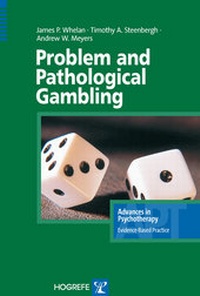
Problem and Pathological Gambling
1st Edition
Published on 1. January 2010
123 pages
978-1-61676-312-1 (ISBN)
Description

An easy-to-use guide leading clinicians through a cost-efficient approach to one of today's major addictions: problem or pathological gambling.
Over the past 30 years there has been a dramatic increase in the availability of convenient and legal gambling opportunities. Most people can reach a casino in a matter of a few hours, lottery tickets in minutes, or an online gaming site in seconds. Accompanying this proliferation of gambling is a growing understanding that between 5% and 9% of adults experience significant to severe problems due to their gambling activities. These problems have become a real health concern, with substantial costs to individuals, families, and communities.
The objective of this book is to provide the clinician - or graduate student - with essential information about problem and pathological gambling. After placing this behavioral addiction and its co-occurring difficulties in perspective, by describing its proliferation, the associated costs, and diagnostic criteria and definitions, the authors present detailed information on a strategy to assess and treat gambling problems in an outpatient setting.
They go on to provide clear and easy-to-follow intervention guidelines, including homework assignments, for a brief and cost-efficient cognitive behavioral approach to problem gambling, involving stepped care and guided self-change. Means of countering problems and barriers to change and vivid case vignettes round off this thorough, but compact guide for clinicians.
Earn 5 CE credits for reading volumes of the Advances in Psychotherapy book series. Click here to find out more!
More details
Other editions
Additional editions
James P. Whelan | Andrew W. Meyers | Timothy A. Steenbergh
Problem and Pathological Gambling
E-Book
08/2007
1st Edition
Hogrefe Publishing
€21.99
Available for download
James P. Whelan | Andrew W. Meyers | Timothy A. Steenbergh
Problem and Pathological Gambling
Book
07/2007
1st Edition
Hogrefe & Huber
from
€24.95
Shipment within 3-4 weeks
Persons
James P. Whelan, PhD, is Associate Professor of Psychology and Director of Clinical Training at the University of Memphis, as well as codirector of the Institute for Gambling Education and Research and the Gambling Clinic. He has also served as Director of Clinical Training and has won awards for his engaged scholarship. Dr. Whelan's research spans several areas, including efficacy for psychological treatments, problem gambling, and sport and exercise psychology.
Timothy A. Steenbergh, PhD, is Associate Professor of Psychology and Director of the Lilly Student Research Initiative at Indiana Wesleyan University. Dr. Steenbergh's research on addictive behaviors has focused primarily on problem gambling. In addition to his research, Dr. Steenbergh also enjoys teaching and providing psychotherapy at a small clinical practice in Marion, IN.
Andrew W. Meyers, PhD, is Professor in the Department of Psychology and Vice Provost for Research at the University of Memphis, as well as codirector of the Institute for Gambling Education and Research. Dr. Meyers has served on the editorial boards of the Journal of Consulting and Clinical Psychology, Behavior Therapy, Health Psychology, and Cognitive Therapy and Research, and for the past 25 years has maintained a private practice focused on addictions and health behavior.
Timothy A. Steenbergh, PhD, is Associate Professor of Psychology and Director of the Lilly Student Research Initiative at Indiana Wesleyan University. Dr. Steenbergh's research on addictive behaviors has focused primarily on problem gambling. In addition to his research, Dr. Steenbergh also enjoys teaching and providing psychotherapy at a small clinical practice in Marion, IN.
Andrew W. Meyers, PhD, is Professor in the Department of Psychology and Vice Provost for Research at the University of Memphis, as well as codirector of the Institute for Gambling Education and Research. Dr. Meyers has served on the editorial boards of the Journal of Consulting and Clinical Psychology, Behavior Therapy, Health Psychology, and Cognitive Therapy and Research, and for the past 25 years has maintained a private practice focused on addictions and health behavior.
Content
- Problem and Pathological Gambling
- About the Authors
- Preface
- Table of Contents
- 1 Description of Problem and Pathological Gambling
- 1.1 Terminology
- 1.1.1 Gambling as Recreation
- 1.1.2 Continuum of Gambling-Related Harm
- 1.2 Definitions
- 1.2.1 Pathological Gambling
- 1.2.2 Problem Gambling
- 1.3 Epidemiology
- 1.3.1 Vulnerable Populations
- 1.3.2 Types of Gambling and Gambling Problems
- 1.3.3 Impact of Gambling Availability
- 1.3.4 Demographic Correlates
- 1.4 Course and Prognosis
- 1.4.1 Negative Effects
- 1.4.2 Natural Recovery
- 1.5 Differential Diagnosis
- 1.6 Comorbidity
- 1.6.1 Substance Use Disorders
- 1.6.2 Mood Disorders
- 1.6.3 Anxiety Disorders
- 1.6.4 Axis II Disorders
- 1.7 Diagnostic Procedures and Documentation
- 1.7.1 Diagnostic Interview for Gambling Severity (DIGS)
- 1.7.2 South Oaks Gambling Screen (SOGS)
- 1.7.3 Lie/Bet Questionnaire
- 1.7.4 Gambling Timeline Follow-Back (G-TLFB)
- 1.7.5 Addiction Severity Index - Gambling Subscale (ASI-G)
- 1.7.6 Gamblers Belief Questionnaire (GBQ)
- 1.7.7 Gamblers Self-Efficacy Questionnaire (GSEQ)
- 2 Theories and Models
- 2.1 Gambling as an Addictive Behavior
- 2.2 Learning Theories
- 2.3 Cognitive Theories
- 2.4 Biological Theories
- 2.4.1 Family and Genetic Studies
- 2.4 2. Neurotransmitter and Neuroanatomical Theories
- 2.5 Disease Model
- 2.6 An Integrated Model of Problem Gambling
- 2.7 Guided Self-Change
- 2.7.1 Harm Reduction
- 2.7.2 Rapid Change Response
- 2.7.3 Self-Change
- 2.7.4 Motivational Approach
- 3 Diagnosis and Treatment Indications
- 3.1 Diagnostic Assessment
- 3.2 Treatment Indications
- 3.3 Clinical Assessment
- 3.3.1 Gambling Behavior
- 3.3.2 Assessment of Possible Treatment Mediators
- 3.3.3 Systemic Factors
- 3.3.4 Comorbid Psychopathology
- 3. Treatments
- 4 Treatment
- 4.1 Method of Treatment
- 4.1.1 Basic Principles
- 4.1.2 Phase 1: Running Start Assessment
- 4.1.3 Phase 2: Motivational Feedback
- 4.1.4 Phase 3: Triggers and Consequences
- 4.1.5 Phase 4: Options and Action Plan
- 4.1.6 Phase 5: Relapse Prevention
- 4.1.7 Follow-Up
- 4.2 Mechanisms of Action
- 4.3 Efficacy and Diagnosis
- 4.4 Variations and Combination Methods
- 4.5 Problems in Carrying Out Treatment
- 4.6 Multicultural Issues
- 5 Case Vignette
- 5.1 Phase 1: Running Start Assessment
- 5.2 Phase 2: Motivation and Feedback
- 5.3 Phase 3: Functional Analysis of Gambling
- 5.4 Phase 4: Implementation of Alternative Behaviors
- 5.5 Phase 5 : Relapse Prevention
- 5.6 Six Month Follow-up
- 6 Further Reading
- 7 References
- 8 Appendices: Tools and Resources
- Appendix 1: Instructions for Completing the Gambling Timeline Follow-Back
- Gambling Calendar
- Helpful Hints
- Information to Record on the Calendar
- Example Week
- Appendix 2: Gamblers' Beliefs Questionnaire (GBQ)
- Appendix 3: Gambling Self-Efficacy Questionnaire
- Appendix 4: Goal Statement
- Appendix 5: Exercise 1 - Mount Recovery
- Appendix 6: Exercise - Making a Decision About Your Gambling
- Thinking About Your Gambling
- The Decision to Change Exercise - Part 1
- The Decision to Change Exercise - Part
- Weighing the Positives and Negatives
- Draw Your Own Change Scale
- Appendix 7: Exercise 3 - Understanding Your Gambling Problem
- Understanding Your Gambling
- Triggers
- Consequences
- Appendix 8: Exercise - Dealing With Your Gambling Problem
- Options to Excessive Gambling
- Comparing Options
- Options Form
- Appendix 9: Exercise - Relapse Prevention
