

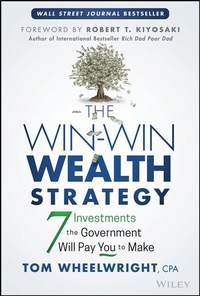
The Win-Win Wealth Strategy
Description

The government wants your help, and it's willing to pay handsomely.
You just need to know what to do.
In The Win-Win Wealth Strategy: 7 Investments the Government Will Pay You to Make, celebrated entrepreneur, investor, and bestselling author Tom Wheelwright, CPA transforms the way you think about building wealth and challenges the paradigm that tax incentives are immoral loopholes. Backed by deep research in 15 countries, he identifies seven investing strategies that are A-OK with governments worldwide and will fatten your wallet while making the world a better place.
You'll learn:
* How to tax-effectively invest in business, technology, energy, real estate, insurance, agriculture, and retirement accounts
* How to use tax incentives to help pay for your next car, house, or tuition bill
* Why "the rich" are not "a drain on society" and, more importantly, how to become one of them
An indispensable and startlingly insightful exploration of straightforward investing strategies, The Win-Win Wealth Strategy improves your confidence in tax-effective investing, so you make better decisions with your money and supercharge your family's generational wealth while creating jobs, developing technology and improving access to food, energy and housing.
More details
Other editions
Additional editions
Person
Content
Preface xv
Acknowledgments xvii
Introduction 1
Chapter 1 Partnering with the Government 3
Chapter 2 Investment #1: Business 13
Chapter 3 Investment #2: Technology | Research and Development 43
Chapter 4 Investment #3: Real Estate 59
Chapter 5 Investment #4: Energy 83
Chapter 6 Investment #5: Agriculture 97
Chapter 7 Investment #6: Insurance 111
Chapter 8 Investment #7: Retirement Savings 129
Chapter 9 Conclusion 151
Bonus Chapter How to Get the Government to Pay for Your Ferrari 155
Endnotes 163
About the Author 225
Index 227
Chapter 1
Partnering with the Government
"Play by the rules but be ferocious."
-Phil Knight
My first full-time job was with Ernst & Whinney (today Ernst & Young) in its Salt Lake City office. With a master's degree from the University of Texas in hand, I soon learned that even in accounting firms, there were office politics. I was an extremely ambitious young accountant, and if there were office politics in play, then I was going to win. I didn't like office politics or make the rules of the game, but everyone was in the game, whether they wanted to play, or not.
I remember telling my manager at the time, "If I have to play the game, I might as well win it." Within two years, I joined the firm's prestigious National Tax Department in Washington, DC. Thousands had applied, but they only selected five of us to play. I had played the game well and won.
The game of taxes
The game of taxes is like my career at Ernst & Young. While nobody really chooses to "play" the tax game or has much if any control over the rules of the game, we are in the game. It's all about how we'll play the game and whether we will win or lose. Since we must play the game, we can choose what kind of player we'll be. Will we be a bench player or an amateur like most taxpayers, or will we be professionals and dominate the field like the rich?
Another way to look at the relationship between taxpayers and the government is as partners. Like it or not, we are all partners with our government. We share a portion of our income in return for services provided. Every time we receive a paycheck, the government takes a portion in taxes. While it's not really a voluntary partnership, it is one nonetheless. There is a famous scene from the sitcom Friends where the character Rachel receives her first paycheck. "Isn't this exciting?" she says. "I earned this! I wiped tables for it, I steamed milk for it, and it was totally . not worth it. Who's FICA? Why's he getting all my money?"1
The government doesn't really care what kind of partner we are. As a silent partner, we pay our full taxes at the highest rate possible, typically up to 40 percent or more. As an active partner, while doing what the government wants us to do, we can pay very little tax and build massive amounts of wealth at the same time. The government is very keen on encouraging investment in government-favored activities through tax breaks in exchange for us taking the risk of the investment.
To win the game of taxes while participating in socially beneficial activities, you must understand the rules of the game. While some may bend the rules, any professional athlete knows that the best way to be successful on the field is to understand the rules completely and discipline yourself enough to play the game to the best of your ability within the rules.
Few people understand the rules of the tax game. Even the rich don't necessarily understand them. They simply have advisors who do - advisors who know the Tax Code inside and out. They do what these advisors tell them, and they win. The average taxpayers cannot afford such advisors. They must learn the game on their own, and because of this, they start out at a disadvantage. The government, who creates the tax game, also makes the rules, and knows them well. They have the advantage of a huge team of agents defending the rules and practically unlimited resources to enforce them.
The object of the game of taxes
If you want to win the game of taxes, you need to understand the object of the game. The object is not merely to reduce taxes. It's to build wealth that will never be taxed.
By the end of this book, you will clearly understand that building wealth is not something frowned upon by the government. In fact, the government encourages wealth building so long as the wealth is used for government-sponsored activities. The best path to building generational, tax-free wealth is understanding how to best partner with the government. Believe it or not, the government wants us to be rich. They know that much of what they want done is best accomplished by taxpayers, not by them. They provide incentives to taxpayers to invest where they want the investments to be made and to accomplish what they want done.
Rules of the Game 1. We are all partners with the government. 2. Understand the rules completely and be disciplined enough to play the game to the best of your ability within the rules. 3. The object is not merely to reduce taxes, it's to build wealth that will never be taxed.The five goals of every government
Every government has five primary goals:
- Keep the peace. This is not just a function of legal systems, police, and traffic lights. The best way to keep the peace is to prevent uprisings. Uprisings are rooted in people feeling disenfranchised and not being able to meet their basic needs, such as food, clothing, and shelter.2 One way to provide for these basic needs is through government handouts. The challenge with direct handouts is that it's a little like eating a candy bar. It satisfies you for a short while but eventually we want another candy bar . leading to an addiction to sugar and poor health.
Democratic governments historically have stayed away from direct subsidies (with the notable exception of the pandemic subsidies) and have instead encouraged people to get jobs to earn enough to take care of their basic needs, plus surplus for a rainy day. They accomplish this through the private market, encouraging private industry to create enough jobs at high enough wages so people can work to sustain themselves and their families. These jobs are created by three primary sectors: government, large companies (500 employees or more), and small businesses (under 500 employees). In the United States, large and small businesses provide 82 percent of the jobs while the government only provides around 18 percent.3 Most other countries also rely heavily on the private sector for job creation.4 Figure 1.1 below shows job classifications in countries around the world.5
Government jobs are the least efficient way to provide jobs, as a dollar of cost only produces a dollar of results. Private industry produces many jobs at a much lower cost to the government. The benefit to the government for providing incentives to industries is that it costs much less than direct employment.
- Protect the people. One of the primary objectives of most governments is national defense, and this doesn't apply only to military spending. Energy production is another key to a good defense and a strong economy. The United States has long maintained a policy of creating energy independence, only recently achieving it. Japan purportedly attacked Pearl Harbor because the United States cut off its oil supplies,6 and there is strong evidence that Germany lost World War II in large part because of a lack of oil.7
Other aspects of defense include agricultural production and cyber-security. In 2020, the cyberattack through the Orion software showed just how seriously governments must treat the national security defenses through technology.8 Subsequently, there have been frequent security breaches that have affected energy transmission.9 There have also been suspicions of security breaches through the Chinese company Huawei, leading Canada and the United States to ban the use of Huawei products.10,11 Cyber-security has become a primary effort of governments to defend infrastructure and national defense secrets.12
- Feed the people. "Let them eat cake" is not an effective way to maintain civilian peace and harmony, as Marie Antoinette discovered. The Arab Spring in the early 2010s was largely attributed to a low standard of living among the masses.13 A lack of food and basic necessities is widely believed to have led to the civil wars in Yemen, Syria, Iraq, and Libya.14 The rise of Adolf Hitler's National Socialists came with the devaluation of the Reichsmark and the subsequent hunger and inability for people to have their basic needs met. More recently, the call for Universal Basic Income by both then-presidential candidate Andrew Yang15 and by U.S. Vice President Kamala Harris,16 along with the earned income credit, the call for increased minimum wages,17 and the child tax credits in the January 2021 stimulus bill enacted by the U.S. Congress18 have all been efforts to ensure the basic needs of the poor and lower middle class are adequately met.
- Shelter the people. Governments learned long ago that private markets do a better job of providing housing than public projects. Poland, Russia, the Czech Republic, and other former Soviet countries still feel the effects of public housing projects. The same is true for parts of the United States in cities like New York and Detroit as well as in the southern suburbs of Paris, France.19 Encouraging the private markets to create housing has long proven to produce a better result, both for the...
