

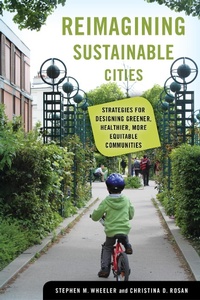
Reimagining Sustainable Cities
Strategies for Designing Greener, Healthier, More Equitable Communities
1st Edition
Published on 7. December 2021
344 pages
978-0-520-38120-9 (ISBN)
Description

A cutting-edge, solutions-oriented analysis of how we can reimagine cities around the world to build sustainable futures.
What would it take to make urban places greener, more affordable, more equitable, and healthier for everyone? In recent years, cities have stepped up efforts to address climate and sustainability crises. But progress has not been fast enough or gone deep enough. If communities are to thrive in the future, we need to quickly imagine and implement an entirely new approach to urban development: one that is centered on equity and rethinks social, political, and economic systems as well as urban designs. With attention to this need for structural change, Reimagining Sustainable Cities advocates for a community-informed model of racially, economically, and socially just cities and regions. The book aims to rethink urban sustainability for a new era.
In Reimagining Sustainable Cities, Stephen M. Wheeler and Christina D. Rosan ask big-picture questions of interest to readers worldwide: How do we get to carbon neutrality? How do we adapt to a climate-changed world? How can we create affordable, inclusive, and equitable cities? While many books dwell on the analysis of problems, Reimagining Sustainable Cities prioritizes solutions-oriented thinking-surveying historical trends, providing examples of constructive action worldwide, and outlining alternative problem-solving strategies. Wheeler and Rosan use a social ecology lens and draw perspectives from multiple disciplines. Positive, readable, and constructive in tone, Reimagining Sustainable Cities identifies actions ranging from urban design to institutional restructuring that can bring about fundamental change and prepare us for the challenges ahead.
What would it take to make urban places greener, more affordable, more equitable, and healthier for everyone? In recent years, cities have stepped up efforts to address climate and sustainability crises. But progress has not been fast enough or gone deep enough. If communities are to thrive in the future, we need to quickly imagine and implement an entirely new approach to urban development: one that is centered on equity and rethinks social, political, and economic systems as well as urban designs. With attention to this need for structural change, Reimagining Sustainable Cities advocates for a community-informed model of racially, economically, and socially just cities and regions. The book aims to rethink urban sustainability for a new era.
In Reimagining Sustainable Cities, Stephen M. Wheeler and Christina D. Rosan ask big-picture questions of interest to readers worldwide: How do we get to carbon neutrality? How do we adapt to a climate-changed world? How can we create affordable, inclusive, and equitable cities? While many books dwell on the analysis of problems, Reimagining Sustainable Cities prioritizes solutions-oriented thinking-surveying historical trends, providing examples of constructive action worldwide, and outlining alternative problem-solving strategies. Wheeler and Rosan use a social ecology lens and draw perspectives from multiple disciplines. Positive, readable, and constructive in tone, Reimagining Sustainable Cities identifies actions ranging from urban design to institutional restructuring that can bring about fundamental change and prepare us for the challenges ahead.
More details
Other editions
Additional editions
Stephen M. Wheeler | Christina D. Rosan
Reimagining Sustainable Cities
Strategies for Designing Greener, Healthier, More Equitable Communities
Book
12/2021
1st Edition
University of California Press
€28.47
Shipment within 10-20 days
Person
Stephen M. Wheeler is a Professor in the Department of Human Ecology at the University of California, Davis. His previous books include Planning for Sustainability, The Sustainable Urban Development Reader (co-edited with Timothy Beatley), and Climate Change and Social Ecology. He is a Switzer Fellow and winner of the Dale Prize for Excellence in Urban and Regional Planning.
Christina D. Rosan is an Associate Professor in the Department of Geography and Urban Studies at Temple University in Philadelphia. Her books include Governing the Fragmented Metropolis: Planning for Regional Sustainability, Growing a Sustainable City?: The Question of Urban Agriculture (with Hamil Pearsall), and Planning Ideas That Matter (co-edited with Bishwapriya Sanyal and Lawrence Vale).
Christina D. Rosan is an Associate Professor in the Department of Geography and Urban Studies at Temple University in Philadelphia. Her books include Governing the Fragmented Metropolis: Planning for Regional Sustainability, Growing a Sustainable City?: The Question of Urban Agriculture (with Hamil Pearsall), and Planning Ideas That Matter (co-edited with Bishwapriya Sanyal and Lawrence Vale).
Content
List of Illustrations
Introduction
1. How Do We Get to Climate Neutrality?
2. How Do We Adapt to the Climate Crisis?
3. How Might We Create More Sustainable Economies?
4. How Can We Make Affordable, Inclusive, and Equitable Cities?
5. How Can We Reduce Spatial Inequality?
6. How Can We Get Where We Need to Go More Sustainably?
7. How Do We Manage Land More Sustainably?
8. How Do We Design Greener Cities?
9. How Do We Reduce Our Ecological Footprints?
10. How Can Cities Better Support Human Development?
11. How Might We Have More Functional Democracy?
12. How Can Each of Us Help Lead the Move toward Sustainable Communities?
Conclusion
Acknowledgments
Notes
Index
Introduction
1. How Do We Get to Climate Neutrality?
2. How Do We Adapt to the Climate Crisis?
3. How Might We Create More Sustainable Economies?
4. How Can We Make Affordable, Inclusive, and Equitable Cities?
5. How Can We Reduce Spatial Inequality?
6. How Can We Get Where We Need to Go More Sustainably?
7. How Do We Manage Land More Sustainably?
8. How Do We Design Greener Cities?
9. How Do We Reduce Our Ecological Footprints?
10. How Can Cities Better Support Human Development?
11. How Might We Have More Functional Democracy?
12. How Can Each of Us Help Lead the Move toward Sustainable Communities?
Conclusion
Acknowledgments
Notes
Index
