

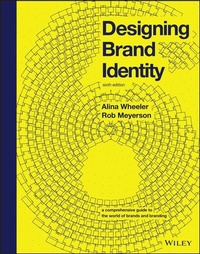
Designing Brand Identity
A Comprehensive Guide to the World of Brands and Branding
6th Edition
Published on 9. January 2024
352 pages
978-1-119-98482-5 (ISBN)
Description

Revised and updated sixth edition of the best-selling guide to branding fundamentals, strategy, and process.
It's harder than ever to be the brand of choice--in many markets, technology has lowered barriers to entry, increasing competition. Everything is digital and the need for fresh content is relentless. Decisions that used to be straightforward are now complicated by rapid advances in technology, the pandemic, political polarization, and numerous social and cultural changes.
The sixth edition of Designing Brand Identity has been updated throughout to address the challenges faced by branding professionals today. This best-selling book demystifies branding, explains the fundamentals, and gives practitioners a roadmap to create sustainable and successful brands. With each topic covered in a single spread, the book celebrates great design and strategy while adding new thinking, new case studies, and future-facing, global perspectives.
Organized into three sections--brand fundamentals, process basics, and case studies--this revised edition includes:
* Over 100 branding subjects, checklists, tools, and diagrams
* More than 50 all-new case studies that describe goals, process, strategy, solutions, and results
* New content on artificial intelligence, virtual reality, social justice, and evidence-based marketing
* Additional examples of the best/most important branding and design work of the past few years
* Over 700 illustrations of brand touchpoints
* More than 400 quotes from branding experts, CEOs, and design gurus
Whether you're the project manager for your company's rebrand or you need to educate your staff or students about brand fundamentals, Designing Brand Identity is the quintessential resource. From research to brand strategy, design execution to launch and governance, Designing Brand identity is a compendium of tools for branding success and best practices for inspiration.
It's harder than ever to be the brand of choice--in many markets, technology has lowered barriers to entry, increasing competition. Everything is digital and the need for fresh content is relentless. Decisions that used to be straightforward are now complicated by rapid advances in technology, the pandemic, political polarization, and numerous social and cultural changes.
The sixth edition of Designing Brand Identity has been updated throughout to address the challenges faced by branding professionals today. This best-selling book demystifies branding, explains the fundamentals, and gives practitioners a roadmap to create sustainable and successful brands. With each topic covered in a single spread, the book celebrates great design and strategy while adding new thinking, new case studies, and future-facing, global perspectives.
Organized into three sections--brand fundamentals, process basics, and case studies--this revised edition includes:
* Over 100 branding subjects, checklists, tools, and diagrams
* More than 50 all-new case studies that describe goals, process, strategy, solutions, and results
* New content on artificial intelligence, virtual reality, social justice, and evidence-based marketing
* Additional examples of the best/most important branding and design work of the past few years
* Over 700 illustrations of brand touchpoints
* More than 400 quotes from branding experts, CEOs, and design gurus
Whether you're the project manager for your company's rebrand or you need to educate your staff or students about brand fundamentals, Designing Brand Identity is the quintessential resource. From research to brand strategy, design execution to launch and governance, Designing Brand identity is a compendium of tools for branding success and best practices for inspiration.
More details
Other editions
Additional editions
Alina Wheeler | Rob Meyerson
Designing Brand Identity
A Comprehensive Guide to the World of Brands and Branding
Book
05/2024
6th Edition
Wiley
€52.50
Available immediately
Persons
Alina Wheeler is a branding consultant who engages enterprises in a dynamic process to build their brands and embrace best practices. Wheeler inspires the whole branding team to seize every opportunity to design compelling customer experiences at every touchpoint. Her best-selling book, Designing Brand Identity, published in 11 languages, was the first book to deconstruct the branding process into a universal, five-phase methodology. She is a past Board member of AIGA and a member of the advisory council for The Dictionary of Brand. She speaks frequently to executives, practitioners, and students around the world. She is also the co-author of Brand Atlas: Branding Intelligence Made Visible.
Rob Meyerson is principal and founder of Heirloom, an independent brand strategy and identity firm. His specialties include naming, brand strategy, brand architecture, and messaging, and past clients include Adobe, John Deere, Disney, and Hewlett Packard Enterprise. Prior to Heirloom, Rob's previous roles included head of brand architecture and naming at HP, director of verbal identity at Interbrand in San Francisco, and director of strategy at FutureBrand, Southeast Asia. Rob is the author of Brand Naming: The Complete Guide to Creating a Name for Your Company, Product, or Service and has published articles about brand strategy and naming in Harvard Business Review, Business Insider, The Guardian, TechCrunch, and Entrepreneur.
Rob Meyerson is principal and founder of Heirloom, an independent brand strategy and identity firm. His specialties include naming, brand strategy, brand architecture, and messaging, and past clients include Adobe, John Deere, Disney, and Hewlett Packard Enterprise. Prior to Heirloom, Rob's previous roles included head of brand architecture and naming at HP, director of verbal identity at Interbrand in San Francisco, and director of strategy at FutureBrand, Southeast Asia. Rob is the author of Brand Naming: The Complete Guide to Creating a Name for Your Company, Product, or Service and has published articles about brand strategy and naming in Harvard Business Review, Business Insider, The Guardian, TechCrunch, and Entrepreneur.
Content
- Cover
- Title Page
- Copyright
- Contents
- Designing Brand Identity
- Basics: Part 1 presents the fundamental concepts needed to kick-start the branding process and creates a shared vocabulary for the entire team.
- Brand basics
- Brand
- Branding
- Brand identity
- Brand strategy
- Why invest
- Stakeholders
- Organizational culture
- Brand experience
- Brand architecture
- Visual identity
- Messaging and voice
- Brand governance
- Brand ideals
- Overview
- Vision
- Meaning
- Authenticity
- Coherence
- Flexibility
- Commitment
- Value
- Differentiation
- Longevity
- Brand elements
- Names
- Brandmarks
- Wordmarks
- Letterform marks
- Pictorial marks
- Abstract marks
- Emblems
- Dynamic marks
- Taglines
- Characters
- Brand dynamics
- Overview
- Social justice
- Sustainability
- Global and local
- Artificial intelligence
- Big data analytics
- Social media
- Digital interfaces
- Mobile apps
- Evidence-based marketing
- Private labeling
- Brand licensing
- Certification
- Crisis communications
- Personal branding
- Before and after
- Overview
- Brandmark redesign
- Packaging redesign
- Renaming
- Process: Part 2 presents a universal process regardless of the project's scope and nature. This section answers the question "Why does it take so long?"
- Process basics
- Overview
- Managing the process
- Brand initiatives
- Measuring success
- Collaboration
- Decision making
- Intellectual property
- Design management
- Phase 1 Conducting research
- Overview
- Defining the problem
- Market research
- Usability testing
- Marketing audit
- Competitive audit
- Verbal audit
- Findings report
- Phase 2 Clarifying strategy
- Overview
- Narrowing the focus
- Positioning
- Brand brief
- Naming
- Phase 3 Designing identity
- Overview
- Identity system design
- Look and feel
- Color
- Typography
- Iconography
- Sound
- Other senses
- Trial applications
- Presentation
- Phase 4 Creating touchpoints
- Overview
- Content strategy
- Website
- Collateral
- Stationery
- Product design
- Packaging
- Advertising
- Branded environments
- Signage and wayfinding
- Vehicles
- Uniforms
- Ephemera
- Phase 5 Managing assets
- Overview
- Changing brand assets
- Launching
- Building brand champions
- Online brand centers
- Guidelines
- Guidelines content
- Brand books
- Best Practices: Part 3 showcases best practices. Local and global, public and private, these projects inspire and exemplify original, flexible, lasting solutions.
- Case studies
- AC Milan
- Adventr
- Airbnb China
- Algramo
- Batiste
- Better Place Forests
- BCG X
- Campbell
- Choban
- City of Vienna
- Deloitte
- DonorsChoose
- DuPont
- Eames Institute
- Eat Curious
- 82nd Street Partnership
- Filthy
- Folx
- Fremtind
- Gentari
- GSK
- Helen of Troy
- High Street Market & Deli
- Hootsuite
- Hopscotch
- Human Rights First
- Italicus
- Jodrell Bank
- KatKin
- Kia
- Lavish Pizza
- LEGO
- LONGFU
- Lucid Motors
- Lumanity
- The Mellon Foundation
- Oli!
- oLiv
- OneTen
- Pan-Afrikan Design Institute
- Papier
- Perth Airport
- Petbarn
- Piedmont Art Walk
- Saga
- Salehiya
- Santa Barbara Botanic Garden
- Sense
- Spotify
- Sun Day Carwash
- US Open
- Viva
- Color Plate
- Index
- About the authors
- Back Cover
- EULA
