

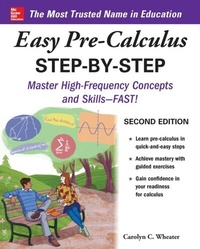
Easy Pre-Calculus Step-by-Step, Second Edition
1st Edition
Published on 28. December 2018
400 pages
978-1-260-13512-1 (ISBN)
Available for download
Description

Get the knowledge and skills you need to solve pre-calculus problems with confidence!The quickest route to learning a subject is through a solid grounding in the basics. Rather than endless drills, this accessible guide presents an original, step-by-step approach to help you develop a better understanding of pre-calculus topics. You'll find important concepts linked together by clear explanations, invaluable exercises, and helpful worked-out problems. Once you've mastered the topics in this book, you will find yourself well-equipped to begin your calculus studies. This book features:*A new Trigonometry chapter that will round out your pre-calculus studies*Clear explanations that break down concepts into easy-to-understand steps*Stay-in-step "e,pop-ups"e, offering helpful advice and cautions against common errors*Step-it-up skill-building exercises linking practice to the core steps already presented*Worked-out solutions to all exercises that reinforce understanding of concepts
More details
Other editions
Additional editions
Carolyn Wheater
Easy Pre-Calculus Step-by-Step, Second Edition
Book
01/2019
2nd Edition
McGraw-Hill Education
€29.70
Shipment within 10-20 days
Content
- Cover
- Title Page
- Copyright Page
- Contents
- Preface
- 1 Graphs and the Graphing Calculator
- Step 1. Review Linear Equations
- Step 2. Meet the Parents
- Step 3. Master the Fundamentals of Graphing
- Step 4. Transform the Graphs
- Step 5. Master Basic Calculator Skills
- 2 Functions
- Step 1. Analyze Relations and Functions
- Step 2. Perform Arithmetic of Functions
- Step 3. Compose Functions
- Step 4. Find Inverse Functions
- 3 Quadratic Functions
- Step 1. Solve Quadratic Functions
- Step 2. Explore Complex Numbers
- Step 3. Graph Parabolas
- Step 4. Apply What You've Learned
- 4 Polynomial Functions
- Step 1. Factor Polynomials
- Step 2. Use Synthetic Division to Find Zeros
- Step 3. Use Long Division to Factor Polynomials
- Step 4. Find the Zeros of Polynomial Functions
- Step 5. Graph Polynomial Functions
- 5 Rational Functions
- Step 1. Operate with Rational Expressions
- Step 2. Deal with Discontinuities
- Step 3. Examine End Behavior
- Step 4. Find Intercepts
- Step 5. Graph Rational Functions
- 6 Conic Sections
- Step 1. Analyze and Graph Parabolas
- Step 2. Analyze and Graph Ellipses
- Step 3. Analyze and Graph Circles
- Step 4. Analyze and Graph Hyperbolas
- Step 5. Graph and Solve Quadratic Systems
- 7 Exponential and Logarithmic Functions
- Step 1. Get to Know the Exponential Function
- Step 2. Define the Logarithmic Function
- Step 3. Learn to Use Properties of Logarithms
- Step 4. Solve Exponential and Logarithmic Equations
- Step 5. Explore Exponential Growth and Decay
- 8 Radical Functions
- Step 1. Review Rules for Exponents
- Step 2. Simplify Radicals and Rationalize Denominators
- Step 3. Explore the Square Root and Cube Root Functions
- 9 Systems of Equations
- Step 1. Review Two-Variable Linear Systems
- Step 2. Solve Systems of Linear Equations in Three Variables
- Step 3. Solve Nonlinear Systems
- 10 Matrices and Determinants
- Step 1. Master Matrix Arithmetic
- Step 2. Find Determinants
- Step 3. Apply Cramer's Rule
- Step 4. Find Inverse Matrices
- Step 5. Solve Systems by Inverse Matrices
- 11 Triangle Trigonometry
- Step 1. Review Right Triangle Trigonometry
- Step 2. Use Trigonometry to Find Areas
- Step 3. Use the Law of Cosines to Extend to Nonright Triangles
- Step 4. Apply the Law of Sines
- 12 Trigonometric Functions
- Step 1. Expand Your Concept of Angles
- Step 2. Learn the Unit Circle
- Step 3. Define Trigonometric Functions
- Step 4. Explore Inverse Trigonometric Functions
- Step 5. Verify Identities
- Step 6. Use Identities
- Step 7. Solve Trigonometric Equations
- 13 Polar and Parametric Equations
- Step 1. Plot Points in the Polar Coordinate System
- Step 2. Convert Coordinates Between Systems
- Step 3. Graph Polar Equations
- Step 4. Convert Equations Between Polar and Rectangular Forms
- Step 5. Convert Equations Between Parametric and Function Forms
- Step 6. Graph Parametric Equations
- 14 Transformations
- Step 1. Understand the Geometry of Reflections
- Step 2. Translate by Reflecting
- Step 3. Rotate by Reflecting
- Step 4. Dilate Geometrically
- Step 5. Use Matrices for Transformations
- 15 Rotating Conics
- Step 1. Create the Equation that Rotates a Conic
- Step 2. Recognize Rotation in Equations
- Step 3. Graph a Rotated Conic
- Step 4: Classify Rotated Conics without Graphing
- 16 Complex Numbers
- Step 1. Change Between Forms
- Step 2. Add and Subtract Complex Numbers
- Step 3. Multiply and Divide Complex Numbers
- Step 4. Raise a Complex Number to a Power
- Step 5. Find the Roots of a Complex Number
- 17 Limits
- Step 1. Evaluate Limits
- Step 2. Deal with Problems
- Step 3. Use Properties of Limits
- Step 4. Evaluate Infinite Limits and Limits at Infinity
- 18 Sequences and Series
- Step 1. Find Terms of Sequences
- Step 2. Find Limits of Sequences
- Step 3. Find Sums of Series
- Step 4. Find Sums of Infinite Series
- Answer Key
- Index

