

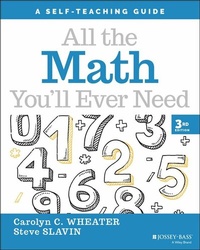
All the Math You'll Ever Need
Description

In the newly revised third edition of All the Math You'll Ever Need: A Self-Teaching Guide, veteran math and computer technology teacher Carolyn Wheater and veteran mathematics author Steve Slavin deliver a practical and accessible guide to math you can use every day and apply to a wide variety of life tasks. From calculating monthly mortgage payments to the time you'll need to pay off a credit card, this book walks you through the steps to understanding basic math concepts.
This latest edition is updated to reflect recent changes in interest rates, prices, and wages, and incorporates information on the intelligent and efficient use of calculators and mental math techniques. It also offers:
* A brand-new chapter on hands-on statistics to help readers understand common graphs
* An easy-to-use-format that provides an interactive method with frequent questions, problems, and self-tests
* Complete explanations of necessary mathematical concepts that explore not just how math works, but also why it works
Perfect for anyone seeking to make practical use of essential math concepts and strategies in their day-to-day life, All the Math You'll Ever Need is an invaluable addition to the libraries of students who want a bit of extra help applying math in the real world.
More details
Other editions
Additional editions
Persons
Steve SLAVIN has a PhD in economics from New York University, and taught economics for 31 years at New York Institute of Technology, Brooklyn College, and New Jersey's Union County College of Mathematics.
Content
Acknowledgments
1 Getting Started
2 Essential Arithmetic
Addition
What Is Multiplication?,
Subtraction
Division
3 Focus on Multiplication
The Multiplication Table,
Learning the Multiplication Table,
Testing Your Knowledge,
About Long Multiplication,
Practice Exercises with Two Digits,
Multiplying Three Digits,
Four-Digit Multiplication,
Word Problems with Multiplication,
4 Focus on Division
Short Division,
Long Division,
Word Problems with Division,
5 Mental Math
Fast Multiplication,
Fast Division,
How Are You Doing So Far?,
Mental Math Tricks
6 Positive and Negative Numbers
What Are Negative Numbers?,
Adding Positive and Negative Numbers,
Subtracting Positive and Negative Numbers,
Multiplying Positive and Negative Numbers,
Division with Positive and Negative Numbers,
7 Fractions
Changing the Look of Fractions,
Adding Fractions,
Subtracting Fractions,
Multiplying by Fractions,
Dividing by Fractions,
8 Decimals
Adding and Subtraction with Decimals,
Multiplying with Decimals,
Dividing with Decimals,
9 Converting Fractions and Decimals
Converting Fractions into Decimals,
Converting Decimals into Fractions,
Simplifying Fractions,
Repeating Decimals
Non-terminating Decimals
10 Ratios and Proportions
Ratios,
Proportions,
11 Solving Problems
Words and Fractions,
Word Problems with Money,
12 Area and Perimeter
Areas of Rectangles,
When We Use Area,
Perimeters of Rectangles,
Areas of Triangles,
13 Circumference and Area
Circumferences of Circles,
The Area of a Circle,
14 Percentages
Fractions, Decimals, and Percents,
Percent Change,
Fast Percent Change,
Percent Distribution,
Tipping,
15 Solving Simple Equations
The Care and Treatment of Equations,
Isolating x,
Addition and Subtraction with x,
Multiplication and Division with x,
Fractions and Decimals in Equations,
Negative Numbers,
Multi-Step Equations,
16 Powers and Roots
Exponents,
Roots,
Advanced Problems,
17 Very Large and Very Small Numbers
Writing Large Numbers,
Scientific Notation,
Millions, Billions, Trillions, and Beyond
Multiplying Large Numbers,
Dividing Large Numbers,
Scientific Notation for Very Small Numbers,
18 Algebra Problems
Age Problems,
Finding the Numbers,
Mixture Problems,
19 Interest Rates
Simple Interest,
Compound Interest,
A Word on Continuous Compounding,
Doubling Time: The Rule of 70,
Discounting,
20 Rate, Time and Distance
The Magic Formula,
The Terms,
Finding Distance,
Finding Rate,
Finding Time,
Rate, Time, and Distance Problems,
Speed Limit Problems,
21 Personal Finances
Mark-Down Problems,
Sales Tax Problems,
Credit Cards,
Federal Income Tax,
Mortgage Interest and Taxes,
22 Business Math
Commissions,
Mark-Ups,
Discounting from List Price,
Quantity Discounts,
2/10 n/30,
Chain Discounts,
Profit
23 A Taste of Statistics
Distributions of Data,
Measures of Center,
Measures of Spread,
Estimating,
24 Review
Index
2
Essential Arithmetic
Every number system (and, yes, there are or have been others) is made up of a set of symbols that we call numbers and one or more operations you can perform with them. Those operations make up what we call arithmetic. The basic operation in our number system is addition, the act of putting together. The other operations-multiplication, subtraction, division-are related to, or built from, addition.
1 ADDITION
Addition is, at its heart, about counting. If you have 6 pair of shoes and you buy 3 new pairs, counting will tell you that you now have 9 pairs. You added 6 + 3 and got an answer of 9 by counting. After a while you don't have to count every time, because you get to know that 6 + 3 = 9.
You store a lot of addition facts like that in your memory, but there's a limit to how much memorization can help. You probably know that 4 + 8 = 12, but you're unlikely to memorize the answer to 5,387 + 9,748. Adding larger numbers requires a little more information about our number system.
Place Value
Our number system is a place value system, meaning that the value of a numeral depends on the place it sits in. In the number 444 each 4 has a different meaning. The 4 on the right is in the ones place so it represents 4 ones or simply 4. The 4 on the left is in the hundreds place and represents 4 hundreds or 400. The middle 4 is in the tens place so it represents 4 tens or 40. The number 444 is a shorthand for 400 + 40 + 4.
That expanded form, 400 + 40 + 4, helps to explain how we add large numbers. We add the ones to the ones, the tens to the tens, the hundreds to the hundreds and on up in the place value system. If you need to add 444 + 312, think:
Add the 4 ones and the 2 ones to get 6 ones, the 4 tens with 1 ten to get 5 tens and the 4 hundreds with 3 hundreds to get 7 hundreds. Now that would look like this:
You're probably thinking that you could just write the numbers underneath one another in standard form and add down the columns, and you'd be absolutely correct.
The reason to think about it in expanded form, at least for a few minutes, comes up when you have to add something like 756 + 968. The basic rule is the same.
But you can't squeeze 16 (or 11 or 14) into one place. 756 + 968 does not equal 161114. You've got to do some regrouping, or what's commonly called carrying. Those 14 ones equal 1 ten and 4 ones. You're going to keep the 4 ones in the ones place and move the ten over to the middle place with the rest of the tens. That will turn
You'll do the same sort of regrouping with the 12 tens. Ten of those tens make 1 hundred, leaving 2 tens in the tens place. You can do this without using the expanded form. Add 6 + 8 to get 14. Put down the 4 and carry the one ten.
Add 1 + 5 + 6 to get 12. Put down the 2 (tens) and carry the 1 (hundred).
Add 1 + 7 + 9 to get 17. The 7 goes in the hundreds place and the 1 (thousand) slides into the thousands place.
Problem 1:
Add 312 and 423.
Solution:
All that's necessary is adding the digits in each column: 2 + 3 = 5, 1 + 2 = 3, and 3 + 4 = 7.
Problem 2:
What is the result when 459 is added to 1,276?
Solution:
This one requires a little bit of regrouping. Add 6 + 9 to get 15, put down the 5 and carry 1 to the next column. Then 7 + 5 is 12, plus the 1 you carried is 13. Put down the 3 and carry the 1. You can think of the rest as 2 + 4 + 1 = 7 and the 1 thousand comes down unchanged, or you can think of it as 12 + 4 is 16, plus 1 you carried is 17.
Problem 3:
What is the combined total of 9,671 and 2,859?
Solution:
Here again you're regrouping. In the ones column, 1 + 9 is 10, so put down the 0 and carry the 1. Then 7 + 5 is 12 plus 1 you carried makes 13. Put down the 3 and carry the 1. Add 6 + 8 + 1 to get 15. Put down the 5 and carry the 1. Finally, 9 + 2 + 1 is 12.
2 MULTIPLICATION
Multiplication is repeated addition. For instance, you probably know 4 × 3 is 12 because you searched your memory for that multiplication fact. There's nothing wrong with that.
Another way to calculate 4 × 3 is to think of it as adding four threes, or adding three fours.
What about 5 × 7? Maybe you know it's 35, but you could always do this:
You do multiplication instead of addition because it's shorter-sometimes much shorter. Suppose you needed to multiply 78 × 95. If you set this up as an addition problem, you'd have to write 78 copies of 95 before you could even start adding.
Let's set this up as a regular multiplication problem and take a look at the expanded form.
The key to this multiplication is you have to multiply 8 × 5 and 8 × 90 and then multiply 70 × 5 and 70 × 90, and add up all the results. Don't get discouraged, because there is a condensed form.
The first set of numbers we'd multiply would be 8 × 5. You probably know, or can figure out, that's 40. (We'll focus on all the multiplication facts you should memorize in Chapter 3, "Focus on Multiplication.") Then we'd multiply 8 × 90, which just means multiplying 8 × 9 and putting a zero at the end. Whenever you multiply a number that ends in zero, you can deal with the non-zero parts and add the zero at the end. (See Chapter 5, "Mental Math" for more on that shortcut.) 8 × 9 =72 so 8 × 90 = 720. Next would come 70 × 5. 7 × 5 = 35 so 70 × 5 =350. The last multiplication would be 70 × 90. Multiply 7 × 9 = 63, and then add a zero for the 70 and another zero for the 90. 70 × 90 = 6,300. Add up 6,300 + 350 + 720 + 40 to get 7,410.
Here's how to write it more compactly. Multiply 8 × 5 = 40, put down the 0 and carry the 4. 8 × 9 = 72 and the 4 we carried makes 76. Write the 76 in front of that 0 you put down and you see 760. This 760 is the 40 and the 720 combined. Now, you need to multiply 95 by 70, which means multiply by 7 and add a zero. So put the zero down first, under the 0 of the 760. Then 7 × 5 = 35. Put down the 5 to the left of the 0 and carry the 3. 7 × 9 = 63 plus the 3 you carried is 66. Write the 66 in front of the 50 and you've got 6,650, which is the 350 and 6300 combined. Add the two lines, and you're done.
As you can see, a long multiplication problem can be broken down into a series of simple multiplication problems. It's important to have basic multiplication facts in memory, so you don't have to spend time doing the repeated addition every time. You'll learn more about that in the next chapter.
Problem 1:
Multiply 73 by 5.
Solution:
Begin with 5 × 3 = 15. Put down the 5 and carry 1. Then 5 × 7 is 35 plus the 1 you carried is 36.
Problem 2:
Find the product of 86 and 12.
Solution:
First multiply 86 by 2.
Multiplying 2 × 6 gives you 12, so put down the 2 and carry 1. Then 2 × 8 is 16 plus 1 you carried is 17.
Place a zero at the end of the second line, or if you prefer, just move one space right, and multiply 1 × 86, which obviously is 86. Add the columns to complete the job.
Problem 3:
What is the result when 125 is multiplied by 32?
Solution:
Multiplying 125 by 2 requires a little bit of carrying.
Place a zero on the second line, or move one space right, then multiply 3 × 125. Add down each column, regrouping where necessary.
Ready to test yourself? Try Self-Test 2.1.
SELF-TEST 2.1
- Add 453 and 975.
- Find the sum of 1,864 and 798.
- Multiply 561 by 92.
- What is the product of 891 and 30?
- Multiply 135 × 112.
If the first two gave you trouble, review Frame 1. If you got any of the last three wrong, review Frame 2. If you've got this, move on!
3 SUBTRACTION
Subtraction is the inverse, or opposite, of addition. Addition puts together. Subtraction takes apart. If you buy a carton of 12 eggs and you use 4 of them to make breakfast, how many eggs are left? 12 - 4 = 8 if you count the remaining eggs. That subtraction problem is another way of thinking about the addition problem 4 + 8 = 12. Each subtraction problem has a related addition problem. 17 - 9 = ? is related to 9 + what = 17? Sometimes it's easier to think about the addition version. If you have 9 and you want 17, you need 1 to make 10 and then 7 more to get up to 17. That's a total of 8.
For larger problems, you'll work column by column,...
