

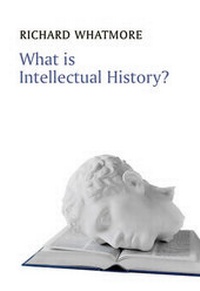
What is Intellectual History?
Description

In this engaging and refreshing introduction to the field, Richard Whatmore begins by examining the historical development of intellectual history, before dissecting its various methodological debates. He presents various alternative ways in which we should think about intellectual history, as well as presenting his own very clear definition of the field. Drawing on a wide range of historical examples, Whatmore shows how ideas - philosophical, political, religious, scientific, artistic - originated in their historical context and how they were both shaped by, and helped to shape, the societies in which they originated. He ends by casting a critical eye over the current state of intellectual history, and a brief discussion of how it might develop in the future.
What is Intellectual History? will become an essential textbook for scholars and students of intellectual history, philosophy, politics, and the humanities.
More details
Other editions
Additional editions
Person
Content
Acknowledgements
Introduction
The identity of intellectual history
The history of intellectual history
The method of intellectual history
The practice of intellectual history
The relevance of intellectual history
Intellectual history present and future
Conclusion
Notes
Further reading
Index
Introduction
On the eastern side of Lake Windermere in Cumbria, in the north west of England, there was once a quarry at Ecclerigg Crag producing slate and stone for the remarkable buildings of the region. Active between the eighteenth and the early twentieth century, the quarry was sufficiently large to have its own dock. Having passed into history, what remains in the grounds of the hotel now standing on the site are five large slabs with detailed carvings made into the bedrock, in addition to ad hoc rocks both submerged in and out of the water. Some of the carvings are dated between 1835 and 1837. One of the master craftsmen employed at the quarry evidently took it upon himself to carve messages into the bare slate. The carvings include names of national and local significance, including 'Nelson', 'Newton', 'Walter Scott', 'Wordsworth', 'Jenner', 'Humphry Davy', 'Richard Watson', as well as the owner of the site, 'John Wilson', the friend of the Lake Poets and a well known local personage through his writing for Blackwood's Magazine and his being Professor of Moral Philosophy at Edinburgh (1820-51), and 'John Laudon McAdam', of road-repairing fame, in addition to the names of several individuals who had endowed local schools. One of the largest slabs, almost five metres high, gives an indication of the opinions of the mason, declaring in gigantic letters 'National Debt L800,000,000 / O, Save My Country, Heaven! / George 3, William Pitt / Money is the Sinews of War / Field Marshal Wellington / Heroic Admiral Nelson.'1
What can historians make of these carvings? The social historian might seek to find out information about the social status of quarry workers, their working conditions, their lives beyond the workplace, and the nature of the society in which they lived by reference to class, gender, ritual and identity. The economic historian might seek information about the comparative wages of the workers, the economic conditions of the time, and the relative position of quarry employment by comparison with other local trades, and against national trends more generally. Related carving might be sought and evaluated. The cultural historian might speculate about the local and regional and national discourses through which individuals and social groups expressed themselves, and go further and analyse the power relations between them, painting a picture of the relationships between specific historic individuals and broader social groups. The intellectual historian has to start with the words. What was the author doing the carving seeking to convey? Why did he do so in precisely this manner? How were the arguments he was making stated elsewhere? What was their lineage and what was their reception?
Such labour can be difficult, especially in a case where the meaning is hard to discern or, as in this instance, the words are carved singly or in an epigrammatic fashion. Tracking down the names of the individuals mentioned in the carvings is relatively easy. They reveal a person with knowledge of leading figures in the locality, seemingly respectful of their position, and valuing charitable activity and more especially the endowment of schools for the poor. They also underscore a respect for technological invention and for science, for poetry and literature, and for military prowess and for acts of heroism. Further than this it is more difficult to go, except for the arguments that are contained in the statements on the slabs. This identifies the condition of the country as lamentable due to the national debt, and in need of saving ('O, Save My Country, Heaven!'). Antagonism towards the relationship between money and war is evident in stating that 'Money is the Sinews of War'. William Pitt is mentioned twice alongside this claim, raising the possibility, impossible to confirm or reject, that the author considered Pitt the warmonger of an earlier generation, and possibly of his own youth given the references to Nelson and to Wellington. Typically for that generation, it was possible to laud in a patriotic fashion the qualities of such great men while lamenting the extent of war and its consequences.
More significant is the fact that the quotation 'O, Save My Country, Heaven!' was taken directly from Alexander Pope's epitaph for Dr Francis Atterbury, Bishop of Rochester, who died in exile at Paris in 1732, in the arms of his daughter, and was held to have uttered such a phrase. Atterbury's own use of the epigraph was well known, and derived in turn from that of Father Paolo Sarpi, the great Venetian historian, who on his deathbed said 'Let her endure' (Esto perpetua), a hope that Venice would maintain itself as an independent sovereign power. The claim that 'Money is the Sinews of War', refuted by both Niccolò Machiavelli and Francis Bacon, can be traced to Cicero's Fifth Philippic, and was echoed by authors as diverse as Rabelais and Tennyson. What did these statements mean to the Ecclerigg Crag mason? They were commonplace in eighteenth-century literature, bemoaning the growth of luxury and commercial society, and predicting dire consequences for all societies because of the corresponding unleashing of the libertine passions, of war, and of increasing debt. David Hume, in his essay 'Of public credit' in his Political Discourses (1752), provides a good example of the literature of jeremiad that the mason inherited. Hume was increasingly desperate about the consequences of debt for the nation-states of Europe, and used the singular image of cudgel-playing in a china shop to describe the consequences for contemporary international relations. The key fact was that the china would be smashed, and the same held for domestic economies and civil societies whose states were heavily indebted. Fear of debt reached a peak during the wars with revolutionary France and with Napoleon Bonaparte, with the debt itself standing at more than 250 per cent of gross domestic product, a figure that has not been reached since. Pitt's association with the debt, especially in 1797 when the government released the Bank of England from the obligation to convert currency to gold, would have been obvious to those living at the time.
Fear of a war or debt-induced bankruptcy was a major reason why so many observers of national life in the eighteenth century were certain, with David Hume, that Britain was declining as a state. With the benefit of hindsight we can identify the spark and smouldering of what was later termed 'The Industrial Revolution'. Economic growth, some historians argue, was never greater than during the eighteenth century.2 Equally, Basil Willey and others have described the period as having been characterized by the growth of stability, a prelude to Victorian self-confidence. For contemporaries, however, eighteenth-century Britain was a new state in crisis, plagued by debt, war and political division, between Jacobites and Hanoverians, Whigs and Tories, Anglicans, Catholics and Dissenters, and by enemies and advocates of the commercialization of society. Few commentators believed that the future could be seen in the present, except to the extent that it presaged national ruin. Great transformations were widely viewed to be on the horizon; a sense of uncertainty pervaded. Even authors who were famously phlegmatic or even optimistic about Britain's prospects, such as Adam Smith or Jean-Louis de Lolme, did not think that the status quo was either stable or worth preserving. Far more commonplace was the jeremiad predicting the collapse of Britain and its defeat in war.
That Britain survived the French revolutionary and Napoleonic wars, and did so to emerge as Europe's leading state in terms of economic and political power, was all the more remarkable given the reservations of a legion of observers. Yet despite becoming a model state in terms of polity and economy for so many other countries, intellectual life in Britain continued to be characterized by a sense of false greatness, of inevitable decline and of unnatural development to a peak of political and commercial supremacy that would never last. With the debt levels of the eighteenth century only marginally diminished by the 1830s, echoes of the old lament about British decline could still be heard. This was exactly the case of the mason of Ecclerigg Crag. The man was a throwback to a previous age of apocalyptic concern and anticipation of national ruin. His carvings are significant in revealing the persistence of particular ideas, and of the continued fears for the future on the eve of the 'age of equipoise' itself. As such, the mason's words matter, in giving us a perspective upon the early Victorian era that is sometimes forgotten.
Understanding the meaning of the mason's words underlines the capacity of intellectual history to reveal what is hidden from us in past thought, the ideas and arguments that are neglected because they have been abandoned or rejected by later generations. The intellectual historian seeks to restore a lost world, to recover perspectives and ideas from the ruins, to pull back the veil and explain why the ideas resonated in the past and convinced their advocates. Ideas, and the cultures and practices they create, are foundational to any act of understanding. Ideas are expressive of the actions of leading philosophers, whose conceptions of liberty, justice or equality stand in need of elucidation, of the actions of culturally significant persons in any society, or indeed of the...
