

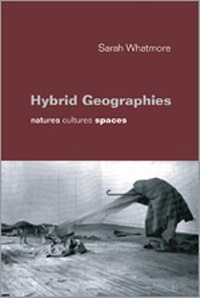
Hybrid Geographies
Natures Cultures Spaces
1st Edition
Published on 20. August 2002
226 pages
978-1-84787-678-2 (ISBN)
Description

`Hybrid Geographies is one of the most original and important contributions to our field in the last 30 years. At once immensley provocative and productive, it is written with uncommon clarity and grace, and promises to breathe new life not only into geographical inquiry but into critical practice across the spectrum of the humanities and social sciences - and beyond. An extraordinary achievement' - Professor Derek Gregory, Department of Geography, University of British Columbia
Hybrid Geographies critically examines the `opposition' between nature and culture, the material and the social, as represented in scientific, environmental and popular discourses. Demonstrating that the world is not an exclusively human achievement, Hybrid Geographies reconsiders the relation between human and non-human, the social and the material, showing how they are intimately and variously linked.
General arguments - informed by work in critical geography, feminist theory, environmental ethics, and science studies - are illustrated throughout with detailed case-study material. This exemplifies the two core themes of the book: a consideration of hybridity (the human/non-human relation) and of the `fault-lines' in the spatial organization of society and nature.
Hybrid Geographies is essential reading for students in the social sciences with an interest in nature, space and social theory.
Hybrid Geographies critically examines the `opposition' between nature and culture, the material and the social, as represented in scientific, environmental and popular discourses. Demonstrating that the world is not an exclusively human achievement, Hybrid Geographies reconsiders the relation between human and non-human, the social and the material, showing how they are intimately and variously linked.
General arguments - informed by work in critical geography, feminist theory, environmental ethics, and science studies - are illustrated throughout with detailed case-study material. This exemplifies the two core themes of the book: a consideration of hybridity (the human/non-human relation) and of the `fault-lines' in the spatial organization of society and nature.
Hybrid Geographies is essential reading for students in the social sciences with an interest in nature, space and social theory.
Reviews / Votes
`Hybrid Geographies is one of the most original and important contributions to our field in the last 30 years. At once immensley provocative and productive, it is written with uncommon clarity and grace, and promises to breathe new life not only into geographical inquiry but into critical practice across the spectrum of the humanities and social sciences - and beyond.An extraordinary achievement' - Professor Derek Gregory, Department of Geography, University of British Columbia
`A wildly fascinating and unique journey through some unexpected spaces of hybrid inquiry. Sarah Whatmore rewrites the nature-society relationship in novel and entertaining ways' - Professor John Urry, Lancaster University
All prices
More details
Edition
First Edition
Language
English
Place of publication
London
United Kingdom
Target group
College/higher education
Professional and scholarly
ISBN-13
978-1-84787-678-2 (9781847876782)
Copyright in bibliographic data and cover images is held by Nielsen Book Services Limited or by the publishers or by their respective licensors: all rights reserved.
Schweitzer Classification
Other editions
Additional editions
Book
08/2002
1st Edition
SAGE Publications Inc
€120.60
Shipment within 15-20 days
Book
08/2002
1st Edition
SAGE Publications Inc
€281.24
Article exhausted; check for reprint
Person
Sarah is a graduate of University College London where she gained a BA (Geography) in 1981; an M.Phil. (Town Planning) in 1983 and, after a stint working for the Greater London Council, a PhD (Geography) in 1988. She spent 12 years teaching in the School of Geographical Sciences at the University of Bristol, where she was promoted to a Chair in Human Geography in 1999 and awarded a DSc for published research in 2000. She moved to the Geography Discipline at the Open University in September 2001 as Professor of Environmental Geography. Sarah has also held visiting appointments in several institutions overseas including the University of California, Santa Cruz and the University of Wisconsin, Madison (USA); the University of Newcastle, (Australia); and the University of Trondheim (Norway).
A Fellow of the Royal Geographical Society (with the Institute of British Geographers) for nearly 20 years, Sarah was elected to the Council of the RGS/IBG and to membership of the Research Committee in June 2004 for 3 years. She is also an elected member of the Academy of Learned Societies in the Social Sciences and a Fellow of the RSA (Royal Society for the encouragement of Arts, Manufactures and Commerce). She is currently an editor of Environment and Planning, A (Pion) and of the Blackwell Dictionary of Human Geography (5th edition), and serves on the editorial boards of several journals.
Her research focuses on relations between people and the material world, particularly the living world, and the spatial habits of thought that inform the ways in which these relations are imagined and practiced in the conduct of science, governance and everyday life. She has published widely on the theoretical and political implications of these questions in two main directions.
A Fellow of the Royal Geographical Society (with the Institute of British Geographers) for nearly 20 years, Sarah was elected to the Council of the RGS/IBG and to membership of the Research Committee in June 2004 for 3 years. She is also an elected member of the Academy of Learned Societies in the Social Sciences and a Fellow of the RSA (Royal Society for the encouragement of Arts, Manufactures and Commerce). She is currently an editor of Environment and Planning, A (Pion) and of the Blackwell Dictionary of Human Geography (5th edition), and serves on the editorial boards of several journals.
Her research focuses on relations between people and the material world, particularly the living world, and the spatial habits of thought that inform the ways in which these relations are imagined and practiced in the conduct of science, governance and everyday life. She has published widely on the theoretical and political implications of these questions in two main directions.
Content
Introducing Hybrid Geographies
SECTION ONE: BEWILDERING SPACES
Displacing the Wild
Topologies of Wildlife
Embodying the Wild
Tales of Becoming Elephant
SECTION TWO: GOVERNING SPACES
Unsettling Australia
Wormholes in Territorial Governance
Reinventing Possession
Boundary Disputes in the Governance of Plant Genetic Resources
SECTION THREE: LIVING SPACES
Transgressing Objectivity
The Monstrous Topicality of `GM' Foods
Geographies of/for a More than Human World
Towards a Relational Ethics
SECTION ONE: BEWILDERING SPACES
Displacing the Wild
Topologies of Wildlife
Embodying the Wild
Tales of Becoming Elephant
SECTION TWO: GOVERNING SPACES
Unsettling Australia
Wormholes in Territorial Governance
Reinventing Possession
Boundary Disputes in the Governance of Plant Genetic Resources
SECTION THREE: LIVING SPACES
Transgressing Objectivity
The Monstrous Topicality of `GM' Foods
Geographies of/for a More than Human World
Towards a Relational Ethics
