

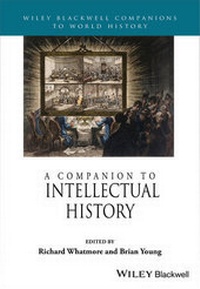
A Companion to Intellectual History
Description

More details
Other editions
Additional editions
Persons
Content
Notes on Contributors
Manuela Albertone is Professor of Early Modern History in the Department of Historical Studies, University of Turin, Italy and Chercheur associé, Institut d'Histoire de la Révolution française, Université Paris 1 Panthéon Sorbonne. Her work focuses on eighteenth-century French and American history, and the relationship between politics and economics. She is a Physiocracy specialist and is particularly interested in the economic origins of political representation. She is the author of numerous books and articles, the most recent of which is National Identity and the Agrarian Republic. The Transatlantic Commerce of Ideas between America and France (1750-1830) (Farnham: Ashgate, 2014). She co-edited with Antonino De Francesco, Rethinking the Atlantic World. Europe and America in the Age of Democratic Revolutions (London: Palgrave Macmillan, 2009).
Edward Baring is Assistant Professor in Modern European Intellectual History at Drew University. He is the author of The Young Derrida and French Philosophy, 1945-1968 (Cambridge: Cambridge University Press, 2011), which won the Morris D. Forkosch Prize for Best Book in Intellectual History, and editor with Peter E. Gordon of The Trace of God: Derrida and Religion (New York: Fordham, 2014). He is currently working on a Europe-wide history of phenomenology in the first half of the twentieth century.
David Burchell is Senior Lecturer in Humanities at the University of Western Sydney and has written on early modern political thought and the histories of ethics, citizenship and religious toleration. He is also a regular contributor to current social and political debates in the national and international media.
John W. Cairns is Professor of Civil Law and Director of the Centre for Legal History in the University of Edinburgh. His research interests lie in legal education and the legal profession (particularly in Enlightenment Scotland), eighteenth-century slavery and the legal history of Louisiana. He is a Fellow of the Royal Society of Edinburgh.
Leo Catana is Associate Professor in the Division of Philosophy, the Department of Media, Cognition and Communication at the University of Copenhagen. He is the author of The Historiographical Concept 'System of Philosophy': Its Origin, Nature, Influence and Legitimacy (Leiden and Boston: Brill, 2008) and The Concept of Contraction in Giordano Bruno's Philosophy (Aldershot: Ashgate, 2005) and has written widely about Platonism, neo-Platonism, and the history and nature of the discipline of philosophy.
John F. M. Clark is lecturer and director of the Institute for Environmental History at the University of St Andrews, where he teaches and researches on history of science, medicine and environment within the School of History. He is the author of Bugs and the Victorians (New Haven: Yale University Press, 2009) and co-editor (with John Scanlan) of Aesthetic Fatigue: Modernity and the Language of Waste (Newcastle upon Tyne: Cambridge Scholars Publishing, 2013).
Stefan Collini is Professor of Intellectual History and English Literature in the Faculty of English at Cambridge University. He has published widely on modern intellectual history, including Public Moralists (Oxford: Clarendon Press, 1991), Matthew Arnold: a Critical Portrait (1994), English Pasts: Essays in History and Culture (Oxford: Oxford University Press, 1999), Absent Minds: Intellectuals in Britain (Oxford: Oxford University Press, 2006), Common Reading: Critics, Historians, Publics (Oxford: Oxford University Press, 2008), and What Are Universities For? (London: Penguin, 2012). He is also a frequent contributor to The London Review of Books, The Times Literary Supplement, The Guardian, and other publications.
Cesare Cuttica is Lecturer in British History, DEPA, Université Paris 8-Vincennes. He is the author of Sir Robert Filmer (1588-1653) and the Patriotic Monarch: Patriarchalism in Seventeenth-Century Political Thought (Manchester University Press, 2012). He edited with Glenn Burgess, Monarchism and Absolutism in Early Modern Europe (London: Pickering & Chatto, 2012), and with Gaby Mahlberg, Patriarchal Moments (London: Bloomsbury, in press). He is currently working on the idea of anti-democracy in early modern England as well as on the thought and methodology of various British intellectual historians.
Michael Drolet teaches the History of Political Thought and Political Theory at Worcester College, University of Oxford. He is a specialist of eighteenth-, nineteenth-, and twentieth-century French thought. He is author of Tocqueville, Democracy and Social Reform (Basingstoke and New York: Palgrave Macmillan, 2003) and The Postmodernism Reader: Foundational Texts (London: Routledge, 2004). He is currently writing an intellectual biography of the French political economist and statesman Michel Chevalier (1806-1879).
Ioannis D. Evrigenis is Professor of Political Science and Chair of the Department of Classics at Tufts University, where he also directs the Bodin Project. He is the author of Fear of Enemies and Collective Action (Cambridge: Cambridge University Press, 2008), which received the 2009 Delba Winthrop Award for Excellence in Political Science, and of Images of Anarchy: The Rhetoric and Science in Hobbes's State of Nature (Cambridge: Cambridge University Press, 2014), as well as co-editor of Herder's Another Philosophy of History and Selected Political Writings (Indianapolis: Hackett Publishing Company, 2004).
Peter E. Gordon is Amabel B. James Professor of History at Harvard University and Faculty Affiliate in the Department of Germanic Languages and Literatures and the Department of Philosophy. He is the author of numerous works, including Continental Divide: Heidegger, Cassirer, Davos (Cambridge, MA: Harvard University Press, 2010), Rosenzweig and Heidegger: Between Judaism and German Philosophy (California: California University Press, 2003), and Adorno and Existence (forthcoming); he has also served as co-editor for several volumes, including The Cambridge Companion to Modern Jewish Philosophy (New York and Cambridge: Cambridge University Press, 2007), Weimar Thought: A Contested Legacy (Princeton: Princeton University Press, 2013), and The Cambridge History of Modern European Thought (forthcoming).
Knud Haakonssen is Professor of Intellectual History at the University of St Andrews and Fellow of the Max Weber Center for Advanced Cultural & Social Studies, University of Erfurt. Books include The Science of a Legislator (Cambridge, Cambridge University Press, 1981), Natural Law and Moral Philosophy (New York: Cambridge University Press, 1996), The Cambridge History of Eighteenth-Century Philosophy (Cambridge: Cambridge University Press, 2006), The Cambridge Companion to Adam Smith (New York: Cambridge University Press, 2006), Enlightenment and Religion (Cambridge: Cambridge University Press, 1996). He is also General editor of The Edinburgh Edition of Thomas Reid (Edinburgh: Edinburgh University Press, 1995-) and Natural Law and Enlightenment Classics (Indianapolis: Liberty Fund, 2002-)
Duncan Kelly is Reader in Political Thought in the Department of Politics and International Studies at the University of Cambridge, and a Fellow of Jesus College, Cambridge. He has published widely on modern political thought and intellectual history, and his books include The State of the Political: Conceptions of Politics and the State in the Thought of Max Weber, Carl Schmitt and Franz Neumann (Oxford: The British Academy, 2003), and The Propriety of Liberty: Persons, Passions and Judgement in Modern Political Thought (Princeton, NJ: Princeton University Press, 2010). He is a co-editor of Modern Intellectual History, and a regular reviewer for the Financial Times, the Times Literary Supplement and other publications.
Katharina Lorenz is Associate Professor in Classical Studies at the University of Nottingham. She has written widely on Roman and Greek art, and on classical historiography. She is the author of Bilder machen Räume. Mythenbilder in pompeianischen Häusern (Berlin: De Gruyter, 2008) and Mythological Images and their Interpretation (Cambridge: Cambridge University Press, in press). She is the director of the Nottingham Digital Humanities Centre.
Deborah Madden is a Senior Lecturer at the University of Brighton. She has published widely on the relationship between dissenting religion, medicine and Enlightenment culture, as well as dissenting education in the eighteenth century. She is currently writing a book on Victorian cultures of life writing.
Sarah Mortimer is Student and Tutor in Modern History, Christ Church Oxford and University Lecturer in History. She is the author of Reason and Religion in the English Revolution: The Challenge of Socinianism (Cambridge: Cambridge University Press, 2010) and has edited, with John Robertson, The Intellectual Consequences of Religious Heterodoxy in Europe (Leiden: Brill, 2012)
Sophus A. Reinert is Assistant Professor of Business Administration in the Business, Government, and the International Economy Unit at...
