

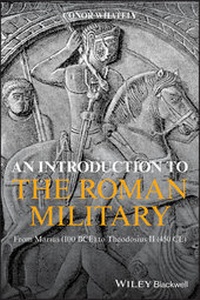
An Introduction to the Roman Military
Description

This book introduces readers to three historical Roman soldiers--Titus Pullo from the late republic, Aurelius Polion from the high imperial era, and Flavius Aemilianus from late antiquity. The three men inspire the themes and chronological organization of the text.Drawing on a wide and diverse body of evidence, the author charts their lives from enlistment to death or retirement, allowing students to envision the life of a Roman soldier who is on duty or experiencing adventures across the Roman world.
An Introduction to the Roman Military: From Marius (100 BCE) to Theodosius II (450 CE) starts with a historical overview before introducing readers to the Roman soldier. It covers such things as the military hierarchy, soldierly origins, recruitment and training, and the soldier's appearance and identity. The next section looks at the Roman military during war--its environment, strategies, campaigns, and enemies. Their existence during times of peace follows that and focuses on how soldiers celebrated victory, mourned defeat, and readjusted to civilian life after a war. The book also features a timeline for readers to follow, as well as two glossaries--one filled with Roman military terms and the other with important names and events.
* Authentically captures the experiences of Roman soldiers
* Educates undergraduate or graduate students on Roman military history
* Describes Roman soldiers based on legal, epigraphic, and archaeological evidence
* Emphasizes the human side of the Roman military
* Moves through three Roman historical periods--the late republic, high imperial, and late antiquity
An Introduction to the Roman Military is an engaging choice as a text for specific courses on the Roman military or army. It is also suitable for more general courses covering ancient warfare.
In addition to university students, researchers and history enthusiasts will have the opportunity to follow the military lives of three Roman soldiers with this unique book.
More details
Other editions
Additional editions
Person
CONOR WHATELY, PHD, is associate professor of Classics at the University of Winnipeg. He has published several book chapters on topics ranging from the audience of late antique military manuals and the Roman war cry to logistics at el-Lejjun (Jordan) and Procopius' account of the siege of Rome in 537/538, journal articles on Procopius' use of numbers and camels at Nessana, and two books, one, Battles and Generals on Procopius' descriptions of combat, the other, Exercitus Moesiae on the Roman military organization of Moesia (on the lower Danube).
Content
List of Figures vii
Acknowledgments ix
Introduction xi
Part I Background 1
1 Sources and Approaches 3
2 Historical Overview 25
3 Soldierly Origins and Background 51
Part II Becoming a Soldier 65
4 Recruitment and Training 67
5 Unit Organization and Structure 81
6 Appearance, Equipment, and Identity 97
Part III Preparing for War 111
7 Strategy, Frontiers, and War 113
8 Food: Campaigns and Supply 127
9 Rome's Foes 141
Part IV Fighting at the Front 157
10 Combat: Battle 159
11 Combat: Sieges 175
12 Life After War: Celebrating Victory, Mourning Defeat, and Readjusting to Civilian Life 189
Part V Beyond War 203
13 Friends and Family 205
14 The Military and the State 219
15 Retirement: Veterans and Their Legacy 235
Conclusion 249
Glossary 253
Timeline 259
Further Reading and Bibliography 269
Index 285
Introduction
This is a story about three men, Titus Pullo, Aurelius Polion, and Flavius Aemilianus, all soldiers in the Roman military. All three lived at different periods in Roman history, Pullo in a period of civil war as Rome's republic was teetering on the brink of collapse, Polion when Rome's empire was just about as big as it would ever be, and Aemilianus when many would argue Rome was in its twilight and the empire was on the verge of splitting in two. This means that Pullo's experience of service in the Roman military was not that of Polion's, whose experience in turn was not that of Aemilianus'. Although this is a story, all three were real men about whom very little is known. Their purpose, however, is to introduce the Roman military, what was for many centuries one of the best, if not the best, militaries in their world.
One of the principal aims has been to write a human-centered introduction to the Roman military. In other words, I treat the Roman military not as a machine, but as an institution comprised of individuals, all residents of the Roman Empire. The intention is not to present a kinder, gentler, Roman military, but rather to emphasize that it is not as mechanical as it is sometimes made out to be. This means presenting some of the good with some of the bad: the love, bravery, and comradery mixed in with the cruelty, fear, and violence. Roman soldiers were, by and large, violent people. They enslaved foreign peoples, cut off their enemies' heads, and occasionally cudgelled to death their own. There's no getting around this. But the Roman military was also filled with what could be called ordinary people. They enlisted for any number of reasons including a desire for adventure or job security. They ate. They drank. They went to the bathroom. Sometimes they got scared. Sometimes they got bored. And so by trying to show the Roman military as a human institution I'm aiming to give some sense of the range of experiences that a soldier might have.
The next question that some readers might be asking is why do we need yet another book on the Roman military? It's true that a quick stroll through a bookstore will reveal any number of books devoted to ancient military history, and it's no stretch to say that the market is crowded. Military history in the academy might not be quite as well placed, and is still looked down upon in some quarters, but even then there are a number of universities that offer courses or modules on the Roman military. By the time that I wrote this introduction, I had taught a course on the Roman military three times, the first two times focused more narrowly on the Roman imperial military (roughly Augustus to Severus Alexander), the most recent time approximately the period covered by this book. In the first go, I used Yann Le Bohec's (2000) excellent Roman Imperial Army (in translation). It soon became clear, however, that while that book truly does provide a treasure trove of information on the army, it's far too technical for many of the students who took my class: intelligent undergraduates who were taking my course as an elective, and who might not have ever taken a Classics or Ancient History course before. In the second attempt, I used Pat Southern's (2007) wide-ranging and seemingly ideal The Roman Army: A Social and Institutional History. But the balance was off, at least for my purposes. There was a substantial gap between the second attempt and the third, and in the interim some other possibilities appeared, including the Blackwell Companion to the Roman Army (Erdkamp 2007), which is now available in paperback. It includes some excellent papers on a variety of themes, but there's too much material, and the coverage is uneven, at least for an introductory course. There's also Roth's Roman Warfare (2009), which would seem an obvious choice. But I confess to preferring a thematic approach, which is how I structured my class. Too many names and dates, in a seemingly endless supply of events, might seem overwhelming to my students who come with little or no background. Other books I could have used didn't, but which deserve attention, include Webster's (1998) The Roman Imperial Army of the First and Second Century A.D., Keppie's (1998) The Making of the Roman Army from Republic to Empire, and James' (2011) Rome and the Sword. Webster's book, somewhat dated but still important, is much more condensed than this book, and a considerable amount of the attention is focused on the military's organization and fortifications, often to the exclusion of other no less important issues. Keppie's deals with a much narrower time frame than this book, the transition from republic to empire, though it does so in some detail. Like Webster's, its emphasis is largely on the military's organization and fortresses. As for James' book, though the chronological range is vast and the scholarship excellent, the focus is narrower than the one I intend for this book, focused as it is on the impact of the sword and equipment in general in shaping Roman military effectiveness and culture. It does, however, include good images, it is easy to read, and makes good use of both texts and artefacts.
And so, I decided to take a crack at writing one myself. If I had any advantage, it's that I have several close friends and family, some colleagues, who have little or no interest in the Roman military. As I conceived of, prepared, and wrote this book, I had them in mind. How should I write something that they might understand - even enjoy, especially on a topic that they had little interest in otherwise? This is a big reason why I decided to focus on the experiences of three, historical individuals (Pullo, Polion, Aemilianus) - and conversations, at different times, with Kate Beats in Cambridge, and then Andy Birley, Beth Greene, and Alex Meyer not far from Vindolanda in the summer of 2016 gave me a lot to think about. But so too did the reviewers' comments on the initial proposal. I also wanted to find a way to mesh my desire for a thematic arrangement with others' for some sense of how things changed at different times in Roman history.
As far as qualifications go, I come at this as a Roman imperial historian (Augustus to Heraclius), who keeps finding himself on the verge of converting to Byzantine studies. Indeed, my initial desire was to focus solely on the first three centuries of the imperial era, from Augustus well into the third century, but some reviewers brought me back in line. Some of my more particular interests have, undoubtedly, been reflected in this book. There is perhaps more on the Roman military on the lower Danube, the eastern frontier, unit organization, and the experience of battle than there should be. Although I have, in many respects, tried to suppress my urges, in some cases I have fallen back on what was most familiar. That said, the subject of much if not most of my published scholarship, Procopius and the age of Justinian, play no major role in this book.
I consider this book to be a source-based approach to the Roman military. This means that I make extensive use of the sources throughout, and I often include extensive quotes. But I've also tried to give each of the different kinds of sources that scholars of the Roman military use due attention as much as my skillset has allowed. Thus, while there are plenty of references to the literary sources like Caesar and Vegetius, I also aim to give due attention to the law codes, the inscriptions, the papyri, and abundant archaeological evidence. I have also then tried to let the evidence guide the discussion, which is why some issues get the attention they do in each topic, and why certain chapters include fuller analysis of certain kinds of evidence.
I have tried to limit the amount of technical terminology - within reason - that I have used in this book. Terms, Latin ones especially, are defined and/or translated where possible. And where key definitions do not appear in the body of the text, they can usually be found in the glossary at the back. That said, there are some big terms that I use in this book throughout that I will set out here, as they have an impact on how I have structured my discussion. Probably the most obvious one is my decision to call the subject of this introductory book the "Roman military" rather than the "Roman army", which is what we find in most studies on the subject. I have opted for military because it is a much more all-encompassing term than army. Plus, the Romans never called their armed forces one "army", but instead several armies.
This book is organized thematically. It starts with the background and origins of our three main characters, and then moves through their careers and the different stages of service all the way through to retirement. Not everyone prefers a thematic approach over a chronological one. By focusing on the experiences of three individuals from different parts of Roman history I hope, where possible, to show how things changed over time. This hasn't been possible in every chapter; as a result, some strive for the universals and generalities that apply to some topics more than others - at least in the eyes of this author. It is also worth highlighting that this is an introduction. It has been written with a view to introducing those with little-to-no background knowledge of the topic discussed. Specialists won't find anything in here that they haven't seen elsewhere. At the same time,...
