

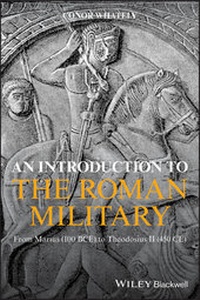
An Introduction to the Roman Military
Description

This book introduces readers to three historical Roman soldiers--Titus Pullo from the late republic, Aurelius Polion from the high imperial era, and Flavius Aemilianus from late antiquity. The three men inspire the themes and chronological organization of the text.Drawing on a wide and diverse body of evidence, the author charts their lives from enlistment to death or retirement, allowing students to envision the life of a Roman soldier who is on duty or experiencing adventures across the Roman world.
An Introduction to the Roman Military: From Marius (100 BCE) to Theodosius II (450 CE) starts with a historical overview before introducing readers to the Roman soldier. It covers such things as the military hierarchy, soldierly origins, recruitment and training, and the soldier's appearance and identity. The next section looks at the Roman military during war--its environment, strategies, campaigns, and enemies. Their existence during times of peace follows that and focuses on how soldiers celebrated victory, mourned defeat, and readjusted to civilian life after a war. The book also features a timeline for readers to follow, as well as two glossaries--one filled with Roman military terms and the other with important names and events.
* Authentically captures the experiences of Roman soldiers
* Educates undergraduate or graduate students on Roman military history
* Describes Roman soldiers based on legal, epigraphic, and archaeological evidence
* Emphasizes the human side of the Roman military
* Moves through three Roman historical periods--the late republic, high imperial, and late antiquity
An Introduction to the Roman Military is an engaging choice as a text for specific courses on the Roman military or army. It is also suitable for more general courses covering ancient warfare.
In addition to university students, researchers and history enthusiasts will have the opportunity to follow the military lives of three Roman soldiers with this unique book.
More details
Other editions
Additional editions
Person
CONOR WHATELY, PHD, is associate professor of Classics at the University of Winnipeg. He has published several book chapters on topics ranging from the audience of late antique military manuals and the Roman war cry to logistics at el-Lejjun (Jordan) and Procopius' account of the siege of Rome in 537/538, journal articles on Procopius' use of numbers and camels at Nessana, and two books, one, Battles and Generals on Procopius' descriptions of combat, the other, Exercitus Moesiae on the Roman military organization of Moesia (on the lower Danube).
Content
List of Figures vii
Acknowledgments ix
Introduction xi
Part I Background 1
1 Sources and Approaches 3
2 Historical Overview 25
3 Soldierly Origins and Background 51
Part II Becoming a Soldier 65
4 Recruitment and Training 67
5 Unit Organization and Structure 81
6 Appearance, Equipment, and Identity 97
Part III Preparing for War 111
7 Strategy, Frontiers, and War 113
8 Food: Campaigns and Supply 127
9 Rome's Foes 141
Part IV Fighting at the Front 157
10 Combat: Battle 159
11 Combat: Sieges 175
12 Life After War: Celebrating Victory, Mourning Defeat, and Readjusting to Civilian Life 189
Part V Beyond War 203
13 Friends and Family 205
14 The Military and the State 219
15 Retirement: Veterans and Their Legacy 235
Conclusion 249
Glossary 253
Timeline 259
Further Reading and Bibliography 269
Index 285
